








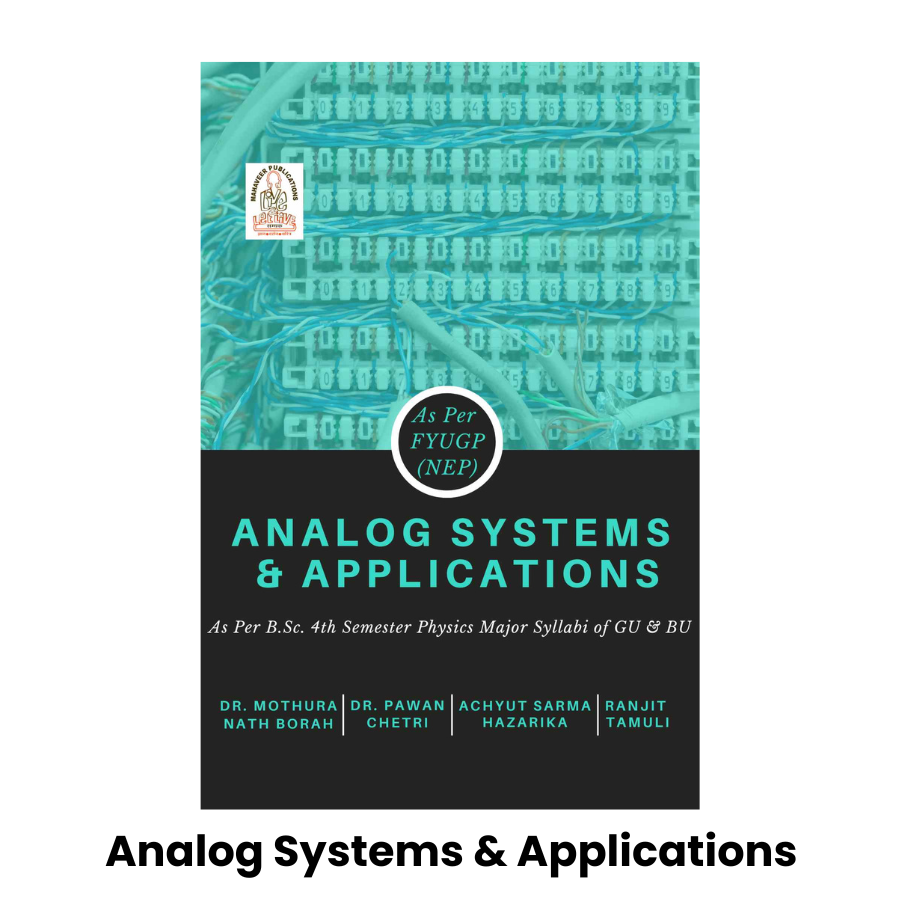
Analog Systems & Applications
Inhouse product
-
 Rs212.50
Rs250.00 -
Rs290.00
Rs310.00 -
Rs430.00
Rs450.00 -
Rs288.00
Rs300.00 -
Rs235.00
Rs250.00 -
Rs300.00
Rs320.00





Reviews & Ratings
Analog Systems & Applications by Dr. Mothura Nath Borah is a well-structured textbook designed in accordance with the FYUGP–NEP 2020 syllabus prescribed for B.Sc. 4th Semester Physics (Major) courses under Gauhati University and Bodoland University.
This book provides a clear, conceptual, and application-oriented understanding of analog electronics and circuit theory, covering the foundational principles and their real-world implementations. The author presents the subject with clarity, precision, and problem-based learning, making it ideal for undergraduate physics students.
Key Features:
-
Covers the complete FYUGP–NEP syllabus for B.Sc. 4th Semester Physics Major.
-
Detailed discussions on semiconductor devices, rectifiers, amplifiers, oscillators, and operational amplifiers (op-amps).
-
Clear explanation of analog system principles and applications in modern electronics.
-
Step-by-step derivations, circuit diagrams, and solved examples to strengthen conceptual understanding.
-
Includes numerical problems, exercises, and short-answer questions for exam preparation.
-
Useful for students of Gauhati University, Bodoland University, and other Indian universities following NEP-based courses.
Chapter 1: Semiconductor Diodes
-
Atomic Energy Levels
-
Energy Levels to Energy Bands
-
Insulator, Conductor and Semiconductor
-
Intrinsic and Extrinsic Semiconductors
-
n-type and p-type Semiconductors
-
-
Mass-action Law
-
Energy Level Diagram
-
Conductivity and Charge Densities
-
Drift Velocity and Mobility
-
Fabrication and Barrier Formation in p-n Junction Diode
-
Diffusion, Total Current and Continuity Equation
-
Injected Minority Carrier Charge
-
Diode Biasing: Forward and Reverse Biasing, Current Flow Mechanism, Static and Dynamic Resistance, Step Junction
Chapter 2: Two-Terminal Devices and Their Applications
-
Half-wave Rectifier
-
RMS Current and Voltage
-
-
Full-wave Rectifier
-
Bridge Rectifier
-
Filters: Capacitor and Inductor Filters
-
Zener Diode and Voltage Regulation
-
LED, Photodiode and Solar Cell
Chapter 3: Bipolar Junction Transistors (BJT)
-
p-n-p and n-p-n Transistor Structure and Operation
-
Current Components and Current Amplification Factor
-
Characteristics of CB, CE, and CC Configurations
-
Input and Output Resistances and β Gain
-
Load Line Analysis and Quiescent Point
-
Transistor Biasing and Stabilization Circuits
Chapter 4: Amplifiers
-
Transistor Biasing: Fixed Bias, Base Bias, and Voltage Divider Bias
-
h-parameter Equivalent Circuit and CE Amplifier Analysis
-
Input and Output Impedance
-
Current Gain and Voltage Gain
-
Power Gain and Classification of Amplifiers
-
Class A, B, and C Amplifiers
-
Chapter 5: Coupled Amplifiers
-
Two-stage RC Coupled Amplifier and Frequency Response
-
Low, Mid, and High Frequency Range Analysis
-
Bandwidth and Gain Bandwidth Product
-
Advantages, Disadvantages, and Applications
Chapter 6: Feedback in Amplifier
-
Principle of Feedback in Amplifiers
-
Positive and Negative Feedback Effects
-
Input/Output Impedance and Non-linear Distortion
Chapter 7: Sinusoidal Oscillators
-
Barkhausen Criterion for Self-Sustained Oscillations
-
RC Phase Shift Oscillator
-
Hartley and Colpitts Oscillators — Frequency Determination and Applications
Chapter 8: Operational Amplifiers (OP-AMP)
-
Circuit Symbol and Black Box Approach
-
Open Loop Voltage Gain and Characteristics
-
Input Offset Voltage and Current
-
Output Offset Voltage Drift and PSRR
-
Inverting and Non-inverting Amplifiers
-
Summing, Integrator, Differentiator, Comparator, and Wien-Bridge Oscillator
Chapter 9: Applications of OP-AMP
-
Adder, Subtractor, Integrator, Differentiator Circuits
-
Voltage Follower and Comparator
-
Amplifier Circuits and Frequency Response
-
Practical vs. Ideal OP-AMP Characteristics
Chapter 10: Conversion
-
D/A Conversion: R-2R Ladder and Binary Weighted Resistor Type
-
A/D Conversion: Successive Approximation and Comparator-based Converters
Chapter 11: Electronic Instruments — Multimeter and CRO
-
Introduction to Measurement Devices
-
Multimeter: Types, Uses, and Applications
-
Cathode Ray Oscilloscope (CRO): Principles and Applications
-
Solved Examples and Theoretical Questions
-
Frequently Bought Products
WAVES & OPTICS
ELECTRICITY & MAGNETISM
Product Queries (0)
Login Or Registerto submit your questions to seller
Other Questions
No none asked to seller yet
-
Rs212.50
Rs250.00 -
Rs290.00
Rs310.00 -
Rs430.00
Rs450.00 -
Rs288.00
Rs300.00 -
Rs235.00
Rs250.00 -
Rs300.00
Rs320.00
Mahaveer Publications