








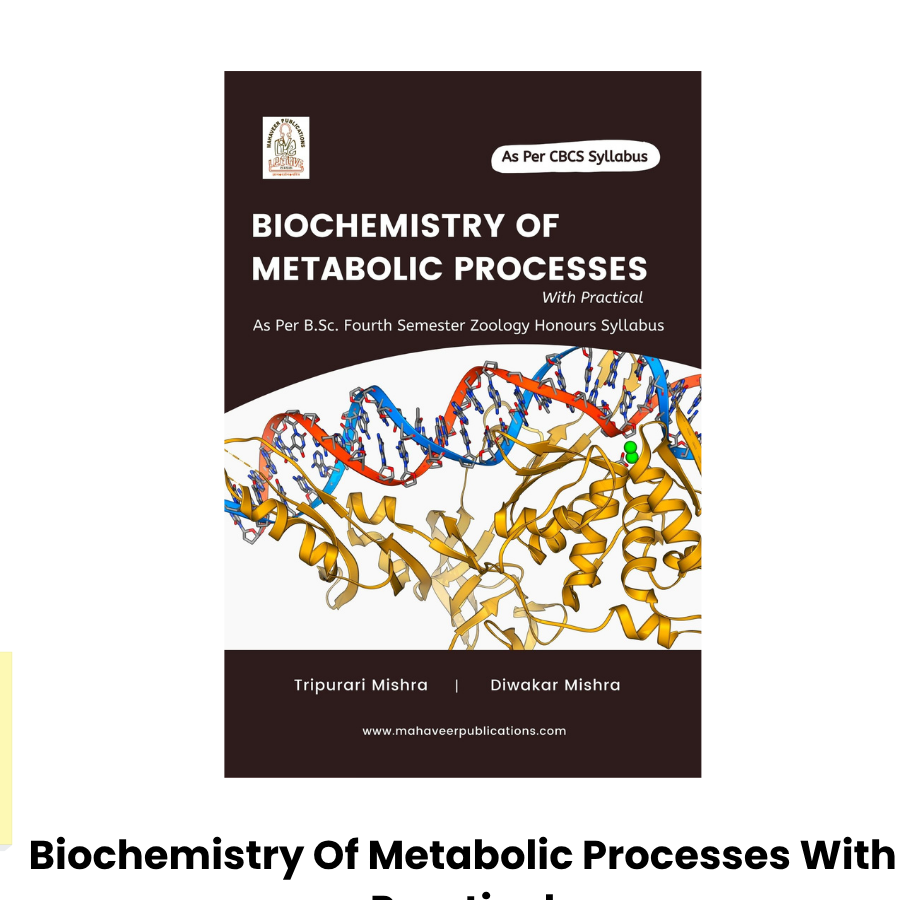
Biochemistry Of Metabolic Processes With Practical
Inhouse product
-
 Rs212.50
Rs250.00 -
Rs290.00
Rs310.00 -
Rs430.00
Rs450.00 -
Rs288.00
Rs300.00 -
Rs235.00
Rs250.00 -
Rs300.00
Rs320.00





Reviews & Ratings
Biochemistry of Metabolic Processes (With Practical) by Dr. Tripurari Mishra and Dr. Diwakar Mishra, published by Mahaveer Publications, is a well-structured and comprehensive textbook prepared according to the FYUGP–NEP syllabus for B.Sc. 5th Semester Zoology Major students under Dibrugarh University, Gauhati University, and other Indian universities.
The book provides a detailed understanding of the biochemical principles underlying cellular metabolism, explaining how living systems derive, store, and utilize energy. It covers the structure, function, and interrelation of biomolecules such as carbohydrates, proteins, lipids, and nucleic acids, and explores their metabolic pathways through clear, conceptual explanations.
Major topics include glycolysis, Krebs cycle, oxidative phosphorylation, lipid metabolism, amino acid catabolism, and enzyme regulation mechanisms. The content is supported by illustrative diagrams, flowcharts, and stepwise biochemical reactions, making complex concepts easier to grasp.
The practical section provides laboratory-based exercises that help students develop analytical and experimental skills in biochemical estimation, enzyme assays, and qualitative analysis of biomolecules, aligning theory with hands-on learning.
Authored by experienced educators and researchers, this textbook serves as an ideal academic resource for undergraduate students of zoology, life sciences, and related disciplines.
Key Features:
-
Designed as per the FYUGP–NEP syllabus for B.Sc. Zoology Major (5th Semester).
-
Comprehensive coverage of metabolic pathways and biochemical regulation.
-
Includes well-illustrated diagrams and flowcharts for better understanding.
-
Practical section with hands-on biochemical experiments and estimations.
-
Written in simple, clear, and exam-oriented language.
-
Authored by Dr. Tripurari Mishra and Dr. Diwakar Mishra, experienced academicians.
-
Published by Mahaveer Publications, a trusted name in academic publishing.
SECTION – A: THEORY
Unit 1: Overview of Metabolism
-
Important Biochemicals
-
Energy Transformations
-
Fatty Acids, Isoprenoids and Steroids
-
Significance of Compartmentalization
-
Biological Membranes
-
Compartmentalization of Metabolic Pathways
-
Significance of ATP Molecule in Metabolism
-
Hydride
-
Intermediary Metabolism and Regulatory Mechanisms
-
Maintenance and Use of Metabolic Fuels
-
Enzyme Induction
-
Regulation of Metabolic Pathways
-
Allosteric Control of Metabolic Pathways
-
Interrelationship of Metabolism among Organs/Tissues
-
Regulation of Gluconeogenesis and Glycolysis
-
Regulation of Glycogen Synthesis and Breakdown
-
Liver Glycogen Phosphorylase
-
Regulation of Carbohydrate Biosynthesis
-
Coupling Reaction and Types
-
Applications of Coupling Reactions
-
Questions
Unit 2: Metabolism of Carbohydrates
-
Introduction
-
Carbohydrate Metabolism and Fate of Absorbed Carbohydrates
-
Conversion of Glycogen (Polysaccharide) to Glucose-1-Phosphate
-
Glycolysis or Embden–Meyerhof Pathway
-
Diphosphoglycerate Pathway
-
Regulation of Glycolysis
-
Conversion of Pyruvate to Acetyl CoA
-
Kreb’s Cycle or Citric Acid Cycle
-
Glyoxylate Cycle
-
Hexose Monophosphate (HMP) or Pentose Phosphate Pathway
-
Gluconeogenesis
-
Importance of Shunt Pathway
-
Glycogenesis and Glycogenolysis
-
Hormonal Control of Glycogen Metabolism
-
Disorders of Carbohydrate Metabolism
-
Effects of Hyperglycemia and Oral Hypoglycemic Agents
-
Hormonal Regulation of Carbohydrate Metabolism
-
Questions
Unit 3: Metabolism of Lipids
-
Fat Oxidation
-
β-Oxidation of Fatty Acids
-
α-Oxidation of Fatty Acids
-
ω-Oxidation of Fatty Acids
-
Conversion of Fats into Carbohydrates
-
Biosynthesis of Fat
-
Metabolism of Triglycerides
-
Cholesterol Biosynthesis
-
Risk Factors for Coronary Artery Diseases
-
Lipid Profile and Atherosclerosis
-
Questions
Unit 4: Protein Metabolism
-
Deamination
-
Transamination
-
Methylcytosine and Cytosine Deamination (C→T Mutations)
-
Decarboxylation
-
Formation of Urea
-
Urea Cycle and Its Reactions
-
The Genetic Code
-
Deciphering the Genetic Code
-
Protein Synthesis and Turnover
-
Control and Genetic Regulation of Protein Synthesis
-
The Operon Hypothesis and The Lac Operon
-
Other Mechanisms of Control
-
Regulation of Enzyme Production in Eukaryotic Cells
-
Effect of Hormones on Protein Metabolism
-
Nucleoprotein and Nucleic Acid Metabolism
-
Biosynthesis of Nucleotides
-
Interrelationship of Carbohydrate, Lipid, and Protein Metabolism
-
Questions
Unit 5: Oxidative Phosphorylation
-
Redox System and Types of Redox Reactions
-
Standard Electrode Potential
-
Redox Reactions in Biology (Cellular Respiration)
-
Review of Mitochondrial Respiratory Chain
-
Electron Transport as a Source of ATP Energy
-
Oxidative Phosphorylation
-
Structure and Function of Mitochondria
-
Cristae and Mitochondrial Particles
-
Respiratory Chain Complex and Transport Mechanism
-
Energy Conservation during Oxidative Phosphorylation
-
Respiratory Inhibitors
-
Bioenergetics
-
Laws of Thermodynamics and Free Energy
-
Coupling of Endergonic and Exergonic Processes
-
Role of Energy Phosphates in Bioenergetics and Energy Capture
-
Role of High-Energy Phosphates as the “Energy Currency” of the Cell
-
Interconversion of Adenine Nucleotides
-
Metabolism of Pyrophosphate
-
Nucleoside Phosphates Related to ATP and ADP
-
Questions
SECTION – B: PRACTICALS
Practicals: Biochemistry of Metabolic Processes
-
Experiment 1: Estimation of Carbohydrates by Colorimetric Method
-
Experiment 2: Estimation of Proteins by Biuret Method
-
Experiment 3: Estimation of Lipids from Biological Samples
-
Experiment 4: Study of Enzyme Activity (Amylase or Catalase)
-
Experiment 5: Demonstration of Qualitative Tests for Biomolecules
Frequently Bought Products

Comparative Anatomy of Vertebrates with practical

Animal Physiology Life Sustaining Systems
Product Queries (0)
Login Or Registerto submit your questions to seller
Other Questions
No none asked to seller yet
-
Rs212.50
Rs250.00 -
Rs290.00
Rs310.00 -
Rs430.00
Rs450.00 -
Rs288.00
Rs300.00 -
Rs235.00
Rs250.00 -
Rs300.00
Rs320.00
Mahaveer Publications