







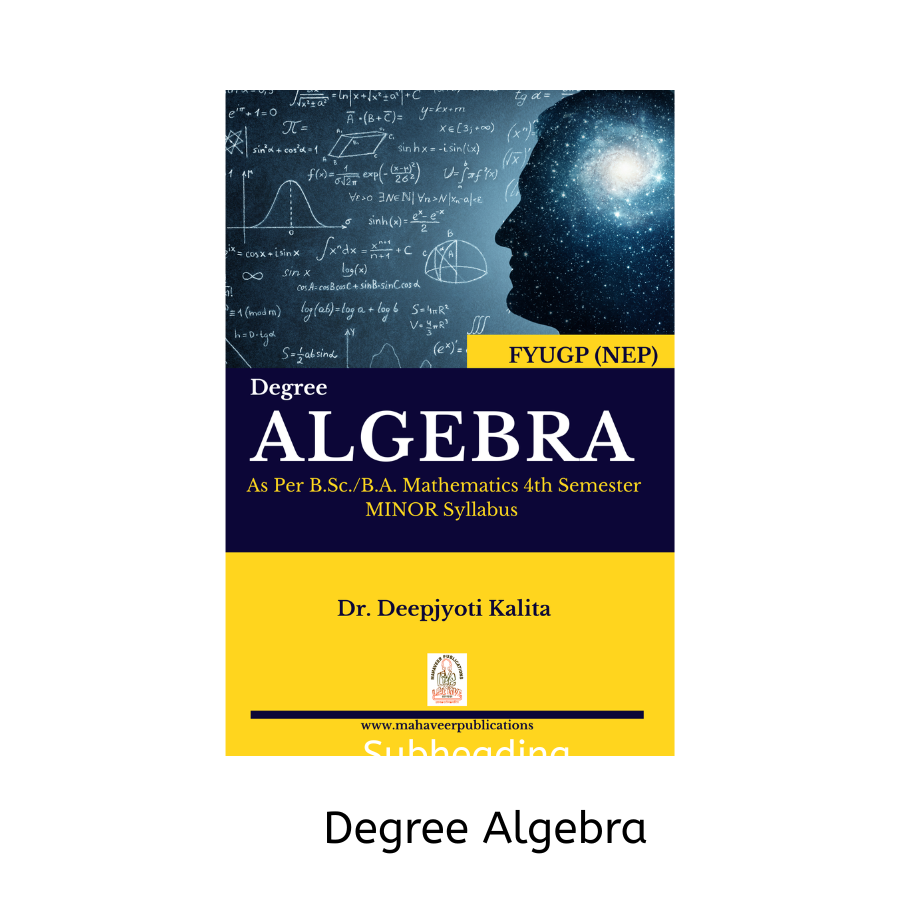
Degree Algebra
Inhouse product
-
 Rs212.50
Rs250.00 -
Rs290.00
Rs310.00 -
Rs430.00
Rs450.00 -
Rs288.00
Rs300.00 -
Rs235.00
Rs250.00 -
Rs300.00
Rs320.00

Reviews & Ratings
This textbook provides a clear, structured, and comprehensive understanding of Algebra, tailored to the CBCS/NEP curriculum of Indian universities. It covers the fundamental concepts of sets, relations, and functions, groups, rings, fields, and vector spaces, forming the foundation for higher mathematical studies. The book is written in a lucid and descriptive style, combining theoretical principles with solved examples and exercises to strengthen conceptual clarity.
The text aligns with the requirements of both B.Sc. and B.A. Mathematics students, addressing the needs of regular and generic elective courses in the 2nd and 4th semesters respectively. It is especially useful for students preparing for university examinations and competitive tests.
Chapter I: Theory of Equations and Expansions of Trigonometric Functions (Pages 1–97)
This chapter introduces students to the fundamental concepts of algebraic equations and their solutions. It covers the Fundamental Theorem of Algebra, Division Algorithm, Remainder and Factor Theorems, and the relationships between roots and coefficients of polynomial equations.
Students will learn methods such as Cardan’s method for solving cubic equations and synthetic division for simplifying polynomials.
A significant part of this chapter also focuses on the expansion of trigonometric functions using algebraic principles. The De Moivre’s Theorem and its applications are explained in detail, enabling students to expand and simplify trigonometric expressions like:
-
, ,
-
Expansion of ,
-
Trigonometric expansions in radians for
Learning Outcomes:
-
Understand and solve polynomial equations up to the cubic and biquadratic forms.
-
Apply De Moivre’s Theorem to find expansions and powers of trigonometric expressions.
-
Relate roots and coefficients in algebraic equations for simplification and analysis.
Chapter II: Matrices (Pages 98–186)
This chapter builds a solid foundation in Matrix Algebra, an essential tool in both pure and applied mathematics. It begins with the definition and types of matrices such as square, diagonal, unitary, Hermitian, and skew-Hermitian matrices.
Students will study matrix operations, transposition, rank, and elementary transformations. Methods for solving systems of linear equations using matrix inversion and determinants are explained thoroughly.
Important theorems such as the Cayley–Hamilton Theorem are discussed along with applications in solving linear systems.
Topics Covered:
-
Matrix operations and properties
-
Inverse and conjugate of a matrix
-
Rank and echelon forms
-
Elementary row and column transformations
-
System of linear equations: homogeneous and non-homogeneous
-
Characteristic roots and equations
Learning Outcomes:
-
Perform matrix operations and identify types of matrices.
-
Solve linear equations using matrix algebra methods.
-
Apply the Cayley–Hamilton theorem to practical problems.
Chapter III: Groups, Rings, and Vector Spaces (Pages 187–305)
This chapter explores the algebraic structures that form the backbone of higher mathematics — Groups, Rings, and Vector Spaces. It begins with the concept of a binary operation and progresses to detailed study of groups and their properties.
Students will learn about cyclic groups, subgroups, Lagrange’s and Euler’s theorems, and various types of rings such as commutative rings, integral domains, and fields.
The chapter further extends into vector spaces, covering subspaces, basis, dimension, and linear dependence/independence—key ideas in both algebra and linear algebra.
Frequently Bought Products
Product Queries (0)
Login Or Registerto submit your questions to seller
Other Questions
No none asked to seller yet
-
Rs212.50
Rs250.00 -
Rs290.00
Rs310.00 -
Rs430.00
Rs450.00 -
Rs288.00
Rs300.00 -
Rs235.00
Rs250.00 -
Rs300.00
Rs320.00
Mahaveer Publications