







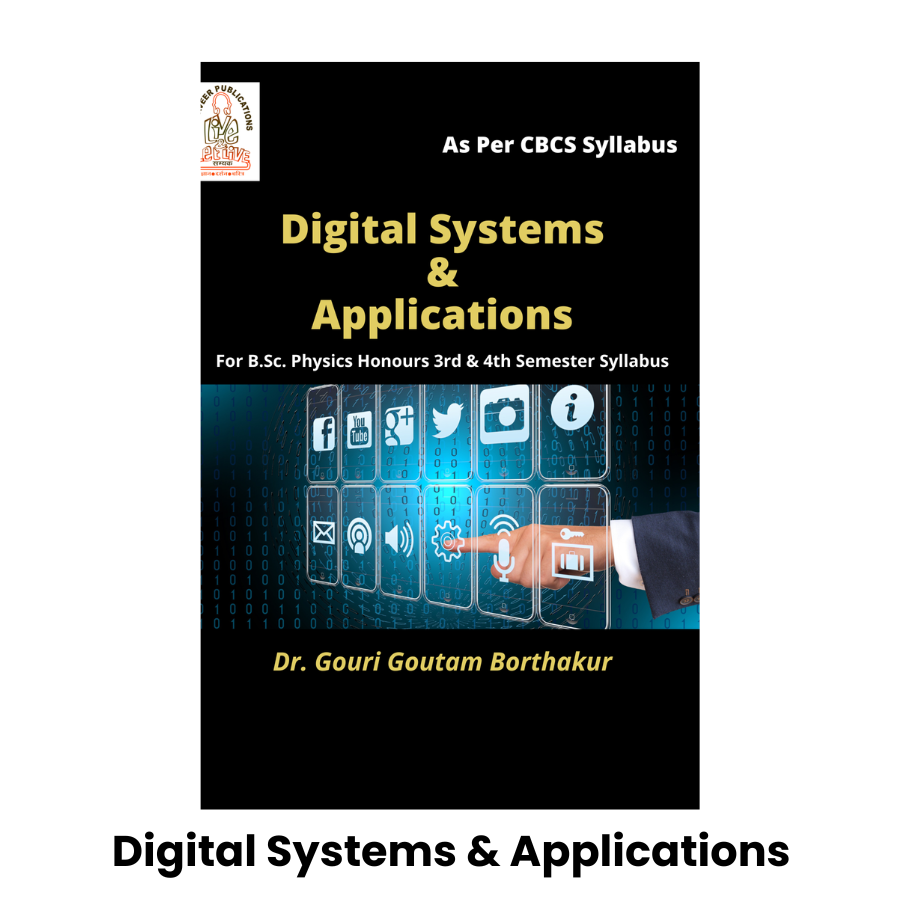
Digital Systems & Applications
Inhouse product
-
 Rs212.50
Rs250.00 -
Rs290.00
Rs310.00 -
Rs430.00
Rs450.00 -
Rs288.00
Rs300.00 -
Rs235.00
Rs250.00 -
Rs300.00
Rs320.00





Reviews & Ratings
? Digital Systems & Applications by Dr. Gouri Goutam Borthakur, published by Mahaveer Publications, is a comprehensive textbook prepared according to the CBCS syllabus for B.Sc. Physics Honours 3rd and 4th Semester students of Dibrugarh University, Gauhati University, Bodoland University, and other universities of Assam.
This book offers a clear understanding of the fundamentals of digital electronics and its real-world applications, combining theoretical explanations with practical illustrations. It introduces students to the principles of logic circuits, Boolean algebra, combinational and sequential systems, and digital-to-analog applications.
Key topics include:
-
Number systems and conversions — Binary, Octal, Decimal, and Hexadecimal
-
Boolean algebra and logic simplification techniques
-
Logic gates — AND, OR, NOT, NAND, NOR, XOR, and XNOR
-
Combinational circuits — Adders, Subtractors, Encoders, Decoders, Multiplexers, Demultiplexers
-
Sequential circuits — Flip-flops, Counters, and Shift Registers
-
Digital arithmetic and logic families (TTL, CMOS)
-
Analog-to-Digital (ADC) and Digital-to-Analog (DAC) conversion techniques
-
Introduction to microprocessors and digital applications
Each chapter includes illustrations, truth tables, circuit diagrams, and solved numerical problems, ensuring clarity and a practical approach to learning.
Course Contents
Chapter 1: Introduction to CRO (Cathode Ray Oscilloscope)
1.1 Introduction
• Nomenclature
• Uses
• Working Principle
1.2 Block Diagram of CRO
• Cathode Ray Tube
• Deflection System
• Time Base
• Vertical and Horizontal Amplifiers
• Delay Line
• Trigger Circuit
• Power Supply
1.3 Deflection Sensitivity of a CRO
1.4 Applications of CRO
• Study of Waveform
• Measurement of Voltage, Current, Time Period, Frequency, and Phase Difference
1.5 Comparison between CRO and DSO
1.6 Multiple Choice Questions
1.7 Numerical Examples
1.8 Conceptual and Short Answer Questions
1.9 Answers to Objective Questions
Chapter 2: Integrated Circuits
2.1 Introduction
2.2 Basic IC Terminology
2.3 Advantages and Drawbacks of ICs
2.4 Scales of Integration (SSI, MSI, LSI, VLSI)
2.5 Classification of ICs
• On the basis of Operation
• On the basis of Construction
2.6 Applications of ICs
2.7 Multiple Choice Questions and Exercises
Chapter 3: Digital Circuits
3.1 Introduction and Differences between Analog & Digital Circuits
3.2 Number Systems and Conversions
• Binary, Decimal, Octal, Hexadecimal
• Binary Coded Decimal, Binary-to-Decimal, Binary-to-Gray Conversions
3.3 Logic Gates
• NOT, AND, OR, XOR, NAND, NOR, XNOR
• Realization using Diodes and Transistors
3.4 Universal Gates and Their Realizations
3.5 Logic Families and Parity Checking
3.6 Numerical and Conceptual Questions
Chapter 4: Boolean Algebra
4.1 Introduction
4.2 De Morgan’s Theorems
4.3 Boolean Laws
4.4 Simplification of Logic Circuits using Boolean Algebra
4.5 Logic Circuit Design using Laws of Boolean Algebra
4.6 Fundamental Products, Minterms, and Maxterms
4.7 Conversion of Truth Table into Logic Circuit
• Using Sum of Products (SOP)
• Using Product of Sums (POS)
4.8 Karnaugh Map (K-Map) Simplification
4.9 Numerical Examples and Exercises
Chapter 5: Data Processing Circuits
5.1 Introduction
5.2 Multiplexers and Demultiplexers — Circuit, Symbol, and Working
5.3 Encoders and Decoders — Function and Application
5.4 Examples and Numerical Exercises
Chapter 6: Arithmetic Circuits
6.1 Introduction
6.2 Binary Addition and Subtraction (1’s & 2’s Complement)
6.3 Adders and Subtractors
• Half and Full Adders/Subtractors
• 4-bit Binary Adder/Subtractor
6.4 Numerical Examples and Conceptual Questions
Chapter 7: Sequential Circuits
7.1 Introduction and Difference between Combinational and Sequential Circuits
7.2 Types and Examples of Sequential Circuits
7.3 Flip-Flops (SR, RS, JK, D, and T)
• Realization using NOR and NAND Gates
• Clocked Flip-Flops and Triggering Mechanisms
7.4 Timers: IC 555 Block Diagram and Applications
7.5 Shift Registers (Serial/Parallel, In/Out Configurations)
7.6 Counters (Asynchronous, Decade, and Ring Counters)
7.7 Computer Organization and Memory Concepts (RAM, ROM, Memory Mapping)
7.8 Intel 8085 Microprocessor Architecture — Components, Registers, Timing, and Instructions
7.9 Assembly Language Basics — 1, 2, and 3 Byte Instructions
Frequently Bought Products
Product Queries (0)
Login Or Registerto submit your questions to seller
Other Questions
No none asked to seller yet
-
Rs212.50
Rs250.00 -
Rs290.00
Rs310.00 -
Rs430.00
Rs450.00 -
Rs288.00
Rs300.00 -
Rs235.00
Rs250.00 -
Rs300.00
Rs320.00
Mahaveer Publications