






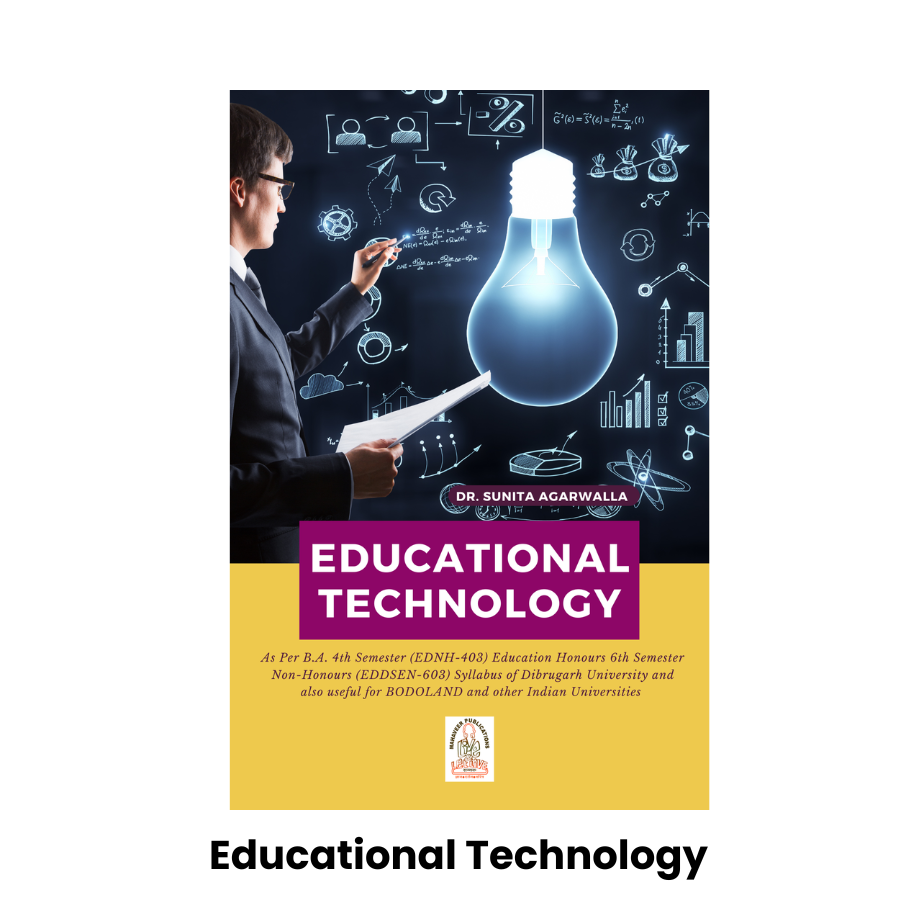
Educational Technology
Inhouse product
-
 Rs212.50
Rs250.00 -
Rs290.00
Rs310.00 -
Rs430.00
Rs450.00 -
Rs288.00
Rs300.00 -
Rs235.00
Rs250.00 -
Rs300.00
Rs320.00



Reviews & Ratings
Educational Technology by Dr. Sunita Agarwalla, published by Mahaveer Publications, is a well-structured and comprehensive textbook designed to meet the syllabus requirements of B.A. Education Honours (4th Semester – EDNH-403) and Non-Honours (6th Semester – EDDSEN-603) courses prescribed by Dibrugarh University, and also recommended for Bodoland University and other Indian universities under the FYUGP / NEP 2020 framework.
The book introduces learners to the role of technology in modern education, emphasizing the effective use of teaching aids, ICT tools, and innovative pedagogical practices that enhance teaching-learning processes. It combines theoretical understanding with practical approaches to classroom integration of educational technology.
Key Features:
-
Syllabus-Aligned Content: Covers the full syllabus of both Honours (EDNH-403) and Non-Honours (EDDSEN-603) papers as per Dibrugarh University and other NEP-based universities.
-
Comprehensive Coverage: Discusses the concept, scope, and importance of educational technology, communication in education, types of teaching aids, ICT integration, e-learning, multimedia applications, and evaluation through technology.
-
Focus on Modern Trends: Explores recent innovations such as digital classrooms, virtual learning environments, MOOCs, AI in education, and educational media.
-
Application-Oriented Approach: Provides practical guidelines for teachers and students on preparing and using audio-visual aids, PowerPoint presentations, educational videos, and online tools.
-
Easy-to-Understand Language: Written in simple, lucid language suitable for undergraduate learners and teacher trainees.
Contents
Unit I: Educational Technology (Pages 10–41)
1.1. Concept and Meaning of Educational Technology
1.2. Components of Educational Technology
1.3. Types of Educational Technology
1.4. Scope of Educational Technology in Modern Education
1.5. Objectives of Educational Technology
1.6. Importance of Educational Technology
1.7. Limitations of Educational Technology
1.8. Future of Educational Technology
Summary & Exercise
Unit II: Information and Communication Technology (ICT) (Pages 42–85)
2.1. Concept and Importance of ICT in Education
2.2. Components of ICT
2.3. Advantages and Disadvantages of ICT
2.4. Role of ICT in Teaching-Learning Process
2.5. ICT in Evaluation and Research
2.6. ICT in Classroom Management
2.7. Integration of ICT with Traditional Teaching Methods
2.8. ICT and NEP 2020 Reforms in Education
Summary & Exercise
Unit III: Communication and Classroom Interaction (Pages 86–98)
3.1. Meaning and Concept of Communication in Education
3.2. Elements of Communication
3.3. Types of Communication
3.4. Barriers to Effective Communication
3.5. Role of Communication in Teaching and Learning
3.6. Models of Communication
3.7. Classroom Communication and Teacher–Student Interaction
3.8. Techniques to Improve Classroom Communication
Summary & Exercise
Unit IV: Teaching Techniques and Methods (Pages 99–124)
4.1. Micro Teaching and Simulation
4.2. Programmed Instruction
4.3. Team Teaching
4.4. Personalized System of Instruction
4.5. Blended Learning and Flipped Classroom
4.6. Use of Multimedia in Teaching
4.7. Innovative and Digital Teaching Techniques
Summary & Exercise
Unit V: Concept of Learning Resources (Pages 125–145)
5.1. Audio-Visual Learning Resources and Their Uses
5.2. Non-Projected Aids
5.3. E-Resources and Their Applications
5.4. EDUSAT
5.5. E-Pathshala
5.6. Open Access Resources – Concept and Benefits
5.7. Peer Group and Community as Learning Resources
Summary & Exercise
Bibliography
Frequently Bought Products
Product Queries (0)
Login Or Registerto submit your questions to seller
Other Questions
No none asked to seller yet
-
Rs212.50
Rs250.00 -
Rs290.00
Rs310.00 -
Rs430.00
Rs450.00 -
Rs288.00
Rs300.00 -
Rs235.00
Rs250.00 -
Rs300.00
Rs320.00
Mahaveer Publications