






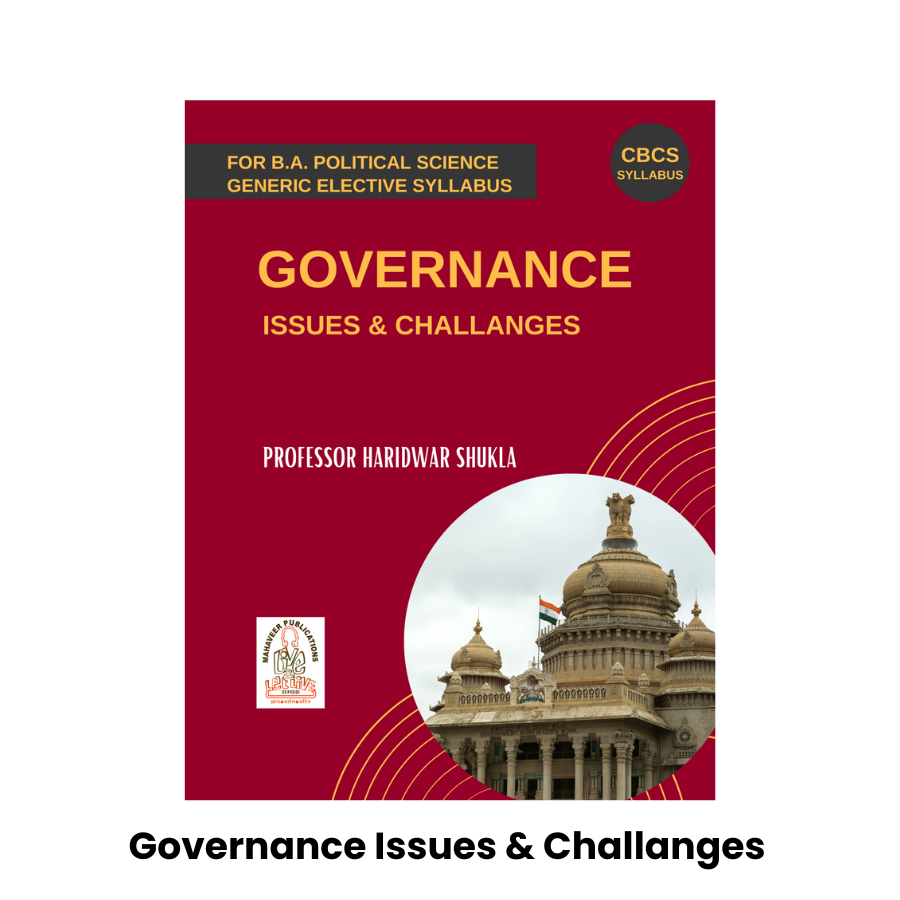
Governance Issues & Challanges
Inhouse product
-
 Rs212.50
Rs250.00 -
Rs290.00
Rs310.00 -
Rs430.00
Rs450.00 -
Rs288.00
Rs300.00 -
Rs235.00
Rs250.00 -
Rs300.00
Rs320.00





Reviews & Ratings
Governance Issues & Challenges by Prof. Haridwar Shukla is a comprehensive and student-oriented textbook designed according to the FYUGP / NEP curriculum for BA Political Science Generic Elective courses. It is prescribed for 6th Semester Minor papers under Dibrugarh University and 8th Semester GE papers under Rabindranath Tagore University, ensuring full alignment with the latest academic framework.
The book offers a clear understanding of the concept of governance, its evolution, core principles, and its relevance in contemporary democratic systems. It discusses the institutional structure of governance in India, emphasizing constitutional provisions, decentralization, federalism, public policy processes, and the role of key governmental and non-governmental bodies.
A major strength of the text is its analysis of the pressing challenges facing India’s governance today—such as corruption, lack of accountability, administrative inefficiencies, digital governance gaps, socio-economic disparities, environmental issues, political instability, and global pressures. Each topic is presented in a descriptive and analytical manner, making it easier for students to grasp complex governance mechanisms.
This textbook also highlights essential ideas of good governance, transparency, citizen participation, ethical leadership, e-governance initiatives, and policy reforms—helping learners understand the pathways for effective and inclusive governance.
Written in simple, accessible language and enriched with updated examples, the book serves as a valuable academic resource for undergraduate students. Published by Mahaveer Publications, it is an ideal reference for Political Science learners, competitive exam aspirants, and anyone seeking foundational knowledge on India’s governance system under the NEP-based framework.
Chapter – 1 : Government and Governance
This chapter introduces the foundational concepts of government and governance, explaining how they differ and the changing nature of the state in a globalised world.
I. Government: Meaning and Concept
– Understanding government as an institution and mechanism of authority.
II. Governance: Meaning and Concept
– Broader, participatory and network-based mechanisms of managing public affairs.
III. Difference Between Government and Governance
– Comparative understanding of structure vs. process, authority vs. participation.
IV. Role of State in the Era of Globalisation
– Impact of global forces on sovereignty, policy making and development.
V. State, Market and Civil Society
– Interrelationship among three key pillars of modern governance.
Exercise
– Practice questions based on the chapter.
Chapter – 2 : Governance and Development
This chapter examines how governance influences development outcomes and democratic participation.
I. Governance and Development
– Linkage between effective governance and socio-economic progress.
II. Changing Dimensions of Development
– From economic growth to sustainable, inclusive and human development.
III. Strengthening Democracy through Good Governance
– Transparency, accountability, decentralisation and citizen engagement.
Exercise
– Unit-based evaluation questions.
Chapter – 3 : Environmental Governance
This chapter discusses governance practices related to environmental protection and sustainable development.
I. Environmental Governance
– Institutions, rules, and processes guiding environmental protection.
II. Human–Environment Interaction
– The interdependence between human activities and natural systems.
III. Green Governance: Sustainable Human Development
– Eco-friendly policies, conservation initiatives and sustainable solutions.
Exercise
– Chapter-end questions.
Chapter – 4 : Local Governance
This chapter focuses on grassroots democratic institutions and their role in participatory governance.
I. Local Governance
– Panchayati Raj, urban local bodies, and decentralised decision-making.
II. Democratic Decentralisation
– Power-sharing, autonomy and strengthening local institutions.
III. People’s Participation in Governance
– Citizen involvement, public forums, and community-led initiatives.
Exercise
– Practice activities and questions.
Chapter – 5 : Good Governance Initiatives in India – Best Practices
This chapter highlights successful initiatives undertaken by the Indian government to promote transparency, service delivery and accountability.
I. Good Governance Initiatives in India
– Key reforms to improve government functioning.
II. Public Service Guarantee Act
– Ensuring timely delivery of public services and grievance redressal.
III. E-Governance (Electronic Governance)
– Digital platforms, automation and improving administrative efficiency.
IV. Citizen’s Charter
– Service commitments and accountability norms for government departments.
V. Right to Information (RTI)
– Enhancing transparency and empowering citizens.
VI. Corporate Social Responsibility (CSR)
– Role of corporate sector in social development and ethical governance.
Exercise
Frequently Bought Products

Political Theory : Concept and Debates 4th Semester

Introduction to Comparative Government and Politics
Product Queries (0)
Login Or Registerto submit your questions to seller
Other Questions
No none asked to seller yet
-
Rs212.50
Rs250.00 -
Rs290.00
Rs310.00 -
Rs430.00
Rs450.00 -
Rs288.00
Rs300.00 -
Rs235.00
Rs250.00 -
Rs300.00
Rs320.00
Mahaveer Publications