








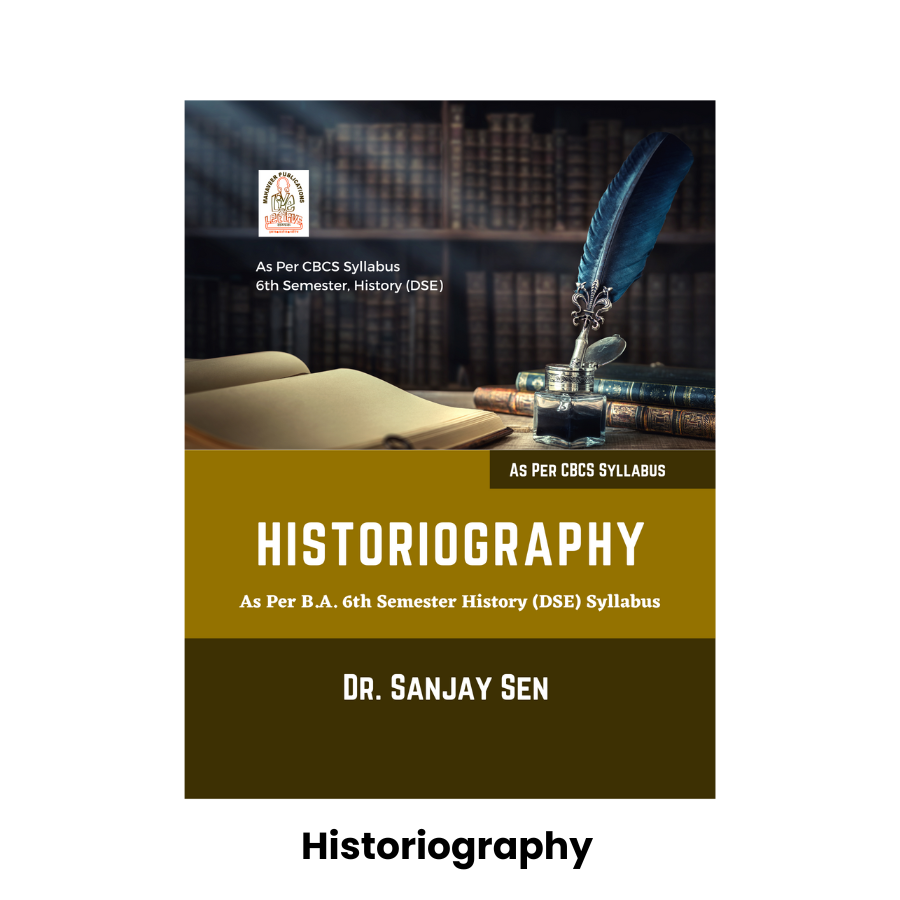
Historiography
Inhouse product
-
 Rs212.50
Rs250.00 -
Rs290.00
Rs310.00 -
Rs430.00
Rs450.00 -
Rs288.00
Rs300.00 -
Rs235.00
Rs250.00 -
Rs300.00
Rs320.00





Reviews & Ratings
Historiography by Dr. Sanjay Sen is a comprehensive and analytical textbook designed according to the BA 6th Semester History (DSE) syllabus under the FYUGP NEP framework and CBCS pattern. Published by Mahaveer Publications, this book provides students with a clear understanding of the major traditions, methods, and interpretations that shape the discipline of history.
The text introduces learners to the evolution of historical writing from ancient to modern times, explaining how historians across cultures and periods have interpreted the past. It examines key historiographical schools—such as Greek, Roman, Church, Enlightenment, Positivist, Marxist, Annales, Subaltern, and Postmodern perspectives—offering conceptual clarity and balanced insights.
The book also highlights the development of Indian historiography, covering early traditions, colonial interpretations, nationalist historians, and contemporary approaches. Through a descriptive and student-friendly style, it explains essential concepts such as historical methodology, objectivity, bias, sources of history, narrative construction, and the philosophy of history.
UNIT – 1 : CONCEPT AND SOURCES
This unit introduces the foundations of historiography—its meaning, scope, purpose, and the core methods used by historians to study and interpret the past.
1.00 Concept of Historiography
– Definition, evolution, and the nature of historical writing.
1.01 Concept: Meaning, Scope and Purpose of History, Varieties of History, Causation & Objectivity
-
1.01.01 Meaning, Scope & Purpose of History
-
1.01.02 Definition of History
-
1.01.03 Scope & Purpose of History
-
1.01.04 Importance of History
-
1.01.05 Nature of History
-
History as a Science or an Art
-
-
1.01.06 General Aims of Teaching History
-
1.01.07 Value of Studying History
-
1.01.08 Varieties of History
-
Political History
-
Constitutional History
-
Legal History
-
Diplomatic History
-
Economic History
-
Social History
-
Cultural History
-
World History
-
Universal History
-
Military History
-
Environmental History
-
Gender History
-
Historiometry
-
-
1.01.09 Causation in History
-
1.01.10 Objectivity in History
1.02 Primary & Secondary Sources; Internal & External Criticism
-
1.02.01 Primary Sources
-
1.02.02 Secondary Sources
-
1.02.03 Evaluation of Historical Material
-
External Criticism
-
Internal Criticism
-
Types & Techniques of Internal Criticism
-
Use of Archaeology, Epigraphy & Numismatics
-
1.03 History & Allied Subjects
-
1.03.01 History & Archaeology
-
1.03.02 History & Epigraphy
-
1.03.03 History & Numismatics
-
1.03.04 History & Paleography
-
1.03.05 History & Chronology
1.04 History and Other Disciplines
-
History & Geography
-
History & Anthropology
-
History & Sociology
-
History & Literature
-
History & Economics
-
History & Political Science
UNIT – 2 : EVOLUTION OF HISTORIOGRAPHY
This unit explores major global historiographical traditions from ancient to medieval periods.
2.01 Ancient Greece & Rome
-
Herodotus (480–430 BCE)
-
Thucydides (456–396 BCE)
-
Livy (64 BCE–17 CE)
-
Tacitus (55–119 CE)
2.02 Chinese Historiography
-
Summa Chien (Sima Qian)
-
Historiography in Arab Countries – Ibn Khaldun
2.03 Medieval European Historiography
– Christian chronicles, monastic writings, medieval worldview.
2.04 Renaissance Historiography
– Humanism, secularism, and revival of critical inquiry.
UNIT – 3 : RENAISSANCE TO ENLIGHTENMENT HISTORIOGRAPHY
This unit deals with the transformation of history writing during the scientific revolution and modern intellectual movements.
3.01 Scientific Revolution & Impact on History Writing
– New methods of inquiry, rationalism, and empiricism.
3.02 Enlightenment Historiography
– Philosophical developments and critical analysis of society.
3.03 Ranke, Niebuhr & Development of Modern History Writing
-
3.03.01 Leopold von Ranke (1795–1885)
-
3.03.02 The Works of Niebuhr
3.04 Marxism and Its Impact on History Writing
– Historical materialism, class struggle, and socio-economic interpretation.
UNIT – 4 : HISTORICAL TRADITIONS IN INDIA
This unit studies major Indian historiographical traditions from early to medieval periods.
4.01 Early Indian Historical Traditions
-
4.01.01 Varieties of Early Indian Traditions
-
4.01.02 Rajatarangini (Kalhana)
4.02 Sultanate & Mughal Period Historiography
-
Development of historical writing during the Sultanate
-
Historians & chronicles during the Mughal period
4.03 Regional Historical Traditions
-
Assam
-
Maharashtra
-
South India
UNIT – 5 : DEVELOPMENT OF HISTORY WRITING IN INDIA (MODERN PERIOD)
This unit covers the rise of modern Indian historiography during the colonial and post-colonial periods.
5.01 Sir William Jones & Asiatic Society of Bengal
-
Contribution to Oriental studies and Indian historical research.
5.02 James Mill & Other Colonial Historians
-
5.02.01 James Mill (1773–1836)
-
5.02.02 Other Colonial Authors
5.03 Nationalist Historiography
– Indian scholars reclaiming history from colonial narratives.
5.04 Marxist & Subaltern Historiography
-
5.04.01 Marxist Historiography
-
5.04.02 Subaltern Historiography
Bibliography
Frequently Bought Products
Product Queries (0)
Login Or Registerto submit your questions to seller
Other Questions
No none asked to seller yet
-
Rs212.50
Rs250.00 -
Rs290.00
Rs310.00 -
Rs430.00
Rs450.00 -
Rs288.00
Rs300.00 -
Rs235.00
Rs250.00 -
Rs300.00
Rs320.00
Mahaveer Publications