








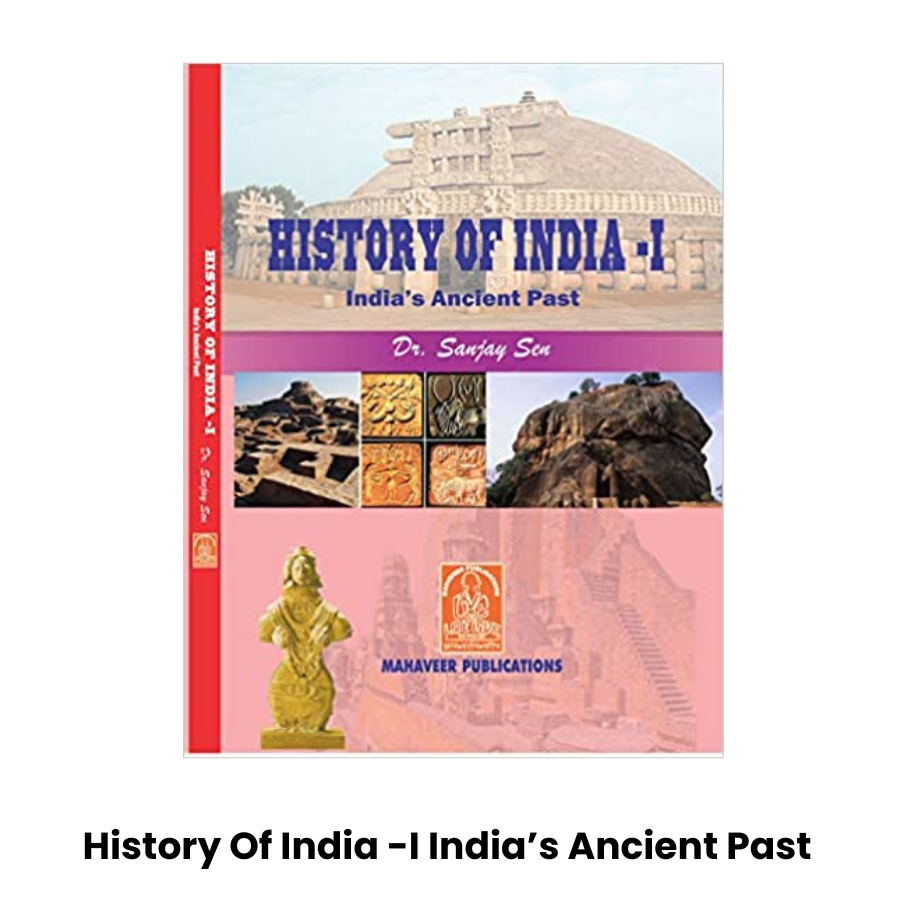
History Of India -I India's Ancient Past
Inhouse product
-
 Rs212.50
Rs250.00 -
Rs290.00
Rs310.00 -
Rs430.00
Rs450.00 -
Rs288.00
Rs300.00 -
Rs235.00
Rs250.00 -
Rs300.00
Rs320.00




Reviews & Ratings
History of India – I: India’s Ancient Past by Dr. Sanjay Sen is a comprehensive and well-structured textbook that introduces students to the roots of India’s civilization, culture, society, and political developments from prehistoric times to the early historic period. Designed for undergraduate History students, this book serves as a foundational resource for understanding the beginnings of India’s long and diverse historical journey.
The book explores key themes such as prehistoric human settlements, the rise and decline of the Indus Valley Civilization, the emergence of the Vedic culture, the formation of early states and social institutions, the development of religions and philosophies, and the evolution of political structures in ancient India. It provides detailed discussions on the Mauryan Empire, post-Mauryan states, economic life, art, architecture, and cultural transformations.
Written in clear and descriptive language, the text combines archaeological findings, literary sources, and historical interpretations to offer a holistic understanding of ancient India. It highlights important debates, regional variations, and continuity–change patterns that shaped the subcontinent’s early history.
Published by Mahaveer Publications, this book is an essential guide for BA History students, competitive exam aspirants, and anyone interested in exploring India’s ancient civilization. It aligns with university syllabi and provides strong foundational knowledge for further historical study.
UNIT – I : Reconstructing Ancient Indian History (Pages 1–120)
This unit explains how historians reconstruct the ancient past using archaeological, literary, and scientific evidence.
1.01 Early Indian Notions of History
-
Understanding how ancient Indians viewed and recorded history.
1.02 Sources of Ancient Indian History
-
Religious Literature
-
Secular Literature
-
Archaeological Sources
-
Archaeology & Archaeological Techniques
-
Interpretation of Archaeological Evidence
-
-
Numismatic Sources (Coins)
-
Epigraphic Sources (Inscriptions)
-
Literary Sources
1.03 Tools & Techniques of Archaeology
-
Scientific methods
-
Material and cultural aspects of technology
1.04 Interpreting Archaeological Evidence
-
Social, cultural, and economic reconstruction
1.05 Numismatics (Study of Coins)
-
Origin, evolution, and importance
-
History of Indian Coinage
-
Coins as Sources
-
1.06 Epigraphy (Study of Inscriptions)
-
Types and techniques
-
Deciphering early Indian scripts
1.07 Accounts of Foreign Travellers
-
Megasthenes (4th century BCE)
-
Strabo (c. 64 BCE–21 AD)
-
Pliny
-
Fa-Hien
-
Hiuen Tsang
1.08 Social, Economic, Cultural Conditions
-
Society
-
Economy
-
Religion
-
Education & Learning
UNIT – II : Prehistoric Hunter-Gatherers (Pages 121–140)
This unit reconstructs prehistoric cultures through archaeological evidence.
2.01 Prehistoric Culture of India
-
Palaeolithic cultures: distribution, tools, technology
2.02 Stages of Stone Age
-
Eolithic Age
-
Palaeolithic Age
-
Lower Palaeolithic
-
Middle Palaeolithic
-
Upper Palaeolithic
-
-
Mesolithic Age
-
Settlement patterns
-
New technologies
-
Rock art
-
2.03 Mesolithic Culture
– Regional diversity and economic life
2.04 Technology, Economy & Rock Art
UNIT – III : The Advent of Food Production (Pages 141–178)
This unit focuses on the Neolithic and Chalcolithic revolutions.
3.01 Neolithic Revolution
-
Tools
-
Agriculture
-
Regional distribution of Neolithic cultures
-
Difference between Neolithic & Palaeolithic Age
3.02 Chalcolithic Cultures
-
Subsistence patterns
-
Chalcolithic Age
-
Cultural and technological changes
3.03 Resource Utilisation
-
Gathering
-
Nomadic lifestyle
-
Pastoralism
-
Agriculture
-
Forests & wildlife
UNIT – IV : The Harappan Civilization (Pages 179–218)
A detailed examination of the Indus Valley Civilization.
4.01 Introduction to Harappan Civilization
-
The Harappan Culture
-
Early & Mature Harappan phases
-
Decline of the Civilization
4.02 Features of Harappan Culture
-
Town planning
-
Economy
-
Social organization
-
Art & craft
-
Religious practices
UNIT – V : Cultures in Transition (Pages 219–357)
This unit explains the shift from Vedic to later Vedic society and associated cultural changes.
5.01 Vedic Civilisation (1500 BCE–600 BCE)
-
Early Vedic society
-
Later Vedic society
-
Differences between Indus Valley and Vedic cultures
5.02 Religious Movements (600 BCE–400 BCE)
-
Jainism
-
Teachings of Mahavira
-
Spread of Jainism
-
-
Buddhism
-
Teachings of Buddha
-
Spread of Buddhism
-
Buddhist councils
-
Contribution to Indian culture
-
5.03 Sixteen Mahajanapadas
-
Meaning of Mahajanapada
-
Characteristics
-
Important Mahajanapadas (e.g., Magadha)
5.04 Rise of Magadha Empire
-
Causes for rise
-
Administrative system
-
Rulers of Magadha
-
Haryanka Dynasty
-
Shishunaga Dynasty
-
Nanda Dynasty
-
5.05 Persian & Greek Invasions
-
Persian invasion
-
Alexander’s invasion
-
Political condition before invasion
-
Impact of Alexander’s invasion
5.06 Central India & the Deccan (1000 BCE–300 BCE)
-
Sangam Age:
-
Meaning
-
Sangam Literature
-
Society
-
Economy
-
Polity
-
Culture
-
Fine arts
-
Religion
-
5.07 Tamilakam (300 BCE–CE 300)
-
Geographical area
-
Chola, Chera, Pandya kingdoms
-
Social & economic structure
Bibliography
Frequently Bought Products
Product Queries (0)
Login Or Registerto submit your questions to seller
Other Questions
No none asked to seller yet
-
Rs212.50
Rs250.00 -
Rs290.00
Rs310.00 -
Rs430.00
Rs450.00 -
Rs288.00
Rs300.00 -
Rs235.00
Rs250.00 -
Rs300.00
Rs320.00
Mahaveer Publications