








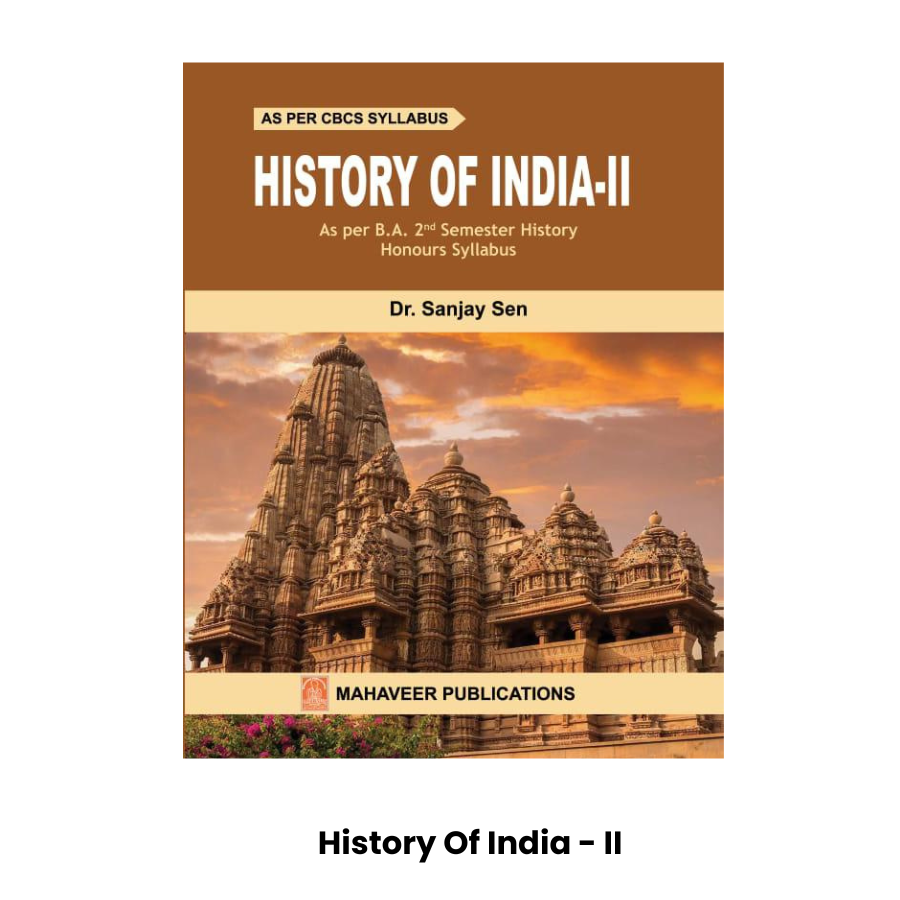
History Of India II
Inhouse product
-
 Rs212.50
Rs250.00 -
Rs290.00
Rs310.00 -
Rs430.00
Rs450.00 -
Rs288.00
Rs300.00 -
Rs235.00
Rs250.00 -
Rs300.00
Rs320.00





Reviews & Ratings
History of India – II by Dr. Sanjay Sen is a comprehensive textbook designed according to the FYUGP / NEP / CBCS syllabus for BA 2nd Semester History Honours students across Indian universities. This book offers a well-structured exploration of the early historical developments of the Indian subcontinent, tracing the transition from prehistoric cultures to the rise of major states and socio-economic institutions in ancient India.
The text provides an in-depth understanding of the Harappan civilisation, the Vedic age, the formation of mahajanapadas, the emergence of states and empires, and the evolution of political structures. Special emphasis is placed on analysing the Mauryan Empire, post-Mauryan polities, and key developments in administration, society, economy, religion, and culture.
The book integrates archaeological findings, literary sources, inscriptions, coins, and recent historical interpretations to present a balanced and updated perspective. Each chapter is written in a descriptive and student-friendly manner, making complex historical themes easy to understand.
Key themes such as urbanisation, trade networks, religious movements, technological advancements, and regional variations are discussed with clarity. The book also highlights historiographical debates and new research trends essential for building analytical skills among undergraduate learners.
Rich in detail and aligned with the academic needs of BA students, this textbook published by Mahaveer Publications serves as a reliable resource for understanding the early phases of Indian history, making it ideal for students, teachers, and competitive exam aspirants.
Unit–01: Economy and Society (circa 300 BCE to circa CE 300)
This unit explores economic foundations, agrarian expansion, urbanisation, crafts, commerce, and social structures during the post-Mauryan and early historic periods. It highlights how diverse production systems shaped social change.
1.01. Expansion of Agrarian Economy
-
Growth of agriculture
-
Production relations
-
Role of peasantry and land ownership
1.02. Urban Growth and Trade Networks
-
Urban development in North India, Central India, and the Deccan
-
Craft production and specialised industries
-
Trade routes, market centres, and coinage
Subtopics
-
Urban growth patterns
-
Pattern of trade in North India
-
Deccan: early historical urbanism
-
Crafts and commerce
-
Trade routes and centres
1.03. Social Stratification in Ancient India
-
Class and varna
-
Jati/caste forms
-
Untouchability as a social practice
-
Gender roles and divisions
-
Marriage systems and stridhana
-
Position of women in ancient society
1.04. Social Life of People
-
Everyday life patterns
-
Social customs and institutions
-
Family structure and kinship
Unit–02: Changing Political Formations (circa 300 BCE to circa CE 300)
This unit traces the emergence, consolidation, and transformation of major political powers from the Mauryan Empire to post-Mauryan states.
2.01. Rise of the Mauryan Empire
-
Foundation and expansion
-
Mauryan administration
-
Economic conditions
-
Art and sculpture
-
Downfall of the Mauryas
-
Contributions of Asoka
-
Place and significance of the Mauryan Age in Indian history
2.02. Post-Mauryan Polities
-
Sunga dynasty
-
Kanva dynasty
-
Kushana dynasty (73–225 CE)
-
Political changes, administration, and cultural contacts
2.03. Satavahana Dynasty (28 BCE–225 CE)
-
Early Satavahanas
-
Later Satavahanas
-
Satavahana rule in Central India
-
Administration, revenue, and achievements
Unit–03: Towards Early Medieval India (circa CE 300 to CE 750)
This unit examines the Gupta Empire, its successors, and the transition towards early medieval political structures.
3.01. Rise and Growth of the Gupta Empire
-
Sources for Gupta history
-
Foundation of the Gupta dynasty (circa 319–335 CE)
-
Expansion under Samudragupta, Chandragupta II, Kumargupta, and Skandagupta
3.02. Gupta State and Society
-
Imperial administration
-
Economy during Gupta rule
-
Social conditions
-
Education and learning
-
Religion and philosophy
3.03. Decline of the Gupta Empire
-
Political fragmentation
-
Foreign invasions
-
Weakening of central authority
3.04. Post-Gupta Kingdoms and Regional Powers
-
Vardhanas
-
Pallavas
-
Chalukyas
-
Growth of regional states in North and South India
Unit–04: Religion, Philosophy & Society (circa 300 BCE – CE 750)
This unit highlights major religious developments, philosophical traditions, and social transformations.
4.01. Consolidation of Brahmanical Tradition
-
Dharma, varnashrama, and social norms
-
Sanskritic culture
4.02. Theistic Cults (from circa 2nd century BCE)
-
Vaishnavism
-
Shaivism
-
Shakta traditions
-
Puranic Hinduism
4.03. Buddhism and Jainism
-
Mahayana Buddhism
-
Hinayana developments
-
Jain doctrines and philosophical ideas
Unit–05: Cultural Developments (circa 300 BCE – CE 750)
This unit discusses the artistic, architectural, literary, and scientific achievements of ancient India.
5.01. Language & Literature
-
Emergence of Sanskrit literature
-
Pali and Prakrit literature
-
Tamil language and Sangam literature
5.02. Science & Technology
-
Knowledge systems
-
Technological advancements
-
Centres of learning
5.03. Art & Architecture
-
Mauryan art and architecture
-
Gandhara and Mathura schools
-
Kushana art
-
Gupta art and architecture
-
Post-Gupta art traditions
-
Pallava art and architecture
-
Chola art and culture
-
Chalukya and Rashtrakuta architecture
Frequently Bought Products
Product Queries (0)
Login Or Registerto submit your questions to seller
Other Questions
No none asked to seller yet
-
Rs212.50
Rs250.00 -
Rs290.00
Rs310.00 -
Rs430.00
Rs450.00 -
Rs288.00
Rs300.00 -
Rs235.00
Rs250.00 -
Rs300.00
Rs320.00
Mahaveer Publications