







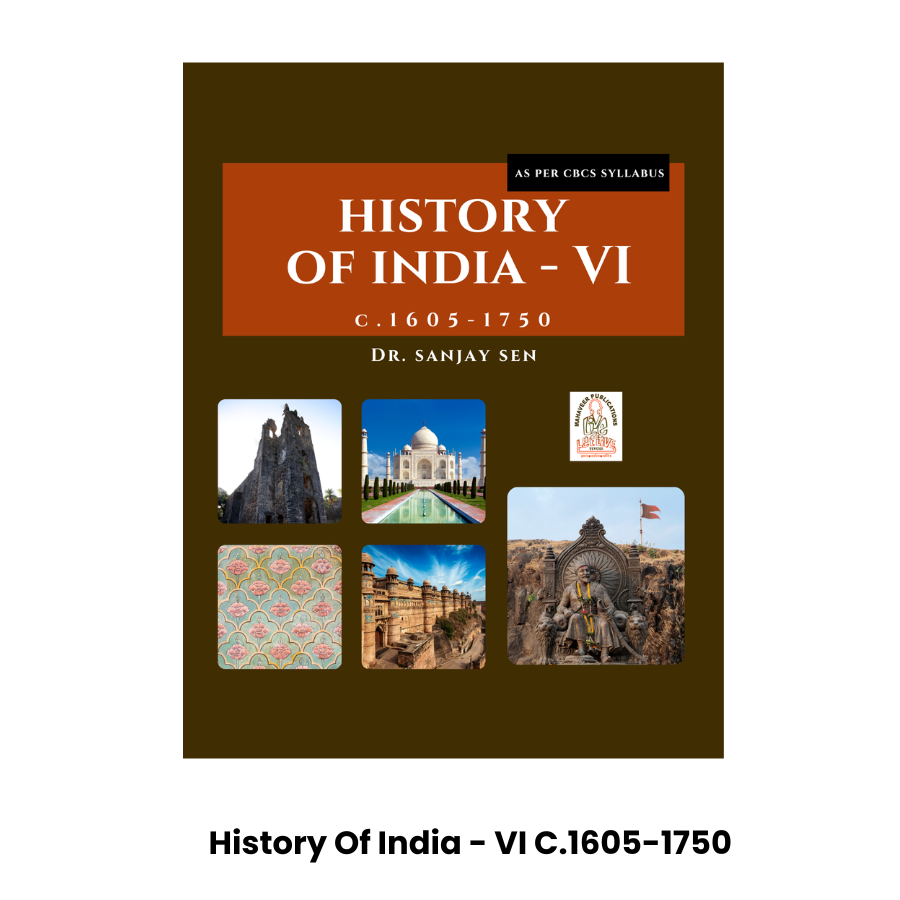
History Of India -VI C.1605-1750
Inhouse product
-
 Rs212.50
Rs250.00 -
Rs290.00
Rs310.00 -
Rs430.00
Rs450.00 -
Rs288.00
Rs300.00 -
Rs235.00
Rs250.00 -
Rs300.00
Rs320.00



Reviews & Ratings
History of India – VI (c.1605–1750) by Dr. Sanjay Sen is a comprehensive and analytical textbook designed in accordance with the CBCS, FYUGP, and NEP undergraduate syllabus for BA History Honours and Non-Honours courses across Indian universities. The book explores the crucial phase of Indian history from the late Mughal period to the rise of regional powers, offering a balanced and well-researched understanding of political, administrative, socio-economic, and cultural developments between 1605 and 1750.
The text begins with the mature Mughal Empire under Jahangir, Shah Jahan, and Aurangzeb, analysing imperial policies, administrative institutions, court culture, art, architecture, and military expansion. It provides an insightful evaluation of the crisis of the Mughal Empire, highlighting debates on decline, succession conflicts, economic pressures, and regional resistance.
A major strength of the book is its detailed discussion on the emergence of regional kingdoms such as the Marathas, Rajputs, Sikhs, Afghans, and various Deccan and South Indian states. These chapters help students understand the fragmentation of authority and transformation of political power in early modern India.
The book also covers significant themes like trade networks, European companies, agrarian structure, revenue systems, social classes, religious movements, and cultural expressions of the period. Each chapter is written in a clear, descriptive, and student-friendly style, supported by updated scholarship and relevant historical interpretations.
Unit–01 : Sources (13–78)
This unit familiarises students with the major historical sources that illuminate the Mughal period between 1605 and 1750. It includes Persian texts, vernacular records, and European travel accounts which together provide a multifaceted perspective on administration, society, culture, and statecraft.
1.01. Persian Sources
-
Tuzuki-Jahangiri
-
Padshahnama
-
Maasir-i-Alamgiri
These chronicles offer insights into imperial policies, royal personalities, court culture, and administrative mechanisms.
1.02. Vernacular Sources
-
Bhakhar
-
Buranjis
-
Banarasidas’s Ardhakathanaka
These regional narratives highlight local histories, socio-cultural conditions, trade, and communication networks.
1.03. European Travel Accounts
-
François Bernier
-
Tavernier
-
Niccolao Manucci
-
Thomas Roe
Travelogues that provide external assessments of the Mughal Empire, economy, military, social practices, and political life.
Unit–02 : Political Culture under Jahangir and Shah Jahan (79–174)
This unit examines the political consolidation, administrative framework, and cultural developments under Jahangir and Shah Jahan, marking a high point in Mughal governance.
2.01. Consolidation and Expansion of the Empire
Jahangir (1605–1627)
-
Extension of the Empire
-
Rajput policy
-
Deccan policy (1616 A.D.)
-
Relations with Central Asia
-
Religious policy
-
Role of Nurjahan
-
Contemporary assessment of Jahangir
Shah Jahan (1627–1658)
-
Internal rebellions
-
Central Asian policy
-
Deccan policy
-
Religious attitude
-
Administrative system
-
The Mughal Empire as the “Golden Period”
-
Estimate of Shah Jahan as a ruler
2.02. Extension of Mughal Rule: Mansabdari & Jagirdari Systems
-
Mansabdari system
-
Jagirdari system
-
Gradual changes in both systems during the reigns of Jahangir and Shah Jahan
2.03. Orthodoxy and Syncretism
-
Naqshbandi Sufis
-
Miyan Mir
-
Dara Shukoh
-
Sarmad
This section focuses on religious movements, ideological debates, and syncretic cultural expressions.
Unit–03 : The Mughal Empire under Aurangzeb and After (175–258)
This unit explores the policies of Aurangzeb, the fragmentation of the empire, and the emergence of powerful regional states.
3.01. State and Religion under Aurangzeb
-
Policies towards North-East and North-West frontier
-
Aurangzeb’s religious policy
-
Rajput policy
-
Deccan policy
-
Administration of Aurangzeb
3.02. Emergence of Successor States and Rise of the Marathas
-
Bengal
-
Awadh
-
Hyderabad
The Marathas
-
Emergence under Shivaji
-
Administration of Shivaji
-
Expansion under the Peshwas
-
Rise of the Maratha power and its impact
-
Contribution to the disintegration of Mughal authority
3.03. Disintegration of the Mughal Empire
-
Causes of decline
-
Political, economic, and administrative factors
3.04. Interpreting 18th Century India: Recent Debates
-
Historiographical perspectives on transition from Mughal to regional power structures
Unit–04 : Visual Culture
This unit highlights the aesthetic and cultural developments of the period, focusing on painting and architecture.
4.01. Paintings
-
Mughal Miniatures
-
Rajput or Rajasthani school
-
Pahari school
-
Pattachitra
4.02. Architecture
-
Imperial architectural styles under the Mughals
-
Regional styles of Bengal and Awadh
Unit–05 : Trade and Commerce
This unit explores the economic life, craft production, industrial technologies, and monetary systems of early modern India.
5.01. Crafts and Technologies; Monetary System
Crafts & Technologies
-
Development of indigenous crafts
-
Innovations in production techniques
Agro-Industries
-
Textiles
-
Textile technology
-
Silk
-
Indigo
-
Sugarcane
-
Oil production
Metals
-
Gold and silver
This unit helps students understand the economic foundations of Mughal India and regional economies in the early 18th century.
Frequently Bought Products
Product Queries (0)
Login Or Registerto submit your questions to seller
Other Questions
No none asked to seller yet
-
Rs212.50
Rs250.00 -
Rs290.00
Rs310.00 -
Rs430.00
Rs450.00 -
Rs288.00
Rs300.00 -
Rs235.00
Rs250.00 -
Rs300.00
Rs320.00
Mahaveer Publications