








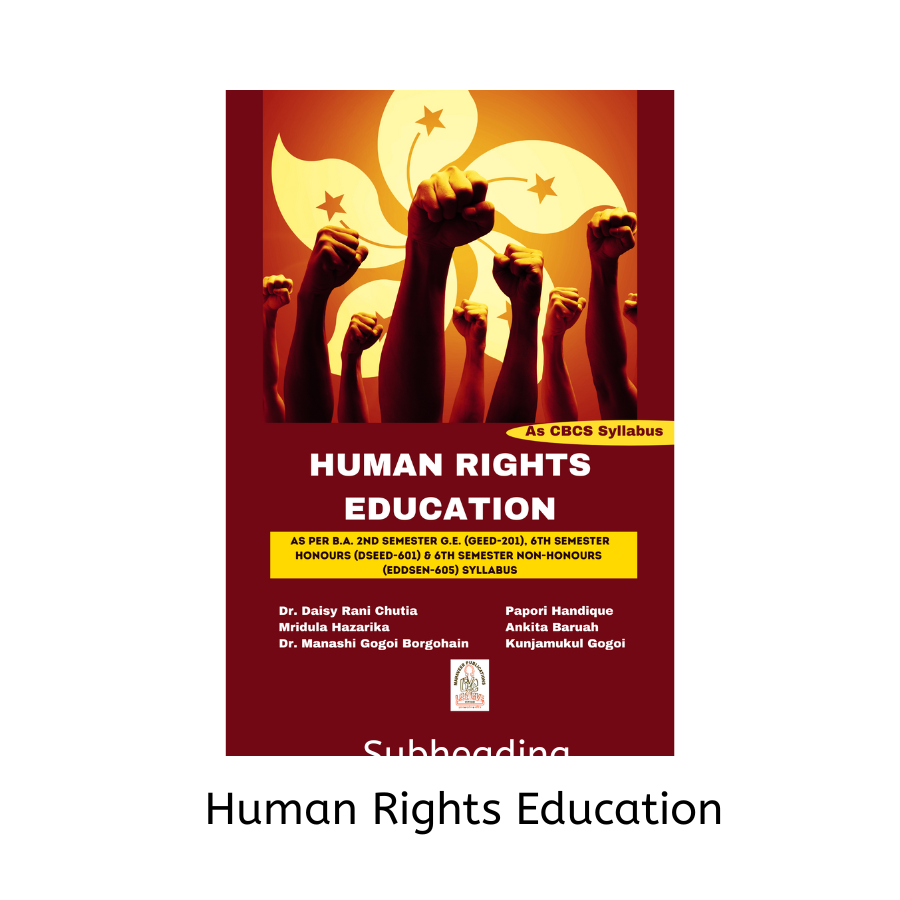
Human Rights Education
Inhouse product
-
 Rs212.50
Rs250.00 -
Rs290.00
Rs310.00 -
Rs430.00
Rs450.00 -
Rs288.00
Rs300.00 -
Rs235.00
Rs250.00 -
Rs300.00
Rs320.00





Reviews & Ratings
This course introduces learners to the field of human rights—its meaning, evolution, normative foundations, legal and institutional frameworks, and its contemporary relevance in society. It is designed to empower students with knowledge of human dignity, equality, freedom, and justice, while enhancing their awareness of rights and duties in the local, national and global spheres. Through case-studies, projects and critical reflection, students will develop the capacity to evaluate human rights challenges in modern society and contribute to promoting a culture of respect and responsibility.
Chapter 1: Introduction to Human Rights
1.00 Meaning of Human Rights
Human rights are the basic rights and freedoms that belong to every human being from birth until death. They ensure dignity, equality, and respect for all individuals. These rights protect individuals from injustice and empower them to lead a life of freedom and security.
1.01 Definition of Human Rights
This section explains how scholars, philosophers, and international organisations such as the United Nations define human rights. It highlights key definitions from the Universal Declaration of Human Rights (UDHR 1948) and other international covenants that describe them as inherent, inalienable, and universal rights.
1.02 Nature of Human Rights
Human rights are universal, indivisible, interdependent, and inalienable. This part elaborates on these features, showing that all human beings—regardless of caste, religion, gender, or nationality—are entitled to equal protection and respect.
1.03 Scope of Human Rights
This section explores the wide scope of human rights, including civil, political, economic, social, and cultural rights. It discusses how these rights extend to freedom of speech, right to education, health, work, equality before law, and the right to live with dignity.
1.04 Theories of Human Rights
Different theoretical perspectives are discussed here—Natural Law Theory, Liberal-Democratic Theory, Marxist Theory, and Sociological Theory—to show how various schools of thought have contributed to the understanding of human rights.
1.05 Constitutional Perspective
This part introduces the Indian constitutional framework that upholds human rights. It relates human rights principles to the Preamble, Fundamental Rights, Directive Principles of State Policy, and Fundamental Duties.
1.06 Fundamental Rights
Students learn about the six fundamental rights guaranteed by the Constitution of India, their objectives, and landmark judicial interpretations. Each right is explained with examples of how it safeguards personal liberty, equality, and justice.
1.07 Fundamental Rights Incorporated in the Indian Constitution
A detailed explanation of how the Indian Constitution incorporates human rights principles through Articles 12 to 35. Important case laws and constitutional amendments are also discussed.
1.08 Fundamental Duties
This section focuses on citizens’ responsibilities under Article 51A. It explains that rights and duties are complementary and that citizens must respect the Constitution, protect public property, and promote harmony.
1.09 Universal Declaration of Human Rights (1948)
This part provides a background of the UN General Assembly’s adoption of the UDHR in 1948. It explains its historical importance, structure (30 Articles), and its role as the foundation of international human rights law.
1.10 Articles of the Universal Declaration
Here, the 30 Articles of the UDHR are summarised—covering civil, political, economic, social, and cultural dimensions of human life. Emphasis is placed on Articles 1 to 21 (civil & political rights) and Articles 22 to 30 (socio-economic rights).
1.11 Human Rights Movement in India
An overview of the growth of human rights awareness in India—from the freedom struggle to post-independence movements for social justice, women’s rights, and environmental protection.
1.12 National Freedom Movement
This topic highlights how India’s struggle for independence itself was a human rights movement—fighting against colonial oppression and demanding liberty, equality, and justice for all Indians.
1.13 Swadeshi Movement
The Swadeshi Movement is discussed as an example of collective assertion of rights and self-reliance. It connected economic independence with human dignity and national pride.
Frequently Bought Products
Product Queries (0)
Login Or Registerto submit your questions to seller
Other Questions
No none asked to seller yet
-
Rs212.50
Rs250.00 -
Rs290.00
Rs310.00 -
Rs430.00
Rs450.00 -
Rs288.00
Rs300.00 -
Rs235.00
Rs250.00 -
Rs300.00
Rs320.00
Mahaveer Publications