








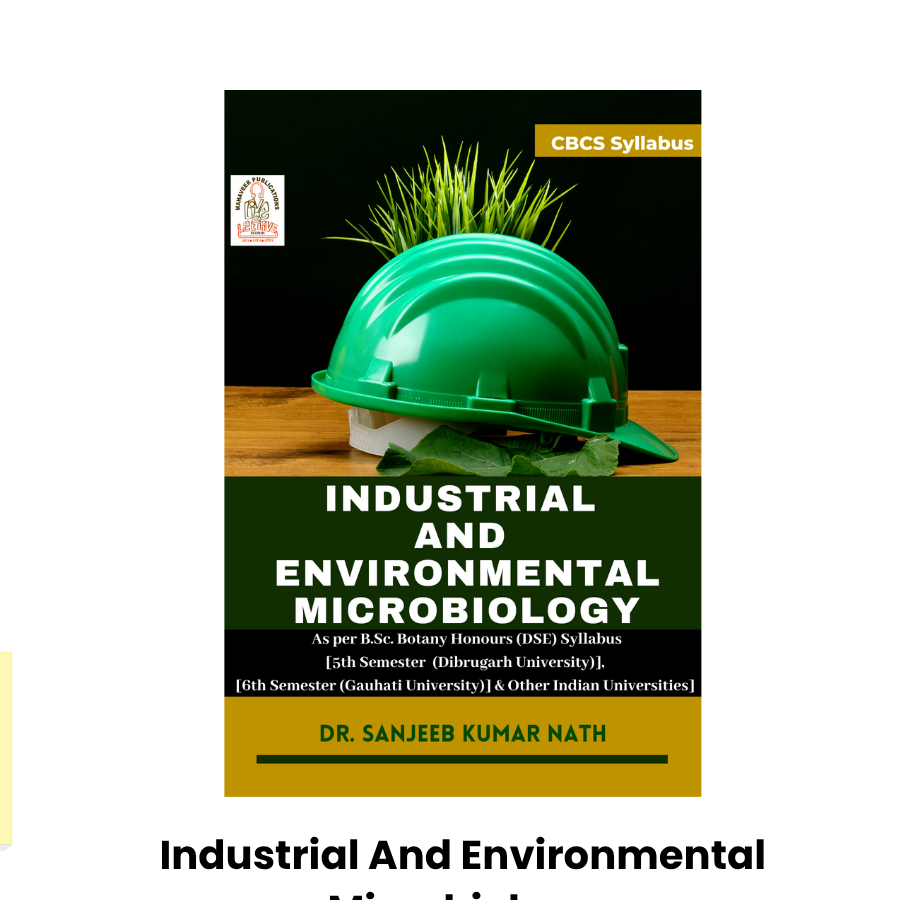
Industrial And Environmental Microbiology
Inhouse product
-
 Rs212.50
Rs250.00 -
Rs290.00
Rs310.00 -
Rs430.00
Rs450.00 -
Rs288.00
Rs300.00 -
Rs235.00
Rs250.00 -
Rs300.00
Rs320.00






Reviews & Ratings
Industrial and Environmental Microbiology by Dr. Sanjeeb Kumar Nath, published by Mahaveer Publications, is a comprehensive textbook designed as per the CBCS and FYUGP–NEP syllabi for B.Sc. Botany Honours students.
This book explores the vital roles of microorganisms in both industrial applications and environmental sustainability. It covers the fundamentals of microbial physiology, growth, and metabolism, followed by their practical uses in fermentation technology, antibiotic production, biofertilizers, biopesticides, and enzyme industries.
The environmental section focuses on the ecological importance of microbes in waste management, biodegradation, wastewater treatment, bioremediation, and recycling of nutrients — essential topics for today’s world addressing environmental conservation and sustainable industrial growth.
Written in a clear and student-friendly manner, the text blends theoretical understanding with practical relevance, offering case studies, examples, and illustrations that enhance conceptual clarity. It’s an indispensable resource for botany, microbiology, and biotechnology students preparing for advanced research and careers in life sciences.
Key Features:
-
Based on CBCS and NEP–FYUGP syllabus of major Indian universities.
-
Covers industrial and environmental aspects of microbiology in depth.
-
Includes fermentation processes, microbial technology, and environmental microbiology.
-
Provides practical applications and experiments for hands-on learning.
-
Written in simple, lucid, and exam-oriented language.
-
Ideal for students of Botany, Microbiology, and Environmental Science.
-
Authored by Dr. Sanjeeb Kumar Nath, a renowned academic in microbiological studies.
-
Published by Mahaveer Publications, trusted for quality academic resources.
COURSE CONTENTS
Unit 1: Scope of Microbes in Industry and Environment
-
Importance of microorganisms in industrial and environmental sectors
-
Microbial diversity in industrial applications
-
Role of microbes in biogeochemical cycles and waste management
-
Significance of microbes in sustainable development
Unit 2: Bioreactors/Fermenters and Fermentation Processes
-
Solid-state and liquid-state (stationary and submerged) fermentations
-
Batch and continuous fermentations
-
Components of a typical bioreactor
-
Types of bioreactors – laboratory, pilot scale, and production fermenters
-
Stirred-tank fermenter, tower fermenter, fixed-bed, fluidized-bed, and air-lift fermenters
Unit 3: Microbial Production of Industrial Products
-
Microorganisms involved in industrial fermentation
-
Media, fermentation conditions, and downstream processing
-
Filtration, centrifugation, cell disruption, solvent extraction, and drying techniques
-
Production and estimation of:
-
Enzymes: Amylase, Lipase
-
Organic acids: Citric acid, Glutamic acid
-
Alcohols: Ethanol
-
Antibiotics: Penicillin
-
Unit 4: Microbial Enzymes of Industrial Interest and Enzyme Immobilization
-
Screening of industrially important microorganisms
-
Casein, starch, and cellulose hydrolysis
-
Methods of enzyme immobilization
-
Advantages and applications of immobilized enzymes
-
Large-scale applications: Glucose isomerase, Penicillin acylase
Unit 5: Microbes and Quality of Environment
-
Distribution of microbes in air, soil, and water
-
Isolation and identification of microorganisms from environmental samples
-
Role of microbes in environmental monitoring and pollution control
Unit 6: Microbial Flora of Water
-
Water pollution and role of microbes in sewage and wastewater treatment
-
Determination of BOD, COD, TDS, TOC in water samples
-
Microorganisms as indicators of water quality
-
Detection of coliform and fecal coliform in water samples
Unit 7: Microbes in Agriculture and Remediation of Contaminated Soils
-
Biological nitrogen fixation
-
Mycorrhizae and biofertilizers
-
Bioremediation and biodegradation of contaminated sites
-
Isolation of root-nodulating bacteria and arbuscular mycorrhizal fungi
PRACTICALS
-
Principles and functioning of instruments in microbiology laboratories.
-
Hands-on study of bioreactors and fermentation systems.
-
Pure culture techniques and media preparation.
-
Screening and identification of industrially important microbes.
-
Determination of water quality parameters (BOD, COD, TDS, TOC).
-
Isolation of root-nodulating bacteria and mycorrhizal associations.
Frequently Bought Products

Analytical Technques In Plant Sciences
Product Queries (0)
Login Or Registerto submit your questions to seller
Other Questions
No none asked to seller yet
-
Rs212.50
Rs250.00 -
Rs290.00
Rs310.00 -
Rs430.00
Rs450.00 -
Rs288.00
Rs300.00 -
Rs235.00
Rs250.00 -
Rs300.00
Rs320.00
Mahaveer Publications