








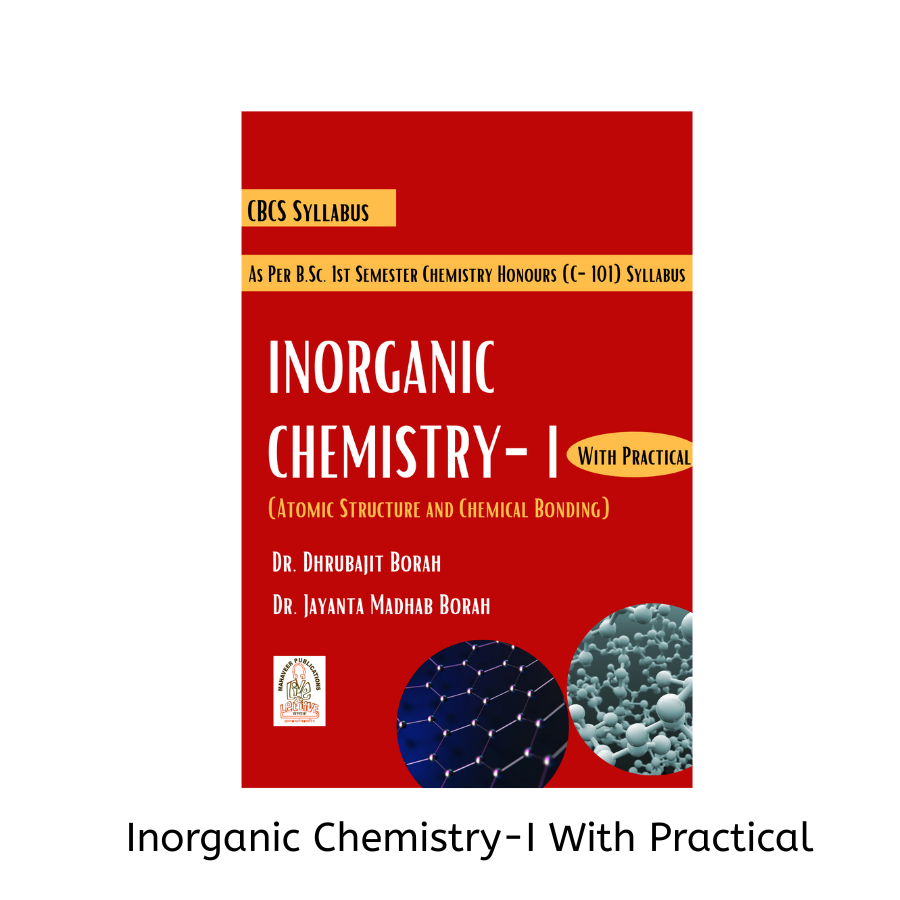
Inorganic Chemistry -I With Practical
Inhouse product
-
 Rs212.50
Rs250.00 -
Rs290.00
Rs310.00 -
Rs430.00
Rs450.00 -
Rs288.00
Rs300.00 -
Rs235.00
Rs250.00 -
Rs300.00
Rs320.00


Reviews & Ratings
Unit 1: Atomic Structure
This unit provides a comprehensive understanding of the fundamental concept of atoms—the basic building blocks of matter. It traces the historical development of atomic theory from Dalton’s model to modern quantum mechanical concepts. The chapter explains subatomic particles, atomic models proposed by Thomson, Rutherford, and Bohr, and their experimental basis. It elaborates on quantum numbers, electronic configuration, and the dual nature of matter and radiation.
Students learn about the Heisenberg uncertainty principle, Schrödinger wave equation, and the shapes of s, p, and d orbitals. The unit emphasizes the modern quantum mechanical model of the atom, providing the foundation for understanding chemical bonding and periodic properties.
Key topics:
-
Discovery of electron, proton, and neutron
-
Atomic models: Thomson, Rutherford, and Bohr
-
Dual nature of matter and radiation (de Broglie and Davisson–Germer experiment)
-
Quantum numbers and orbitals
-
Aufbau principle, Pauli’s exclusion principle, Hund’s rule
-
Electronic configuration and stability of half-filled and completely filled orbitals
Unit 2: Periodicity of Elements
This unit explores how the periodic law serves as the cornerstone of inorganic chemistry. It discusses the modern periodic table, periodic classification of elements, and periodic trends in physical and chemical properties. Students will understand how atomic and ionic radii, ionization energy, electron affinity, and electronegativity vary along periods and down groups, and how these trends explain the chemical reactivity of elements.
Special attention is given to anomalies such as diagonal relationships, inert pair effect, and variations among transition and inner transition elements. The unit links atomic structure with chemical behaviour, helping students correlate electronic configuration with position in the periodic table.
Key topics:
-
Modern periodic law and long form of periodic table
-
Classification of elements (s, p, d, f blocks)
-
Periodic trends: atomic and ionic radii, ionization energy, electron affinity, electronegativity
-
Effective nuclear charge and shielding effect
-
Diagonal relationship and inert pair effect
-
Variation of oxidation states and metallic/non-metallic character
Unit 3: Chemical Bonding
The Chemical Bonding unit delves into the forces that hold atoms together to form molecules and compounds. It explains different types of chemical bonds—ionic, covalent, coordinate, metallic, and hydrogen bonds—along with theories that describe them. The chapter provides conceptual clarity on bond parameters such as bond length, bond energy, and bond order, and introduces hybridization and molecular geometry through the VSEPR theory.
Students will also learn about the molecular orbital (MO) theory, drawing MO diagrams for simple diatomic molecules, and understanding bond order and magnetic behaviour. The comparison between valence bond theory (VBT) and MO theory develops an analytical perspective for interpreting bonding patterns in molecules.
Key topics:
-
Ionic bond: lattice energy, Born–Haber cycle
-
Covalent bond: Lewis structures, octet rule and its limitations
-
VSEPR theory and molecular geometry
-
Valence bond theory and concept of hybridization
-
Molecular orbital theory (for H₂, He₂, O₂, N₂, CO)
-
Coordinate bonds, metallic bonds, hydrogen bonding and its significance
Unit 4: Oxidation and Reduction
This unit provides a detailed understanding of oxidation–reduction (redox) processes, which are central to chemical reactions. It covers classical and modern concepts of oxidation number and electron transfer, balancing of redox equations using ion–electron and oxidation number methods, and applications in everyday chemical and industrial processes.
The discussion includes types of redox reactions, electrode potentials, and the concept of standard reduction potential, laying the foundation for later electrochemistry studies. Students learn to identify oxidizing and reducing agents, calculate oxidation numbers, and understand redox processes in compounds and coordination complexes.
Key topics:
-
Definitions of oxidation and reduction (classical and electronic concepts)
-
Oxidation number: rules and calculations
-
Balancing of redox equations (ion–electron and oxidation number methods)
-
Disproportionation and comproportionation reactions
-
Redox reactions in acidic and basic media
-
Applications of redox processes in analytical and industrial chemistry
Inorganic Chemistry Practical
The practical section introduces students to laboratory skills essential for qualitative and quantitative inorganic analysis. Emphasis is placed on accuracy, observation, and systematic procedure.
Frequently Bought Products
Product Queries (0)
Login Or Registerto submit your questions to seller
Other Questions
No none asked to seller yet
-
Rs212.50
Rs250.00 -
Rs290.00
Rs310.00 -
Rs430.00
Rs450.00 -
Rs288.00
Rs300.00 -
Rs235.00
Rs250.00 -
Rs300.00
Rs320.00
Mahaveer Publications