








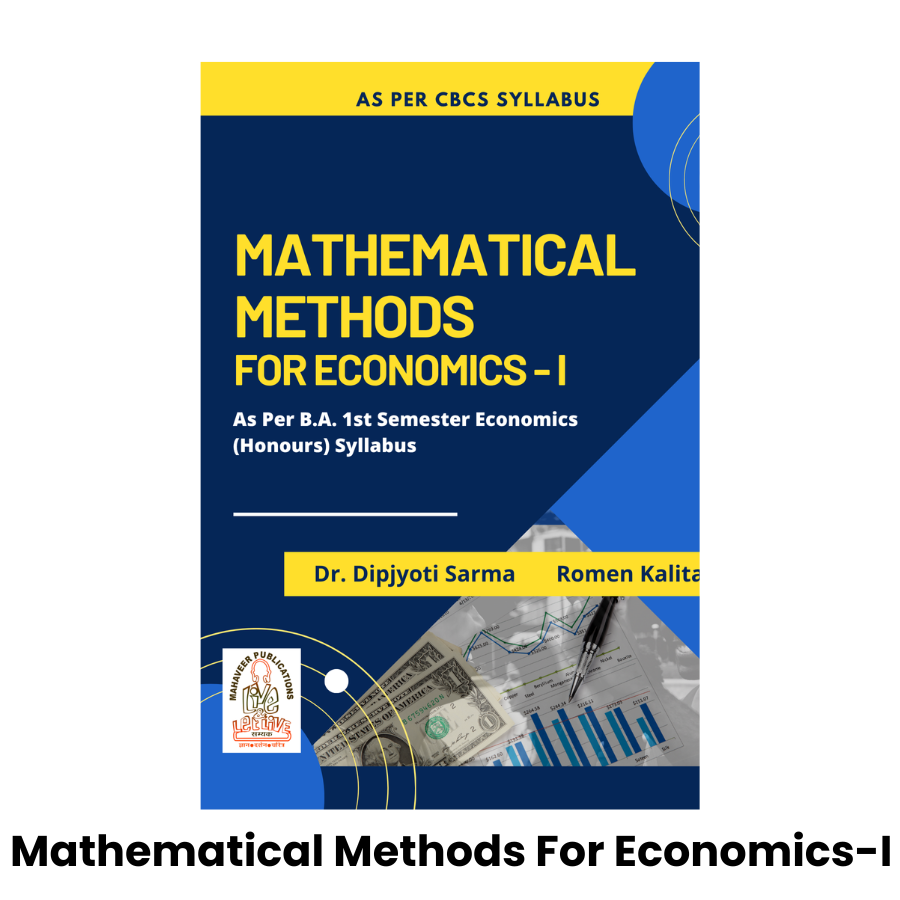
Mathematical Methods For Economics -I
Inhouse product
-
 Rs212.50
Rs250.00 -
Rs290.00
Rs310.00 -
Rs430.00
Rs450.00 -
Rs288.00
Rs300.00 -
Rs235.00
Rs250.00 -
Rs300.00
Rs320.00





Reviews & Ratings
Mathematical Methods for Economics – I by Dr. Dipjyoti Sarma and Romen Kalita is a concise and well-structured textbook prepared in accordance with the CBCS syllabus prescribed for B.A. 1st Semester Economics (Honours) courses of Indian universities.
The book provides a clear introduction to the mathematical tools and techniques essential for understanding modern economic theory and quantitative analysis. It blends mathematical concepts with economic applications, helping students to develop logical reasoning and analytical skills required for economic problem-solving.
Key Features:
-
Covers the entire CBCS syllabus for B.A. 1st Semester Economics Honours.
-
Presents mathematical concepts in a step-by-step and simplified manner for beginners in economics.
-
Includes topics such as sets, functions, limits, differentiation, integration, matrices, determinants, and optimization.
-
Demonstrates economic applications of each mathematical concept through examples and solved problems.
-
Contains practice exercises and numerical problems for self-assessment and examination preparation.
-
Useful for students of Dibrugarh University, Gauhati University, Bodoland University, and other Indian universities following CBCS or NEP-based syllabi.
Chapters
Chapter 1: Logic and Set Theory (Pages 1–34)
-
Basic concepts of logic and statements
-
Truth tables, tautology, contradiction, and implications
-
Concept of sets, types of sets, Venn diagrams
-
Operations on sets: union, intersection, complement, difference
-
Laws of set algebra and Cartesian product
-
Application of set theory in economics
Chapter 2: Functions of One Variable (Pages 35–66)
-
Definition and types of functions
-
Domain, range, and graph of a function
-
Linear, quadratic, exponential, and logarithmic functions
-
Inverse and composite functions
-
Applications of functions in demand, supply, and cost analysis
Chapter 3: Derivative for Functions of One Variable (Pages 67–122)
-
Concept of limits and continuity
-
Definition and rules of differentiation
-
Higher order derivatives
-
Marginal analysis: marginal cost, revenue, and utility
-
Elasticity and rate of change
-
Applications of derivatives in economic problems
Chapter 4: Integration of Functions (Pages 123–163)
-
Definition and basic rules of integration
-
Definite and indefinite integrals
-
Integration by substitution and by parts
-
Applications of integration in economics: total cost, total revenue, consumer and producer surplus
Chapter 5: Differential Equations (Pages 164–184)
-
Meaning and order of differential equations
-
First order and first degree equations
-
Solution of separable and linear differential equations
-
Applications in economics: growth models, market equilibrium, and dynamic analysis
-
Frequently Bought Products
Product Queries (0)
Login Or Registerto submit your questions to seller
Other Questions
No none asked to seller yet
-
Rs212.50
Rs250.00 -
Rs290.00
Rs310.00 -
Rs430.00
Rs450.00 -
Rs288.00
Rs300.00 -
Rs235.00
Rs250.00 -
Rs300.00
Rs320.00
Mahaveer Publications