








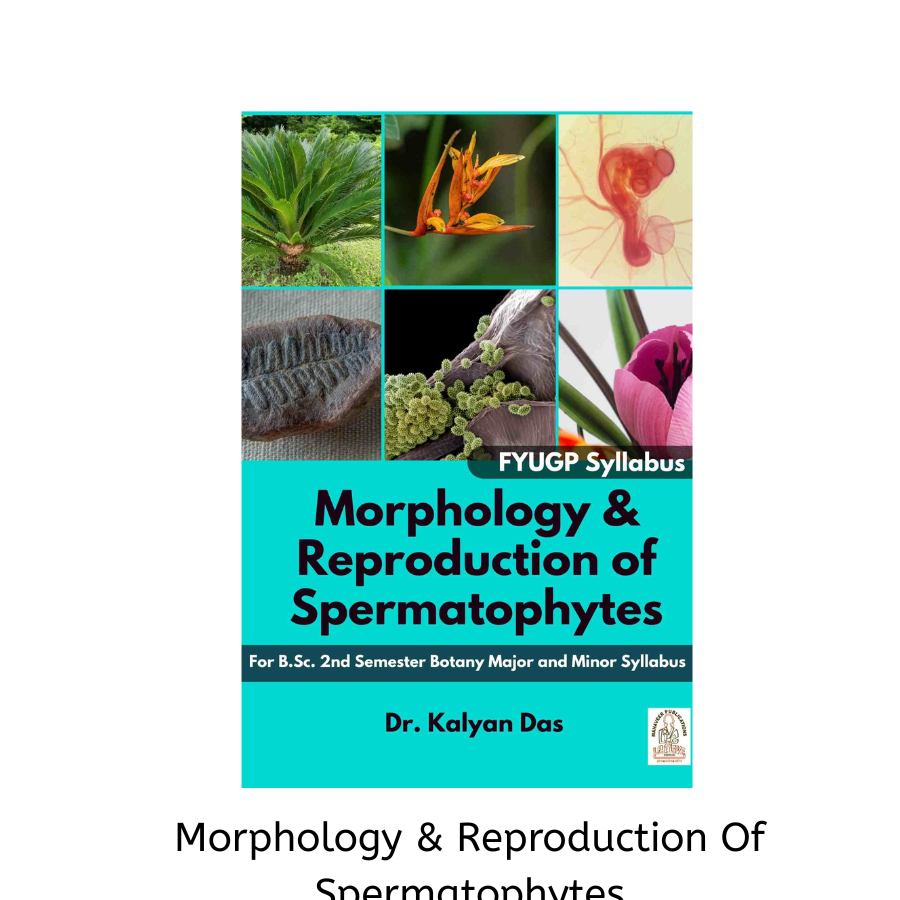
Morphology & Reproduction Of Spermatophytes
Inhouse product
-
 Rs212.50
Rs250.00 -
Rs290.00
Rs310.00 -
Rs430.00
Rs450.00 -
Rs288.00
Rs300.00 -
Rs235.00
Rs250.00 -
Rs300.00
Rs320.00



Reviews & Ratings
The paper “Morphology and Reproduction of Spermatophytes” deals with the study of seed-bearing plants — the most advanced and evolutionarily successful group in the plant kingdom. It provides a comprehensive understanding of the structural organization, form, function, and reproductive biology of both Gymnosperms and Angiosperms.
This course builds the foundation for higher studies in plant morphology, taxonomy, evolution, and reproductive biology, equipping students with conceptual clarity and observational skills through both theory and practical work.
UNIT – I: Gymnosperms
Chapter 1: Gymnosperms
1.1 Characteristics of Gymnosperms
1.2 Economic and Ecological Importance of Gymnosperms
1.3 Classification of Gymnosperms
1.4 Cycas
1.5 Pinus
1.6 Gnetum
1.7 Ginkgo
1.8 Patterns of Embryo Development in Gymnosperms
Chapter 2: Fossil Plants
2.1 Fossils
2.2 Types of Fossils
2.3 Process of Fossilization
2.4 Determination of Age of Fossils
2.5 Early Vascular Plants
2.6 Geological Time Scale
UNIT – II: Morphology of Angiosperms
Chapter 3: The Root
3.1 Characteristics of Root
3.2 Regions of the Root
3.3 Types of Roots
3.4 Functions of Root
3.5 Modifications of Roots
Chapter 4: The Stem
4.1 Characteristics of Stem
4.2 Functions of Stem
4.3 Nature of Plant Stem
4.4 Types of Stems
4.5 Branching System of Stem
4.6 Modifications of Stem
Chapter 5: The Leaf
5.1 Characteristics of a Leaf
5.2 Functions of the Leaf
5.3 Parts of a Leaf
5.4 Types of Leaves
5.5 Shape of the Leaf Blade
5.6 Leaf Margin
5.7 Apex of the Lamina
5.8 Leaf Surface
5.9 Modification of Leaves
5.10 Venation
5.11 Nature of Leaf
5.12 Phyllotaxy
5.13 Trichomes
Chapter 6: Flower and Inflorescence
6.1 Angiosperms
6.2 Parts of a Flower
6.3 Classification of Flowers (based on ovary position)
6.4 Perfect and Imperfect Flowers
6.5 Monoecious and Dioecious Flowers
6.6 Types of Flowers (based on symmetry)
6.7 Types of Flowers (based on fusion of pistils)
6.8 Types of Flowers (based on length of stamen)
6.9 Union of Stamens
6.10 Inflorescence
6.11 Aestivation
6.12 Placentation
UNIT – III: Embryology of Angiosperms
Chapter 7: Plant Embryology – Introduction
7.1 History of Plant Embryology
7.2 Eminent Plant Embryologists and their Contributions
7.3 Scope of Embryology
7.4 Induction of Flowering
7.5 Flower as a Modified Shoot
7.6 Flower Development – Genetic and Molecular Aspects
Chapter 8: Anther and Pollen Biology
8.1 Anther Wall
8.2 Function of Anther Wall
8.3 Microsporogenesis
8.4 Callose Deposition and its Significance
8.5 Microgametogenesis
8.6 Pollen Wall Structure
8.7 Male Germ Unit
8.8 NPC System of Classification
8.9 Palynology and its Scope
8.10 Pollen Wall Proteins
8.11 Pollen Viability
8.12 Pollen Storage
8.13 Pollen Germination
8.14 Abnormal Features or Grouping of Pollen
Chapter 9: Ovule
9.1 Structure of a Mature Ovule
9.2 Types of Ovules
9.3 Special Structures in Ovule
9.4 Megasporogenesis
9.5 Development of Female Gametophyte (Megagametogenesis)
9.6 Structure of Mature Embryo Sac
Chapter 10: Pollination, Fertilization and Post-Fertilization Developments
10.1 Pollination
10.2 Structure of Stigma and Style
10.3 Fertilization
10.4 Path of Pollen Tube in the Pistil
10.5 Double Fertilization
10.6 Post-Fertilization Events
10.7 True and False Fruit
10.8 Embryogeny
10.9 Development of Dicot Embryo
10.10 Structure of Dicot Embryo
10.11 Structure of Monocot Embryo
10.12 Endosperm
10.13 Suspensor – Structure and Functions
10.14 Embryo–Endosperm Relationship
10.15 Nutrition of Embryo
10.16 Embryo Development in Paeonia
10.17 Seed Structure
10.18 Importance of Seed
10.19 Seed Dispersal
Chapter 11: Polyembryony, Apomixes, Parthenocarpy and Self-Incompatibility
11.1 Polyembryony
11.2 Significance of Polyembryony
11.3 Apomixis
11.4 Differences between Apomixis and Polyembryony
11.5 Self-Incompatibility
11.6 Methods to Overcome Self-Incompatibility
11.7 Modification of Stigma Surface
11.8 Parasexual Hybridization (Protoplast Fusion)
11.9 Cybrids
11.10 In Vitro Fertilization
11.11 Parthenocarpy
Practicals
-
Study of Gymnosperms: Cycas, Pinus, Gnetum (Permanent slides and specimens)
-
Study of Fossil Impressions and Models
-
Morphological Studies of Root, Stem, Leaf, Flower, and Inflorescence
-
Study of Pollen Grains, Anther, and Ovule Structure
-
Observation of Germinating Pollen Grains
-
Study of Double Fertilization Models and Seed Structure
Frequently Bought Products

English Language & Communication Skills

Yoga Theory & Practical

WAVES & OPTICS
Product Queries (0)
Login Or Registerto submit your questions to seller
Other Questions
No none asked to seller yet
-
Rs212.50
Rs250.00 -
Rs290.00
Rs310.00 -
Rs430.00
Rs450.00 -
Rs288.00
Rs300.00 -
Rs235.00
Rs250.00 -
Rs300.00
Rs320.00
Mahaveer Publications