







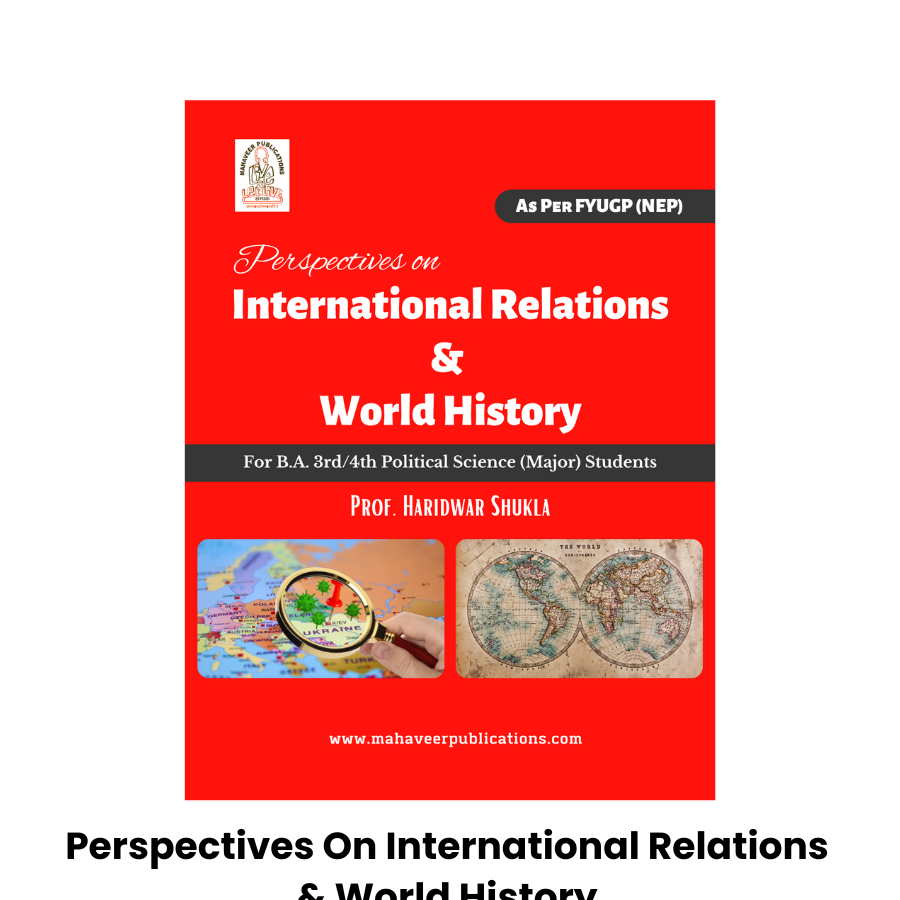
Prespectives On International Relations & world History
Inhouse product
-
 Rs212.50
Rs250.00 -
Rs290.00
Rs310.00 -
Rs430.00
Rs450.00 -
Rs288.00
Rs300.00 -
Rs235.00
Rs250.00 -
Rs300.00
Rs320.00




Reviews & Ratings
Perspectives on International Relations & World History by Prof. Haridwar Shukla is a comprehensive and analytically crafted textbook designed for the BA 3rd/4th Semester Political Science Major under the FYUGP NEP and CBCS curriculum. The book aims to provide students with a strong conceptual foundation in international relations and a deeper understanding of global historical developments that shape contemporary world politics.
The text introduces major theories, concepts, and approaches in International Relations, including realism, liberalism, constructivism, and post-colonial perspectives, helping learners understand how states interact, negotiate, and form alliances. It explains essential themes such as power dynamics, national interest, diplomacy, global governance, international law, and the functioning of international organizations like the UN, WTO, IMF, and others.
In its World History component, the book traces significant global events, transitions, and transformative processes that have influenced international relations—from ancient civilizations and medieval systems to colonial expansion, world wars, the Cold War, decolonization, globalization, and the rise of new power blocs. By connecting historical trajectories with modern political developments, the book offers a holistic framework for understanding global affairs.
Written in simple, descriptive, and student-friendly language, the book integrates theoretical insights with historical examples and contemporary case studies. It encourages critical thinking, comparative analysis, and global awareness—all essential competencies for Political Science learners.
Published by Mahaveer Publications, this textbook serves as an essential academic resource for undergraduate students pursuing Political Science major courses. It is equally valuable for aspirants of civil services and competitive exams who require clarity in International Relations and world history foundations.
CHAPTER – 01 : Studying International Relations (Pages 9–42)
This chapter introduces the foundations of International Relations (IR) as a discipline and explains why the study of global politics is vital in today’s world.
I. Meaning, Definition, Nature and Scope of International Relations
– Explains IR as a field of academic study, its boundaries, and significance.
II. International Relations and International Politics
– Differences and areas of overlap between the two.
III. Importance of the Study of International Relations
– Relevance of IR for diplomacy, global peace, foreign policy, and global cooperation.
IV. Evolution of the Discipline of International Relations
– Growth and transformation of IR from early 20th century to the present.
V. Levels of Analysis in IR
-
a) Domestic Level
-
b) Regional Level
-
c) Systemic/Global Level
Questions
– End-of-chapter review questions.
CHAPTER – 02 : History and International Relations (Pages 43–59)
This chapter builds the historical foundation of the modern international system.
I. Emergence of the International State System
– How the world moved from empires/kingdoms to modern nation-states.
II. Pre-Westphalia System
– Medieval political order and pre-modern diplomacy.
III. Westphalia System
– Rise of state sovereignty and the beginning of the modern state system.
IV. Post-Westphalia Developments
– Nation-states, nationalism, colonialism, and global power shifts.
Questions
CHAPTER – 03 : Theoretical Perspectives (Pages 60–97)
Analyzes major theories used to understand international relations.
I. Classical Realism & Neo-Realism
– Power politics, national interest, security dilemmas.
II. Liberalsim & Neo-Liberalism
– Cooperation, institutions, interdependence.
Questions
CHAPTER – 04 : Critical Perspectives (Pages 98–148)
Introduces alternative and critical approaches to international relations.
I. Marxist Approaches
– Capitalism, imperialism, global inequality.
II. Feminist Perspectives
– Gender, patriarchy, and power in global relations.
III. Euro-centrism or Euro-centrism Debate
– Western dominance in IR theories.
IV. Perspective from the Global South
– Issues faced by developing nations.
V. Green Theory in International Relations
– Environmental politics, sustainability, global ecological issues.
Questions
CHAPTER – 05 : An Overview of Twentieth Century IR History (Pages 149–209)
Explores major global events that shaped 20th-century international politics.
I. World War-I : Causes & Consequences
II. Significance of the Bolshevik Revolution
III. Rise of Fascism
IV. Rise of Nazism
V. World War-II : Causes & Consequences
Questions
CHAPTER – 06 : Cold War and Post-Cold War (Pages 210–294)
Examines the major political developments after World War II.
I. Cold War : Different Phases
– Origins, bipolarity, arms race, major crises.
II. Emergence of the Third World
– Non-aligned movement, decolonization.
III. Collapse of the USSR
– End of bipolarity and transformation of global politics.
IV. The End of the Cold War
– Changing power equations.
V. Post-Cold War Developments
– Globalization, regionalism, new security issues.
VI. Emergence of Other Centers of Power
– EU, China, regional blocs, multipolar world.
Questions
Frequently Bought Products
Introduction to Comparative Government and Politics

GLOBAL POLITICS
Product Queries (0)
Login Or Registerto submit your questions to seller
Other Questions
No none asked to seller yet
-
Rs212.50
Rs250.00 -
Rs290.00
Rs310.00 -
Rs430.00
Rs450.00 -
Rs288.00
Rs300.00 -
Rs235.00
Rs250.00 -
Rs300.00
Rs320.00
Mahaveer Publications