








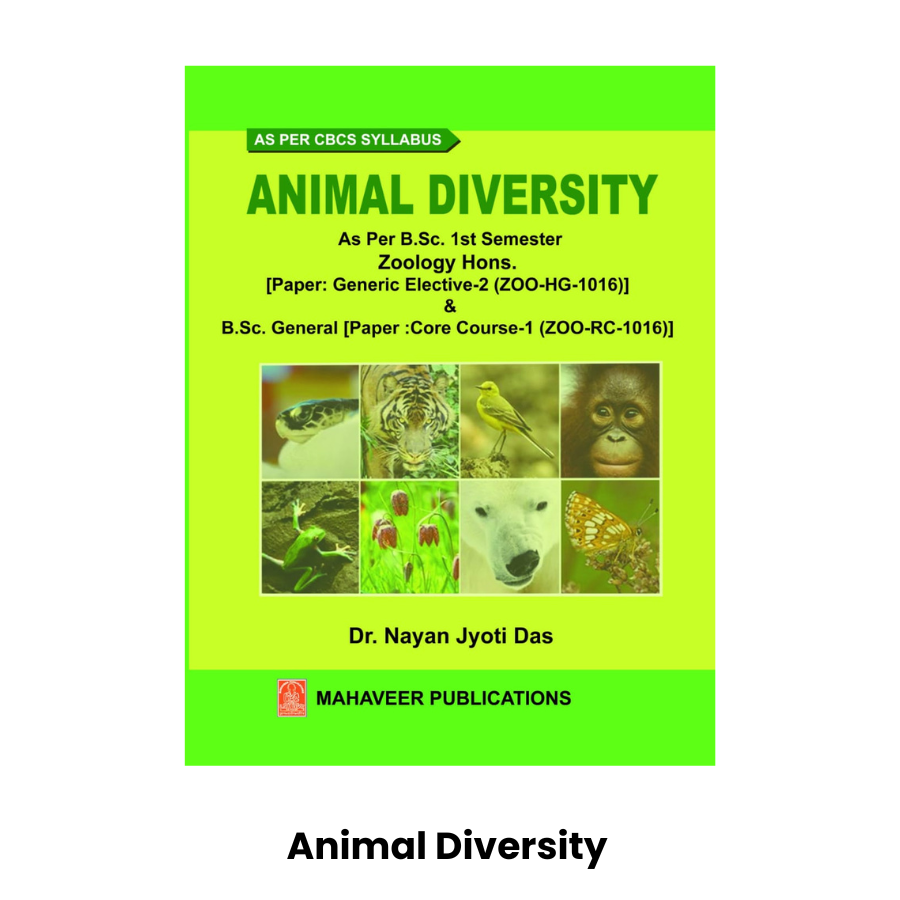
Animal Diversity
Inhouse product
-
 Rs212.50
Rs250.00 -
Rs290.00
Rs310.00 -
Rs430.00
Rs450.00 -
Rs288.00
Rs300.00 -
Rs235.00
Rs250.00 -
Rs300.00
Rs320.00


Reviews & Ratings
This book is designed as an introductory textbook for students enrolled in the B.Sc. 1st Semester Zoology programme under the Choice-Based Credit System (CBCS). Its aim is to provide:
-
A foundational overview of animal classification (both non-chordate and chordate groups)
-
Basic definitions and concepts relevant to animal diversity
-
Illustrations and diagrams (though some reviews mention room for improvement) While a detailed table of contents is not fully available in the public preview, the following can be inferred:
-
Introductory chapters on what constitutes “animal diversity”: terminology, definitions, importance of studying animals in zoology.
-
Coverage of non-chordate phyla (such as Porifera, Cnidaria, Platyhelminthes, etc) likely in brief given the page-count.
-
Coverage of chordate groups (basic vertebrate outline) given the mention of “Animal Diversity … Introduction” for Generic Elective.
-
Diagrams and tables to support taxonomic distinctions (reviews indicate “figures and diagram should be improved”).
-
Language: English.
-
-
A syllabus-aligned resource for quickly grasping major taxonomic groups, their features and significance
Chapter 1: Kingdom Protista
Introduces unicellular eukaryotic organisms with emphasis on general characteristics, classification, modes of locomotion, and the life cycle of Plasmodium. This chapter builds the foundation for understanding protozoan diversity and disease biology.
Chapter 2: Phylum Porifera
Focuses on the simplest multicellular animals, highlighting their unique canal system, body organization, and classification.
Chapter 3: Phylum Cnidaria
Discusses cnidarian diversity through their structural organization, polymorphism, and classification, along with the importance of cnidocytes.
Chapter 4: Phylum Acoelomates / Platyhelminthes
Explains flatworms, their adaptations to parasitic life, classification, and life cycle of Taenia solium.
Chapter 5: Phylum Pseudocoelomates / Nemathelminthes
Covers roundworms with emphasis on parasitic adaptations, general features, and classification.
Chapter 6: Phylum Coelomate Protostomes / Annelida
Explores segmented worms, their metamerism, body organization, and classification.
Chapter 7: Phylum Arthropoda
The largest animal phylum is explained with detailed general characters, classification, and specialized behavioural aspects like social life in insects.
Chapter 8: Phylum Mollusca
Highlights the soft-bodied animals, their classification, economic importance, and pearl formation process.
Chapter 9: Phylum Echinodermata
Explains general characteristics, water vascular system, evolutionary position, and classification.
Chapter 10: Protochordates
Covers the transition group between invertebrates and vertebrates, including their phylogenetic significance.
Chapter 11: Agnatha
Introduces jawless vertebrates with classification of cyclostomes and their unique features.
Chapter 12: Pisces
Covers general characters, classification, and important physiological concepts such as osmoregulation and fish migration.
Chapter 13: Amphibia
Explains evolutionary significance of amphibians, their adaptation for terrestrial life, reproduction, and parental care.
Chapter 14: Amniotes / Reptilia
Discusses reptiles with emphasis on terrestrial adaptations and classification.
Chapter 15: Aves (Birds)
Provides detailed understanding of bird classification, origin, and flight adaptations.
Chapter 16: Mammalia
Covers evolution, primates, dentition patterns, and classification of mammals, emphasizing their adaptive radiation.
Frequently Bought Products
Invertebrate Zoology-I

Cell Biology (Including Practicals)
Product Queries (0)
Login Or Registerto submit your questions to seller
Other Questions
No none asked to seller yet
-
Rs212.50
Rs250.00 -
Rs290.00
Rs310.00 -
Rs430.00
Rs450.00 -
Rs288.00
Rs300.00 -
Rs235.00
Rs250.00 -
Rs300.00
Rs320.00
Mahaveer Publications