








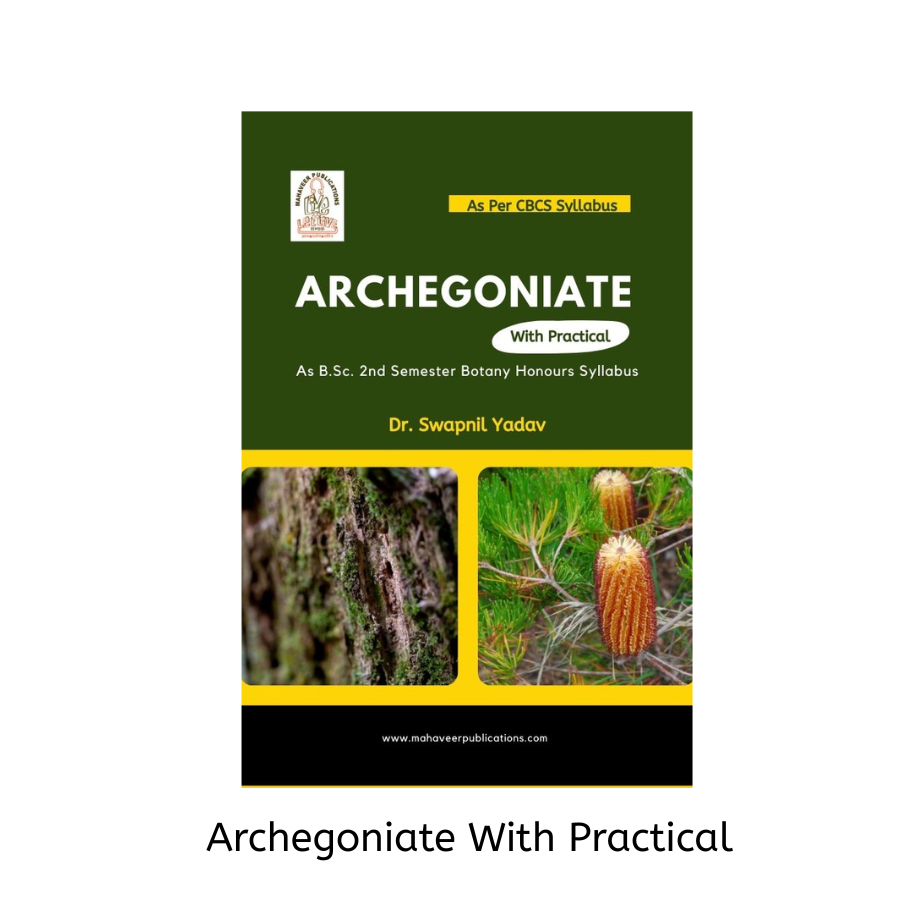
Archegoniate With Practical
Inhouse product
-
 Rs212.50
Rs250.00 -
Rs290.00
Rs310.00 -
Rs430.00
Rs450.00 -
Rs288.00
Rs300.00 -
Rs235.00
Rs250.00 -
Rs300.00
Rs320.00


Reviews & Ratings
The book “Archegoniate with Practical” by Dr. Swapnil Yadav is designed to meet the academic requirements of B.Sc. 2nd Semester Botany Honours students following the CBCS syllabus prescribed by Indian universities. It provides a comprehensive study of the Archegoniates — a group of plants that includes Bryophytes, Pteridophytes, and Gymnosperms, which represent crucial evolutionary stages in the plant kingdom.
The text combines theoretical clarity with practical learning, helping students understand the structure, reproduction, and life cycles of these plants in detail. Each unit is presented in a simple, descriptive, and systematic manner, supplemented by diagrams, examples, and comparative accounts to strengthen conceptual understanding.
Unit-wise Overview
Unit I – Bryophytes
This unit introduces students to the world of Bryophytes, emphasizing their origin, general characters, classification, and affinities.
-
Detailed studies of Riccia, Marchantia, Pellia, Porella, Anthoceros, Sphagnum, Funaria, and Polytrichum include their morphology, anatomy, gametophyte and sporophyte structures, and reproductive cycles.
-
The unit also explains the ecological and economic importance of Bryophytes, highlighting their evolutionary significance as the first land plants.
Unit II – Pteridophytes
This section explores the structure, reproduction, and evolution of seedless vascular plants.
-
Topics include general characters, classification, parthenogenesis, and stelar evolution.
-
Detailed studies of Psilotum, Selaginella, Equisetum, Ophioglossum, and Marsilea are presented with emphasis on morphology, anatomy, reproduction, and life cycles.
-
Special focus is given to heterospory, seed habit, telome theory, and the economic importance of Pteridophytes.
Unit III – Gymnosperms
This unit deals with the seed-bearing, non-flowering plants that bridge the evolutionary gap between Pteridophytes and Angiosperms.
-
Covers general characters, classification, and affinities of Gymnosperms.
-
Detailed accounts of Cycas, Pinus, Ginkgo, and Gnetum include their sporophyte, anatomy, gametophyte, and reproductive structures.
-
Students will understand the evolutionary adaptations that led to seed formation and dominance of Gymnosperms in terrestrial ecosystems.
Unit IV – Fossil Plants
This final section deals with fossil forms and their evolutionary significance.
-
Discusses the structure and importance of Psilophyton, Rhynia, Cycadeoidea, and Sphenophyllum, along with methods of fossilization and geological time scales.
-
Helps students trace the evolutionary history of Archegoniates through paleobotanical evidence.
Practicals
The practical section includes:
-
Microscopic and macroscopic study of Bryophyte, Pteridophyte, and Gymnosperm specimens.
-
Slide preparation, identification, and diagrammatic representation of gametophyte and sporophyte stages.
-
Observation of fossil plant specimens and preparation of herbarium records.
Frequently Bought Products

Plant Systematics with practical
Genetics with practical

Biomolecules & Cell Biology (With Practical)
Product Queries (0)
Login Or Registerto submit your questions to seller
Other Questions
No none asked to seller yet
-
Rs212.50
Rs250.00 -
Rs290.00
Rs310.00 -
Rs430.00
Rs450.00 -
Rs288.00
Rs300.00 -
Rs235.00
Rs250.00 -
Rs300.00
Rs320.00
Mahaveer Publications