








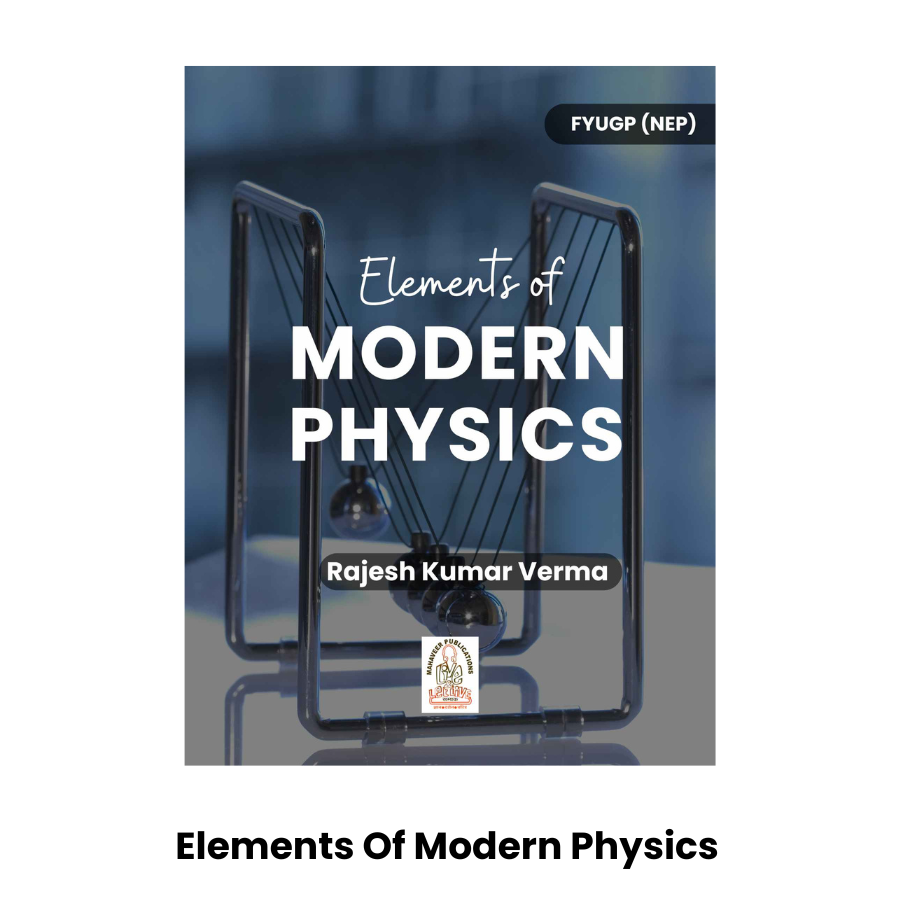
Elements Of Modern Physics With Practical
Inhouse product
-
 Rs212.50
Rs250.00 -
Rs290.00
Rs310.00 -
Rs430.00
Rs450.00 -
Rs288.00
Rs300.00 -
Rs235.00
Rs250.00 -
Rs300.00
Rs320.00






Reviews & Ratings
Elements of Modern Physics with Practical is a comprehensive textbook designed to meet the updated requirements of the FYUGP/NEP undergraduate Physics curriculum, providing a clear and systematic understanding of the fundamental concepts of modern physics along with hands-on practical components.
This book introduces students to the revolutionary developments in physics that shaped the 20th century and continue to influence scientific research today. Beginning with the breakdown of classical physics and the emergence of quantum ideas, the text covers atomic physics, nuclear physics, quantum mechanics, special relativity, particle physics, and essential modern experimental techniques.
The practical section supplements the theory with a collection of well-structured laboratory experiments, enabling students to correlate conceptual understanding with real-world applications. Each experiment includes objectives, theory, apparatus, procedure, observations, precautions, and viva-voce questions—making it a complete guide for both learners and instructors.
Unit I – Quantum Theory and Black Body Radiation
This unit introduces the historical development of quantum theory, classical limitations, Planck’s quantum hypothesis, photoelectric effect, Compton scattering, and Einstein’s interpretations. Essential graph-based analyses and theoretical/MCQ sections strengthen understanding.
Unit II – Uncertainty Principle and Wave–Particle Duality
Covers Heisenberg’s Uncertainty Principle, thought experiments, localization, wave packets, phase and group velocities, de Broglie wavelength relations, and energy levels in atoms with solved examples.
Unit III – Schrödinger Equation
Includes interference effects, superposition principle, wave function interpretation, time-independent and time-dependent Schrödinger equations, normalization, operators, eigenvalues, eigenfunctions, and the operator formalism in quantum mechanics. This unit builds the foundation of modern wave mechanics.
Unit IV – One-Dimensional Box and Step Barrier
Discusses quantum confinement in a 1D rigid box, quantum dots, quantum wires, wells, tunnelling phenomena, potential barriers, transmission/reflection coefficients, and applications like alpha-particle emission.
Unit V – Structure of the Atomic Nucleus (Nuclear Physics)
Explores nuclear size, mass, angular momentum, binding energy, packing fraction, stability of nuclei, nature of nuclear forces, and scattering concepts. Solved problems help apply theoretical concepts.
Unit VI – Nuclear Models
Covers liquid drop model, shell model, spin–orbit coupling, magic numbers, model predictions, and model failures. This unit helps compare theoretical and experimental nuclear properties.
Unit VII – Natural Radioactivity
Describes radioactive laws, decay processes (α, β, γ), neutrino theory, electron capture, decay constants, half-life, mean life, successive disintegration, equilibrium concepts, and gamma interactions with matter.
Unit VIII – Detection of Nuclear Radiation & Nuclear Fission/Fusion
Explains accelerators (Van de Graaff, cyclotron, synchrocyclotron), detectors (Geiger–Müller counter, scintillation counter, neutron detectors), nuclear reactors, stellar energy, fission/fusion reactions, and related theoretical questions.
Unit IX – Lasers
Covers stimulated and spontaneous emission, Einstein coefficients, population inversion, optical/electrical pumping, three-level and four-level laser systems, Ruby laser, He–Ne laser, and fundamental principles of laser operation.
Frequently Bought Products
WAVES & OPTICS
ELECTRICITY & MAGNETISM

Analog Systems & Applications

Classical Mechanics
Product Queries (0)
Login Or Registerto submit your questions to seller
Other Questions
No none asked to seller yet
-
Rs212.50
Rs250.00 -
Rs290.00
Rs310.00 -
Rs430.00
Rs450.00 -
Rs288.00
Rs300.00 -
Rs235.00
Rs250.00 -
Rs300.00
Rs320.00
Mahaveer Publications