








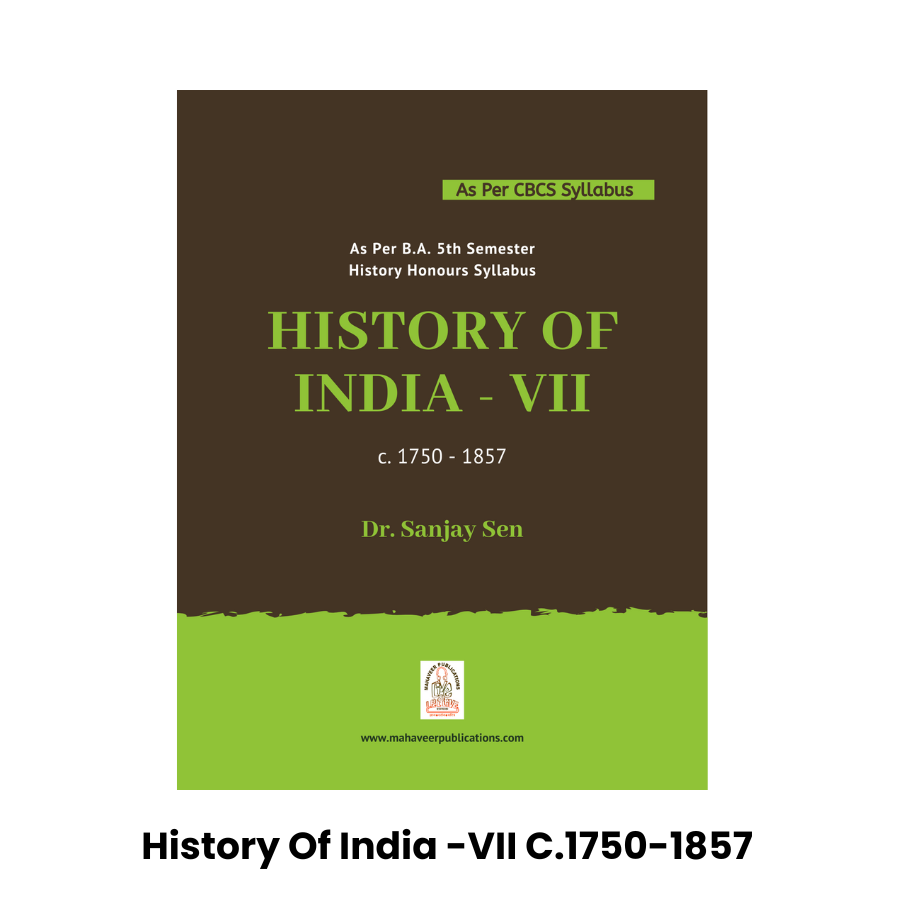
History Of India -VII C.1750-1857
Inhouse product
-
 Rs212.50
Rs250.00 -
Rs290.00
Rs310.00 -
Rs430.00
Rs450.00 -
Rs288.00
Rs300.00 -
Rs235.00
Rs250.00 -
Rs300.00
Rs320.00





Reviews & Ratings
This book covers the crucial period in Indian history from approximately 1750 to 1857 — that transitional era in which pre-colonial polities, agrarian systems and indigenous economic/social frameworks underwent profound change, and the foundations of British colonial rule in India were firmly established. Key features include:
-
A systematic narration of political developments: The decline of regional powers and the rise of the East India Company’s dominance; major battles, treaties, and alliances.
-
A detailed account of socio‐economic transformations: Agrarian changes, land-revenue systems, the impact of trade and early industrial imports, and the processes of economic exploitation.
-
Emphasis on indigenous responses and resistance: Peasant and tribal uprisings, local leadership, and the early stirrings of opposition to colonial rule.
-
A theme of transition: How old social orders, cultural institutions and political dynamics shifted under colonial pressure; how traditional structures adapted (or failed to adapt) to new conditions.
-
Use of both primary sources and historiographical perspectives: The book presents data and narrative along with interpretation, enabling the student to engage critically with the period.
-
Designed for the CBCS (Choice Based Credit System) syllabus: Each unit aligns with the typical core‐paper structure of the 5th semester, offering clear learning outcomes, questions, and suggestions for further reading.
UNIT 01: INDIA IN THE MID–18th CENTURY
1.01 Society, Economy, Polity: Debates
This section examines mid-18th century India just before the consolidation of British rule.
Topics include:-
The nature of Indian society: caste, community structures and regional variations.
-
Agrarian and rural economic patterns.
-
Urban centers, trade networks, artisanship, and decline of certain industries.
-
Debates among historians about whether mid-18th century India was truly in “decline” or only undergoing transition.
1.02 Eighteenth Century Political Condition
-
Fragmentation of Mughal authority.
-
Rise of successor states: Awadh, Bengal, Hyderabad, Mysore, Punjab, Marathas.
-
Changing military and administrative structures.
-
Political instability and competition between regional powers.
1.02.01–1.02.04 European Settlements & Rivalries
-
Arrival, settlement and expansion of the Portuguese, Dutch, French and English.
-
Competition for trade routes and commercial privileges.
-
Carnatic Wars and the struggle for supremacy.
-
How European military technology and diplomacy shaped the political landscape.
1.03 Expansion & Consolidation of Colonial Power
-
Early forms of extraction: revenue farming, monopoly of trade, and commercial profits.
-
Mercantilism and how British economic policy drained resources from India.
-
The establishment of administrative and military control after battles like Plassey (1757) and Buxar (1764).
-
British expansion into Bengal, Mysore, Maratha territories, Awadh, Punjab and Sind.
UNIT 02: COLONIAL STATE AND IDEOLOGY
2.01 Arms of the Colonial State
-
Army: recruitment patterns, transformation into a disciplined colonial force.
-
Police: establishment of surveillance systems to maintain colonial order.
-
Law: introduction of British laws, courts, and codified criminal and civil procedures.
2.02 Ideologies of the Raj
-
Understanding how the British justified their rule.
-
Orientalism: early British admiration of Indian culture.
-
Utilitarianism: colonial “civilizing mission” — promoting law, order, and modernity.
-
Evangelicalism: missionaries, education, and social reforms driven by Christian ideology.
-
Racial superiority theories and their impact on administration.
2.03 Indigenous Responses & Modern Education
-
Indian intellectual responses to British rule.
-
Rise of modern education, English-medium institutions, and early reformers.
-
Growth of new professions and middle classes.
UNIT 03: RURAL ECONOMY AND SOCIETY
3.01 Land Revenue Systems and Forest Policy
-
Changes in land ownership and taxation.
-
Permanent Settlement, Ryotwari, Mahalwari: structure, impact and regional variations.
-
Forest policies restricting traditional rights; displacement of forest communities.
3.02 Commercialization and Indebtedness
-
Transformation from subsistence agriculture to cash-crop production.
-
Growth of moneylenders, rural credit crises, and indebtedness.
3.03 Rural Society: Change and Continuity
-
How colonial policies reshaped caste, labour, and village institutions.
-
Resilience of traditional customs despite economic pressure.
3.04 Famines
-
Causes of repeated famines under colonial rule.
-
The political economy of food insecurity.
-
Government failure and death tolls in major famines.
UNIT 04: TRADE AND INDUSTRY
4.01 Deindustrialization
-
Decline of Indian handicrafts, especially textiles.
-
British policies that favoured machine-made imports.
-
Impact on artisans, weavers, and urban centres.
4.02 Trade and Fiscal Policy
-
Colonial restrictions on Indian industries.
-
Tariffs, taxation, monopoly trading companies.
4.03 Drain of Wealth
-
How India’s resources, revenue and profits were transferred to Britain.
-
Dadabhai Naoroji’s theory and economic critique of colonialism.
4.04 Growth of Modern Industry
-
Beginnings of modern industry: jute, coal, cotton mills.
-
Role of Indian entrepreneurs and foreign capital.
UNIT 05: POPULAR RESISTANCE
5.01 Tribal and Rural Rebellions
Santhal Uprising (1855–57):
-
Causes: land alienation, exploitation by moneylenders, police and zamindars.
-
Leadership of Sidhu and Kanhu Murmu.
-
Brutal suppression by colonial forces.
Indigo Rebellion (1860):
-
Resistance of Bengal peasants to forced indigo cultivation.
-
Role of ryots, intellectuals and press.
5.02 Agrarian Leagues and Peasant Revolts
-
Pabna Agrarian Leagues (1873): non-violent struggle against zamindari oppression.
-
Deccan Riots (1875): revolt of indebted peasants in Bombay Presidency.
5.03 The Revolt of 1857: Causes, Courses and Consequences
5.03.01 Nature of the Revolt
-
Debate: First War of Independence or Sepoy Mutiny?
-
Combination of political, military, economic and cultural grievances.
5.03.02 Causes
-
Cartridge controversy.
-
Annexation policies (Doctrine of Lapse).
-
Displacement of rulers, peasants, soldiers.
-
Cultural and religious interference.
5.03.03 Course of the Revolt
-
Major centres: Delhi, Kanpur, Lucknow, Jhansi, Bareilly.
-
Role of Rani Lakshmibai, Nana Saheb, Kunwar Singh, Bahadur Shah II.
5.03.04 Causes of Failure
-
Lack of unified leadership.
-
Limited geographical spread.
-
Superior British resources.
5.03.05 Consequences
-
End of East India Company rule.
-
Beginning of direct Crown rule.
-
Reorganization of army, administration and finances.
5.03.06 Impact
-
Political awakening among Indians.
-
Rise of nationalist thought.
5.03.07 Significance
-
Symbol of resistance against colonialism.
-
Inspiration for later national movements.
5.03.08 Prominent Leaders
-
Rani Lakshmibai, Nana Saheb, Tantia Tope, Bahadur Shah II, Kunwar Singh, Begum Hazrat Mahal.
-
Frequently Bought Products

History of Early and Medieval Assam
History of Modern Europe (1789-1945)
Product Queries (0)
Login Or Registerto submit your questions to seller
Other Questions
No none asked to seller yet
-
Rs212.50
Rs250.00 -
Rs290.00
Rs310.00 -
Rs430.00
Rs450.00 -
Rs288.00
Rs300.00 -
Rs235.00
Rs250.00 -
Rs300.00
Rs320.00
Mahaveer Publications