







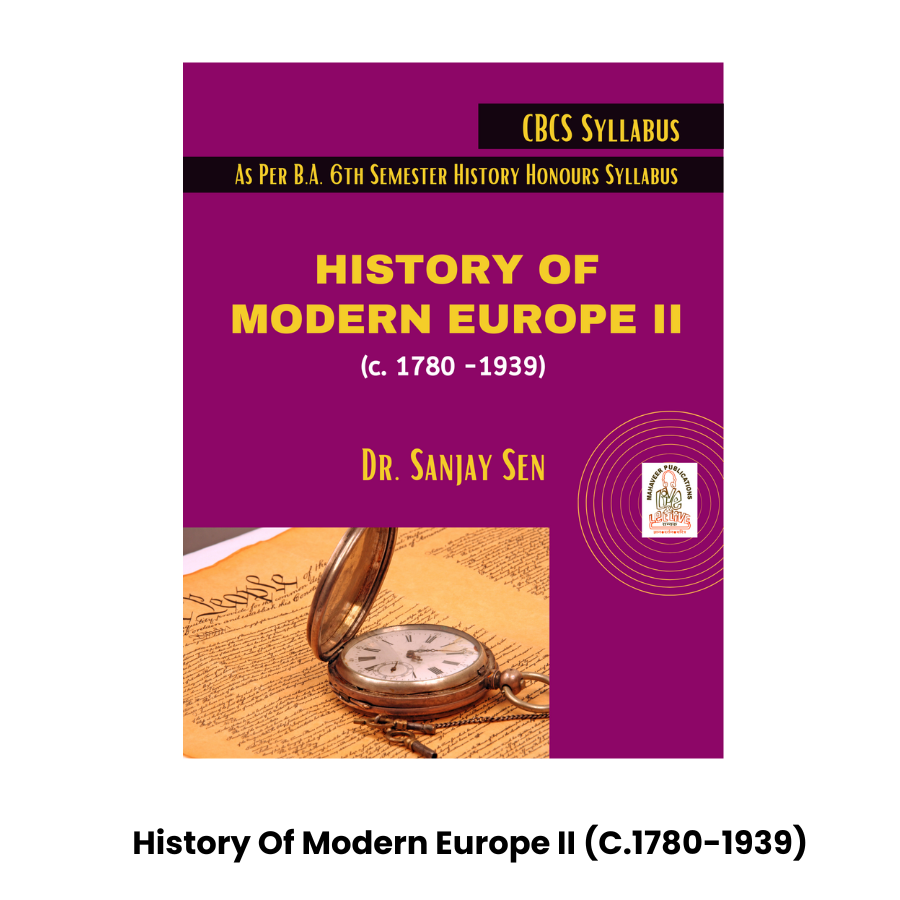
History Of Modern Europe II (C.1780-1939)
Inhouse product
-
 Rs212.50
Rs250.00 -
Rs290.00
Rs310.00 -
Rs430.00
Rs450.00 -
Rs288.00
Rs300.00 -
Rs235.00
Rs250.00 -
Rs300.00
Rs320.00


Reviews & Ratings
History of Modern Europe II (c.1780–1939) by Dr. Sanjay Sen offers an in-depth and analytical study of the major political, social, economic, and ideological developments that shaped modern Europe from the late 18th century to the outbreak of the Second World War. Designed strictly according to the FYUGP NEP/CBCS syllabus for BA 6th Semester History Honours, this textbook provides a clear, structured, and scholarly framework for understanding the transformation of Europe over more than 150 pivotal years.
The book traces Europe’s journey beginning with the Age of Revolutions, particularly the French Revolution, and moves through the rise of nationalism, the Industrial Revolution, and the consolidation of powerful nation-states like Germany and Italy. It examines the growing forces of imperialism, the shift in global power structures, and the evolution of new social classes and political ideologies including liberalism, socialism, and totalitarianism.
Unit I – Liberal Democracy, Working-Class Movements and Socialism in the 19th and 20th Centuries (11–87)
This unit explores the transformation of democratic institutions in Britain and Europe, tracing the struggle for parliamentary democracy and the emergence of civil liberties. Students learn about the rise of early capitalism, the forms of social protest that accompanied it—including food riots, Luddism, and Chartism—and the early socialist thinkers who laid the foundation for modern socialist theory. The unit also covers the growth of Social Democracy, its impact on politics and culture, and the spread of Christian Democracy as a political force in Western and Central Europe.
Overall, this unit provides a comprehensive understanding of how industrialization, class conflict, and political reform shaped modern democratic cultures.
Unit II – The Crisis of Feudalism in Russia and Experiments in Socialism (88–161)
This unit examines the decline of feudal structures in Russia, beginning with the emancipation of serfs and the rise of Russian Populism. It highlights the contrasting ideologies of Social Democracy and revolutionary movements that questioned the old political order. The unit offers a detailed discussion of the Revolutions of 1905 and the Bolshevik Revolution of 1917, analysing their causes, outcomes, and global impact. Students also study the early programmes of socialist construction under the Bolsheviks, linking the Russian experiment to broader global socialist movements of the early 20th century.
Unit III – Imperialism, War, and Crisis (c. 1880–1939) (162–229)
This unit provides an in-depth overview of the age of high imperialism, explaining its concepts, mechanisms, and different forms. It covers the expansion of European empires, growth of militarism, and formation of power blocs and alliances. The unit then moves to the First World War—its causes, consequences, and the peace settlements such as the Paris Peace Conference. Students also explore the inter-war global order marked by economic crises, the Great Depression, and the fragile attempts at recovery.
The unit helps learners understand how imperial rivalry and systemic instability set the stage for worldwide conflict.
Unit IV – Post-1919 Political Development (230–281)
This unit traces political transformations after the First World War. It includes the rise of new ideologies such as Fascism in Italy and Nazism in Germany, highlighting the political and economic circumstances that nurtured totalitarian regimes. Students study the Spanish Civil War as a major ideological conflict of the interwar period. The unit concludes with an analytical exploration of the origins of the Second World War, showing how unresolved diplomatic tensions, expansionist ambitions, and failed international institutions contributed to global war.
Unit V – Cultural and Intellectual Developments Since c.1850 (282–305)
In this unit, students examine major cultural, social, and intellectual changes that reshaped modern Europe. Topics include:
-
Changing notions of culture,
-
The creation of a new public sphere,
-
The role of mass media and mass education in expanding literacy,
-
Emergence of new cultural forms from Romanticism to Abstract Art,
-
Institutionalization of academic disciplines such as History, Sociology, and Anthropology,
-
Influential thinkers like Darwin and Freud,
-
Formation of ideologies through constructions of race, class, gender, and empire.
This unit equips learners with the intellectual tools needed to understand the evolution of modern thought and its global implications.
Frequently Bought Products

History Of India vIII C. 1857-1950

Historiography
Product Queries (0)
Login Or Registerto submit your questions to seller
Other Questions
No none asked to seller yet
-
Rs212.50
Rs250.00 -
Rs290.00
Rs310.00 -
Rs430.00
Rs450.00 -
Rs288.00
Rs300.00 -
Rs235.00
Rs250.00 -
Rs300.00
Rs320.00
Mahaveer Publications