








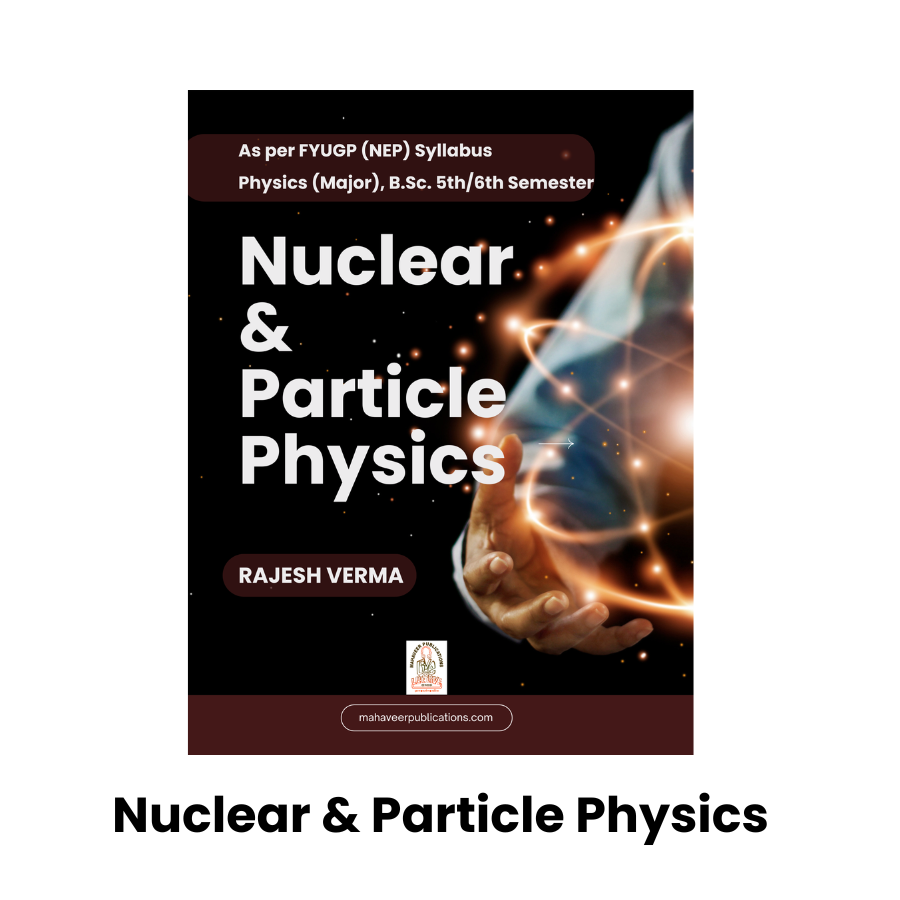
Nuclear & Particle Physics
Inhouse product
-
 Rs212.50
Rs250.00 -
Rs290.00
Rs310.00 -
Rs430.00
Rs450.00 -
Rs288.00
Rs300.00 -
Rs235.00
Rs250.00 -
Rs300.00
Rs320.00




Reviews & Ratings
Nuclear & Particle Physics by Rajesh Verma is a comprehensive and student-friendly textbook designed according to the NEP-2020 and CBCS syllabus prescribed for B.Sc. Physics (Discipline Specific Elective) courses of Gauahti, Bodoland, Assam & Other Indian universities and Autonomous Colleges.
This book provides a clear and systematic understanding of the structure, properties, and interactions of atomic nuclei and fundamental particles, integrating classical concepts with modern experimental findings. The author presents complex topics in a simplified and conceptual manner, making it accessible to undergraduate learners.
Key Features:
-
Covers the complete MAJOR syllabus for 5th & 6th semester B.Sc. Physics courses.
-
Explains the structure of nucleus, radioactivity, nuclear reactions, and binding energy in detail.
-
Discusses nuclear models — Liquid Drop Model, Shell Model, and Collective Model — with diagrams and solved examples.
-
Introduces the fundamentals of particle physics, including classification of elementary particles, quantum numbers, conservation laws, and the Standard Model.
-
Incorporates illustrative problems, conceptual questions, and numerical exercises for self-assessment.
-
Useful for students of Dibrugarh University, Gauhati University, Bodoland University, and other Indian universities following NEP/CBCS/FYUGP curriculum.
Unit-wise Course Outline
Chapter 1: General Properties of Nuclei
-
Basic properties of nuclei: size, shape, mass, charge, density, spin, magnetic moment
-
Nuclear binding energy, packing fraction and stability
-
Mass defect and semi-empirical mass formula
-
Nuclear forces and their characteristics
-
Saturation property and charge independence
Chapter 2: Nuclear Models
-
Introduction and need for nuclear models
-
Liquid Drop Model: assumptions and limitations
-
Shell Model: quantum numbers, magic numbers, energy levels
-
Collective Model and its applications
-
Comparison of different models
Chapter 3: Radioactivity Decay
-
Law of radioactive decay and half-life
-
Types of radioactive decay: α, β, and γ decay
-
Conservation laws in radioactive disintegration
-
Successive disintegration and radioactive equilibrium
-
Artificial radioactivity and its applications
Chapter 4: Nuclear Reaction
-
Types of nuclear reactions and reaction energetics
-
Q-value and threshold energy
-
Conservation laws in nuclear reactions
-
Compound nucleus theory and nuclear cross section
-
Fission and fusion reactions
Chapter 5: Interaction of Nuclear Radiation with Matter
-
Interaction of charged particles with matter
-
Energy loss and range of particles
-
Interaction of γ-rays: photoelectric effect, Compton scattering, pair production
-
Attenuation of γ-rays and radiation shielding
Chapter 6: Detectors for Nuclear Radiations
-
Basic principles of detection
-
Ionization chamber, proportional counter, Geiger-Müller counter
-
Scintillation detector and semiconductor detector
-
Neutron detectors and nuclear emulsions
Chapter 7: Particle Accelerators
-
Introduction to accelerators and their applications
-
Linear accelerators and cyclotrons
-
Synchrotron and betatron
-
Van de Graaff generator
-
Uses of accelerators in nuclear and medical physics
Chapter 8: Elementary Particles
-
Classification of fundamental particles
-
Leptons, mesons, baryons and hadrons
-
Conservation laws and quantum numbers
-
Fundamental interactions (strong, weak, electromagnetic, gravitational)
-
Quarks and the Standard Model
-
Frequently Bought Products

Renewable Energy And Energy Harvesting

Digital Systems & Applications
Product Queries (0)
Login Or Registerto submit your questions to seller
Other Questions
No none asked to seller yet
-
Rs212.50
Rs250.00 -
Rs290.00
Rs310.00 -
Rs430.00
Rs450.00 -
Rs288.00
Rs300.00 -
Rs235.00
Rs250.00 -
Rs300.00
Rs320.00
Mahaveer Publications