








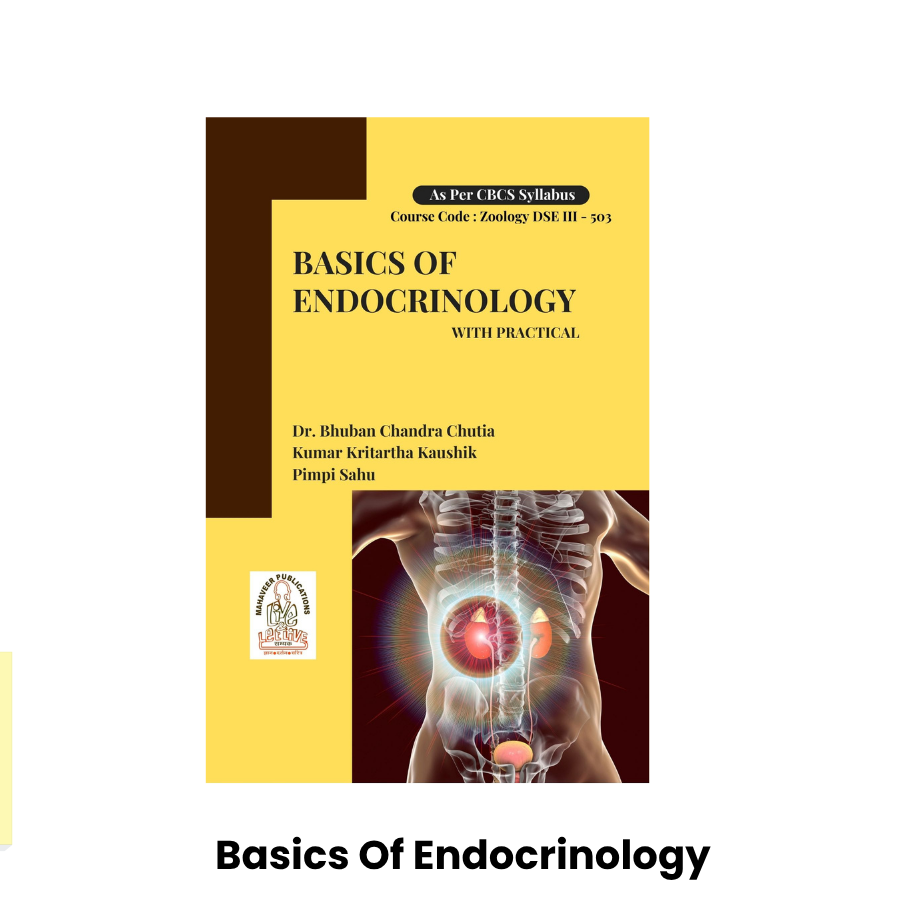
Basics of Endocrinology
Inhouse product
-
 Rs212.50
Rs250.00 -
Rs290.00
Rs310.00 -
Rs430.00
Rs450.00 -
Rs288.00
Rs300.00 -
Rs235.00
Rs250.00 -
Rs300.00
Rs320.00


Reviews & Ratings
Basics of Endocrinology (With Practical) by Dr. Bhuban Chandra Chutia, published by Mahaveer Publications, is an essential textbook crafted according to the NEP–CBCS syllabus for B.Sc. 5th Semester Zoology DSE–III students of Dibrugarh University, Gauhati University, and other Indian universities following the FYUGP pattern.
This book offers a clear and comprehensive understanding of the endocrine system, hormones, and their physiological regulation in animals, particularly humans. It introduces students to the structure and function of major endocrine glands, mechanisms of hormone action, feedback control, and the role of hormones in maintaining homeostasis, growth, reproduction, and metabolism.
The text bridges classical endocrinology with modern scientific approaches, including topics on neuroendocrine integration, hormonal disorders, and therapeutic applications of hormones. Each chapter is supported by simple illustrations, definitions, and flowcharts to enhance conceptual clarity.
The practical section includes well-structured laboratory exercises focused on hormone assay methods, identification of endocrine glands in specimens, and analysis of hormonal effects — equipping students with valuable experimental skills.
Written in an easy-to-understand style, the book is designed to meet the academic and examination needs of undergraduate zoology students and aspirants preparing for higher studies in life sciences and physiology.
Key Features:
-
Based on NEP–CBCS syllabus for B.Sc. 5th Semester Zoology (DSE–III).
-
Covers fundamentals of endocrine glands and hormone functions.
-
Integrates theoretical and practical aspects of endocrinology.
-
Includes clear illustrations, tables, and concise summaries for revision.
-
Provides lab-based exercises and observation guidelines.
-
Written in lucid, student-friendly language for easy comprehension.
-
Ideal for undergraduate students of Zoology, Physiology, and Life Sciences.
-
Published by Mahaveer Publications, a leading name in academic publishing.
COURSE CONTENTS
Unit 1: Introduction to Endocrinology
-
Definition, scope, and significance of endocrinology
-
Classification of hormones and their chemical nature
-
General organization of the endocrine system
-
Mechanisms of hormone action
-
Feedback regulation and control of hormone secretion
-
Historical perspectives and major contributions in endocrinology
Unit 2: Epiphysis, Hypothalamo–Hypophysial Axis
-
Structure and functions of the pineal gland (epiphysis)
-
Hypothalamus: neurosecretory cells and regulatory hormones
-
Pituitary gland (hypophysis): structure, hormones, and their physiological roles
-
Disorders associated with hypothalamo–hypophysial axis
-
Relationship between hypothalamus and pituitary control
Unit 3: Peripheral Endocrine Glands
-
Thyroid gland: structure, hormones, synthesis, and regulation
-
Parathyroid glands: hormones and calcium–phosphate balance
-
Adrenal glands: cortex and medulla, hormones, and functions
-
Pancreas (Islets of Langerhans): insulin, glucagon, and their regulation
-
Gonadal hormones: testicular and ovarian hormones, roles in reproduction and secondary sexual characteristics
-
Hormonal disorders: hypo- and hyper-secretion syndromes
Unit 4: Regulation of Hormone Action
-
Mechanisms of hormone–receptor interaction
-
Signal transduction pathways (cAMP, IP₃, DAG)
-
Role of feedback loops in endocrine control
-
Inter-relation between endocrine and nervous systems
-
Stress hormones and metabolic regulation
-
Hormonal control of growth, metabolism, and reproduction
Unit 5: Practical
-
Identification of major endocrine glands in vertebrate specimens.
-
Study of permanent slides of endocrine tissues.
-
Estimation of glucose, calcium, or other hormone-regulated metabolites.
-
Demonstration of hormone assay principles (ELISA / RIA – demonstration based).
-
Study of symptoms of selected endocrine disorders using case references.
-
Chart / model study of hypothalamo–hypophysial axis and feedback regulation.
References
(An updated list of standard endocrinology and physiology textbooks recommended for undergraduate zoology students.)
-
Frequently Bought Products
Animal Physiology and Immunology, Controlling And Coordinating

Animal Physiology Life Sustaining Systems
Product Queries (0)
Login Or Registerto submit your questions to seller
Other Questions
No none asked to seller yet
-
Rs212.50
Rs250.00 -
Rs290.00
Rs310.00 -
Rs430.00
Rs450.00 -
Rs288.00
Rs300.00 -
Rs235.00
Rs250.00 -
Rs300.00
Rs320.00
Mahaveer Publications