








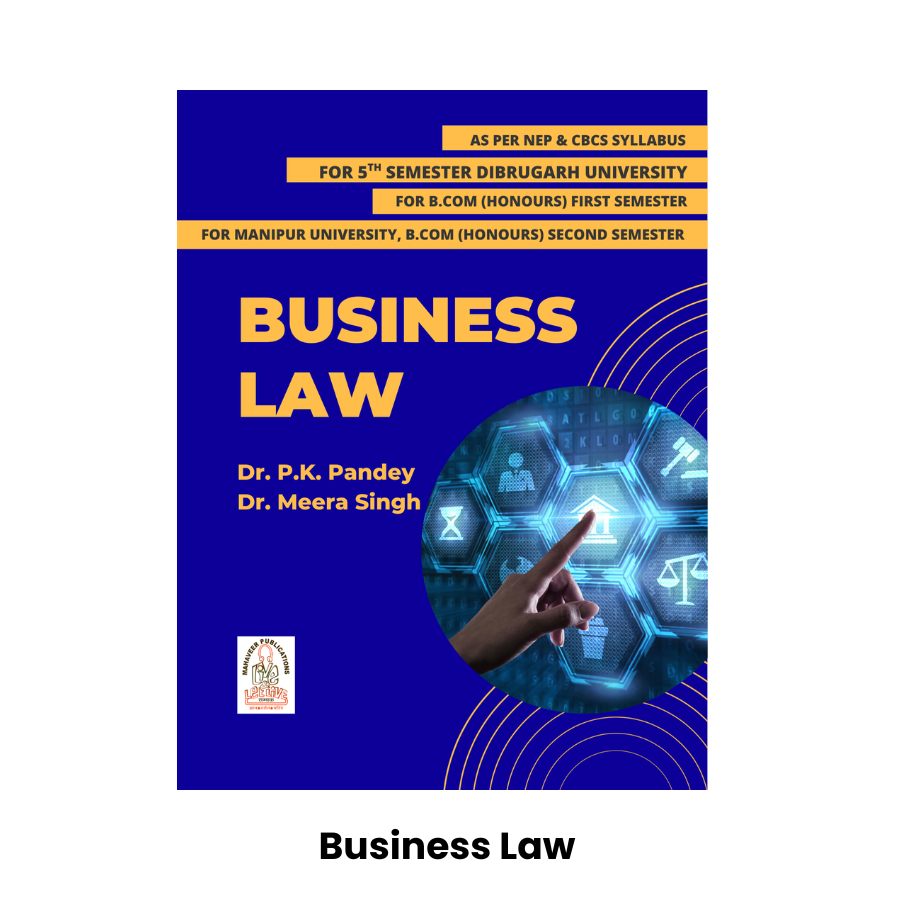
Business Law
Inhouse product
-
 Rs212.50
Rs250.00 -
Rs290.00
Rs310.00 -
Rs430.00
Rs450.00 -
Rs288.00
Rs300.00 -
Rs235.00
Rs250.00 -
Rs300.00
Rs320.00




Reviews & Ratings
Business Law, authored by Dr. P.K. Pandey and Dr. Meera Singh, is a comprehensive and student-friendly textbook designed strictly according to the CBCS syllabus prescribed for B.Com Honours First Semester of Nagaland University and Rajiv Gandhi University (Arunachal Pradesh). The book introduces learners to the essential legal framework governing business activities in India and equips them with conceptual clarity as well as practical understanding of commercial laws.
Written in simple, precise and exam-oriented language, this textbook covers all major branches of Business Law that a commerce student must learn at the undergraduate level. Complex legal concepts are explained through real-life examples, illustrations and case-based understanding, helping students relate theory to actual business situations.
1. Contract: Concept, Meaning, Essentials & Types (Pages 15–31)
This chapter introduces the foundation of Business Law through the general principles of contracts.
Topics Covered
-
Meaning, concept and definition of contract
-
Structure of the Indian Contract Act, 1872
-
Nature and essentials of a valid contract
-
Standard form contracts – meaning, need & importance
-
Types of contracts:
-
Valid, void, voidable
-
Express & implied
-
Quasi contracts
-
Unilateral & bilateral contracts
-
Chapter Round-Up included.
2. Offer and Acceptance (Pages 32–41)
A detailed study of how agreements are formed.
Topics Covered
-
Meaning & essentials of a valid offer
-
Kinds of offer
-
Invitation to offer
-
Communication of offer
-
Revocation of offer
-
Introduction to acceptance
-
Essentials & communication of acceptance
-
Revocation of acceptance
-
Offer & acceptance through telephone
Chapter Round-Up included.
3. Consideration (Pages 42–46)
-
Meaning & definition
-
Legal rules regarding consideration
-
Exceptions to the rule “No consideration, no contract”
4. Contractual Capacity (Pages 47–53)
-
Competency of parties
-
Contracts by minors
-
Persons of unsound mind
-
Contracts disqualified by law
5. Free Consent (Pages 54–70)
-
Meaning and importance
-
Coercion
-
Undue influence
-
Fraud and misrepresentation
-
Mistake
Chapter Round-Up included.
6. Legality of Object & Consideration (Pages 71–77)
-
Unlawful object
-
Void agreements
-
Distinction between unlawful and illegal agreements
7. Agreements Declared Void (Pages 78–86)
-
Restraint of marriage
-
Restraint of trade
-
Restraint of legal proceedings
-
Uncertain agreements
-
Wagering agreements
8. Contingent Contracts (Pages 87–91)
-
Definition
-
Events collateral to contracts
-
When contingent contracts can be enforced
-
Distinction between contingent and wagering agreements
9. Performance of Contract (Pages 92–107)
-
Meaning & obligations
-
Who must perform?
-
Effect of incomplete performance
-
Performance by third party
-
Attempted performance
-
Rules regarding time, place, manner
-
Appropriation of payment
-
Assignment of contracts
10. Discharge of Contract (Pages 108–118)
-
Performance
-
Agreement or consent
-
Breach
-
Lapse of time
-
Impossibility
-
Operation of law
11. Quasi Contracts (Pages 119–130)
-
Nature & basis
-
Types:
-
Supply of necessaries
-
Payment by interested person
-
Non-gratuitous acts
-
Finder of goods
-
Mistake or coercion
-
12. Breach of Contract: Remedies & Damages (Pages 131–154)
-
Meaning of breach
-
Types of damages:
-
General, special
-
Liquidated & unliquidated
-
-
Remedies:
-
Rescission
-
Injunction
-
Specific performance
-
Quantum meruit
-
PART II: SPECIFIC CONTRACTS
13. Indemnity & Guarantee (Pages 155–169)
-
Essentials
-
Rights and liabilities of indemnifier & indemnity holder
-
Guarantee – features, types
-
Surety’s rights & liabilities
-
Discharge of surety
14. Bailment & Pledge (Pages 170–191)
-
Definition & essentials
-
Duties of bailor & bailee
-
Rights of bailee
-
Termination of bailment
-
Essentials of pledge
-
Rights of pawner & pawnee
-
Distinction: bailment vs pledge vs mortgage
15. Contract of Agency (Pages 192–206)
-
Who is an agent & principal?
-
Creation of agency
-
Rights & duties of agent and principal
-
Termination
PART III: SALE OF GOODS ACT, 1930
16. Formation of Contract of Sale (Pages 207–218)
-
Meaning of sale & agreement to sell
-
Essentials
-
Sale vs agreement to sell
-
Sale vs bailment vs hire purchase
17. Conditions & Warranties (Pages 219–224)
-
Meaning
-
Express & implied conditions
-
Implied warranties
-
Distinction between conditions & warranties
18. Transfer of Property in Goods (Pages 225–238)
-
Specific, ascertained & unascertained goods
-
Passing of property
-
Delivery of goods
19. Performance of Contract of Sale (Pages 239–246)
-
Rules regarding delivery
-
Payment rules
-
Delivery by installments
20. Rights of Unpaid Seller (Pages 247–272)
-
Rights against goods
-
Rights against buyer
-
Suit for damages & price
PART IV: LAW RELATING TO PARTNERSHIP
21. Indian Partnership Act (Pages 247–272)
-
Definition & essentials of partnership
-
Types & nature
-
Partnership vs company
-
Partnership vs co-ownership
-
Rights, duties & liabilities of partners
-
Dissolution of firm
22. Limited Liability Partnership Act, 2008 (Pages 273–285)
-
Meaning, features
-
Advantages & disadvantages
-
LLP vs partnership vs company
-
Incorporation, rights & liabilities
-
Winding up
PART V: NEGOTIABLE INSTRUMENTS ACT, 1881
23. Negotiable Instruments: Meaning & Types (Pages 286–301)
-
Definition
-
Characteristics
-
Types
-
Cheque vs bill of exchange
24. Holder & Holder in Due Course (Pages 302–309)
-
Privileges
-
Payment in due course
25. Negotiation & Liability (Pages 310–318)
-
Negotiation
-
Endorsement
-
Presentment
-
Liability of parties
26. Crossing of Cheques & Presumptions (Pages 319–335)
-
General and special crossing
-
Payment of crossed cheque
-
Noting & protest
-
Presumptions of law
27. Dishonour (Bouncing) of Cheques (Pages 336–350)
-
Section 138 overview
-
Trial procedure
-
Penalties
-
Compounding of offence
PART VI: COMPETITION ACT, 2002 (Pages 351–357)
PART VII: FOREIGN EXCHANGE MANAGEMENT ACT, 2000 (Pages 358–379)
Frequently Bought Products
Product Queries (0)
Login Or Registerto submit your questions to seller
Other Questions
No none asked to seller yet
-
Rs212.50
Rs250.00 -
Rs290.00
Rs310.00 -
Rs430.00
Rs450.00 -
Rs288.00
Rs300.00 -
Rs235.00
Rs250.00 -
Rs300.00
Rs320.00
Mahaveer Publications