







E- Commerce
Inhouse product
-
 Rs212.50
Rs250.00 -
Rs290.00
Rs310.00 -
Rs430.00
Rs450.00 -
Rs288.00
Rs300.00 -
Rs235.00
Rs250.00 -
Rs300.00
Rs320.00




Reviews & Ratings
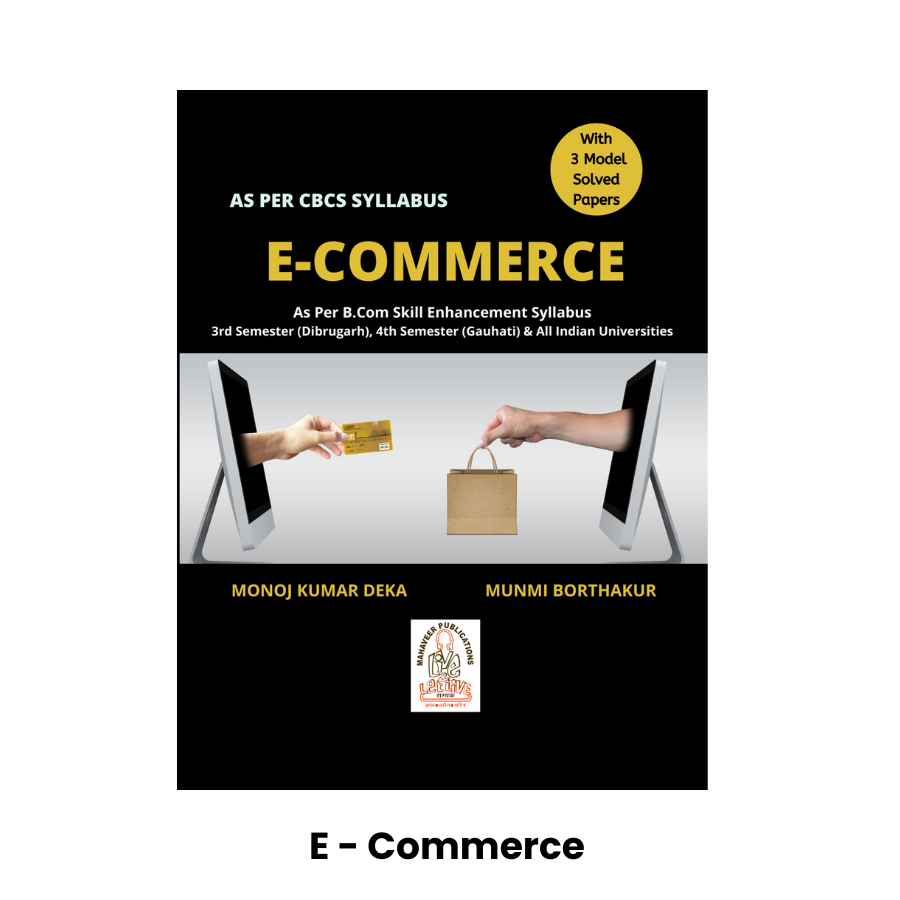
E-Commerce, authored by Monoj Kumar Deka and Munmi Borthakur, is a comprehensive and student-friendly textbook developed strictly according to the CBCS Skill Enhancement Course (SEC) syllabus for B.Com 3rd Semester (Dibrugarh University) and B.Com 4th Semester (Gauhati University). The book is also widely relevant for B.Com programs across all Indian universities that offer E-Commerce as a skill-based elective.
This book provides a practical, easy-to-understand and structured introduction to the world of online business. With the rapid shift of commercial activities to the digital space, understanding E-Commerce has become essential for commerce students, entrepreneurs and future business professionals. The textbook combines conceptual frameworks with real-world applications, making learning engaging and industry-oriented.
UNIT 1: INTRODUCTION TO E-COMMERCE (Pages 11–26)
This unit introduces students to the foundations of electronic commerce, its features, advantages, limitations, business models, and the basics of internet technologies essential for online business.
1.0 Objectives
Overview of concepts and skills students should acquire through this unit.
1.1 Introduction
Meaning, evolution and scope of E-commerce; comparison with traditional commerce.
1.2 Features of E-Commerce
Ubiquity, global reach, interactivity, personalization, information density, etc.
1.3 Advantages of E-Commerce
1.3.1 Advantages to Organizations
Expanded markets, reduced costs, automation, improved supply chain.
1.3.2 Advantages to Customers
Convenience, choice, price comparison, 24×7 availability.
1.3.3 Advantages to Society
Better services, online transactions, digital governance.
1.4 Disadvantages of E-Commerce
1.4.1 Technical Disadvantages
Server issues, security risks, internet limitations.
1.4.2 Non-Technical Disadvantages
Lack of trust, privacy concerns, digital divide.
1.5 E-Commerce Business Model
B2B, B2C, C2C, C2B models; evolving digital business models.
1.6 Introduction to World Wide Web & Internet
1.6.1 Evolution of WWW
Timeline and development of internet technologies.
1.6.2 Basic Features
Hyperlinks, multimedia, web pages, browsing.
1.6.3 Role of Internet
Internet as backbone of E-commerce activities.
1.7 Designing, Building & Launching E-Commerce Website
Basic steps, domain registration, hosting, interface design.
1.8 Let Us Revise
Summary of key concepts.
Model Questions
Chapter-based questions for practice.
UNIT 2: SECURITY AND ENCRYPTION (Pages 27–38)
This unit covers the crucial aspects of online security, privacy, threats, and ways of protecting E-commerce systems.
2.0 Objectives
What students will learn about security mechanisms.
2.1 Introduction to E-Commerce Security
Types and importance of E-commerce security.
2.2 Information Privacy
Data privacy principles, protection of customer information.
2.3 E-Commerce Security Dimensions
Integrity, confidentiality, authentication, availability.
2.4 What is E-Commerce Security?
Components and goals of a secure online environment.
2.5 Major Threats to E-Commerce Security
Hacking, phishing, malware, DoS attacks, identity theft.
2.6 Reasons for E-Commerce Security Threats
System vulnerabilities, human errors, technological loopholes.
2.7 Ways to Combat E-Commerce Threats
Security protocols, encryption, firewalls, SSL, digital certificates.
2.8 Let Us Revise
Summary of key concepts.
Model Questions
UNIT 3: IT ACT 2000 AND CYBER CRIMES (Pages 39–57)
This unit discusses the legal framework governing E-commerce in India, along with cyber crimes and digital security legislations.
3.0 Objectives
3.1 Cyber Crime
Types of cyber crimes, cyber fraud, phishing, cyber terrorism.
3.2 Cyber Law
Need for cyber law and legal protection.
3.3 Information Technology Act, 2000
Key provisions, electronic records, penalties.
3.4 Digital Signature
Meaning, working, legal recognition.
3.5 Electronic Governance
E-governance initiatives and online public services.
3.6 Attribution, Acknowledgement & Dispatch of Electronic Records
Legal recognition of electronic documents.
3.6.1 Attribution of Electronic Records
3.6.2 Acknowledgement of Receipt
3.6.3 Time & Place of Dispatch/Receipt of Electronic Records
3.7 Regulation of Certifying Authorities
Role of CA and digital certificate system.
3.8 Digital Signature Certificates
3.9 Duties of Subscribers
3.10 Penalties & Adjudication
3.11 Cyber Regulations Appellate Tribunal
3.12 Offences
Model Questions
UNIT 4: E-PAYMENT SYSTEM (Pages 58–67)
This unit explains different payment methods, digital signatures, online banking and the working of payment gateways.
4.0 Objectives
4.1 Introduction
Significance of electronic payments.
4.2 Traditional Payment Methods
Cash, cheque, demand draft.
4.3 Electronic Payment Methods
Cards, UPI, digital wallets, net banking.
4.4 Digital Signature
4.4.1 How Digital Signatures Work
4.4.2 Applications of Digital Signatures
4.4.3 Digital Signature in India
4.5 Payment Gateway
Verification, authorization, settlement.
4.6 Concept of Online Banking
4.6.1 Features
4.6.2 Types of Fund Transfers (NEFT, RTGS, IMPS)
4.6.3 Advantages
4.6.4 Disadvantages
4.7 Let Us Revise
Model Questions
UNIT 5: ONLINE BUSINESS TRANSACTIONS (Pages 68–90)
5.0 Objectives
5.1 Introduction
5.2 Advantages & Disadvantages of Online Transactions
Speed, convenience vs security risks, dependency on technology.
5.3 E-Commerce Applications
Retail, banking, tourism, healthcare, education, government.
5.4 Online Services
5.5 Online Auctions
Forward auctions, reverse auctions, bidding systems.
5.6 Online Portals
Portals for business, education, newspapers, services.
5.7 Online Learning
5.8 Online Publishing & Entertainment
5.9 Online Shopping
Ordering systems, supply chain, customer experience.
UNIT 6: BASIC HTML FOR WEB PAGE CREATION (Pages 91–126)
This unit gives practical exposure to website creation using basic HTML.
6.1 Introduction to HTML
6.2 HTML Tags & Structures
Heading tags, paragraph tags, bold/italic, line breaks, HR.
6.3 Lists
Ordered, unordered, definition lists.
6.4 Images & Hyperlinks
Embedding images, absolute vs relative links.
6.5 Tables
Table tags, captions, attributes.
6.6 Basic Form Creation
Input fields, submit/reset buttons.
6.7 Frames
6.8 Cascading Style Sheets (CSS)
6.8.1 Advantages
6.8.2 Disadvantages
6.8.3 Types of CSS (Inline, Internal, External)
6.8.4 CSS Syntax
6.8.5 CSS Box Model
6.9 Let Us Revise
Model Question Papers I, II, III
Frequently Bought Products
Product Queries (0)
Login Or Registerto submit your questions to seller
Other Questions
No none asked to seller yet
-
Rs212.50
Rs250.00 -
Rs290.00
Rs310.00 -
Rs430.00
Rs450.00 -
Rs288.00
Rs300.00 -
Rs235.00
Rs250.00 -
Rs300.00
Rs320.00
Mahaveer Publications