








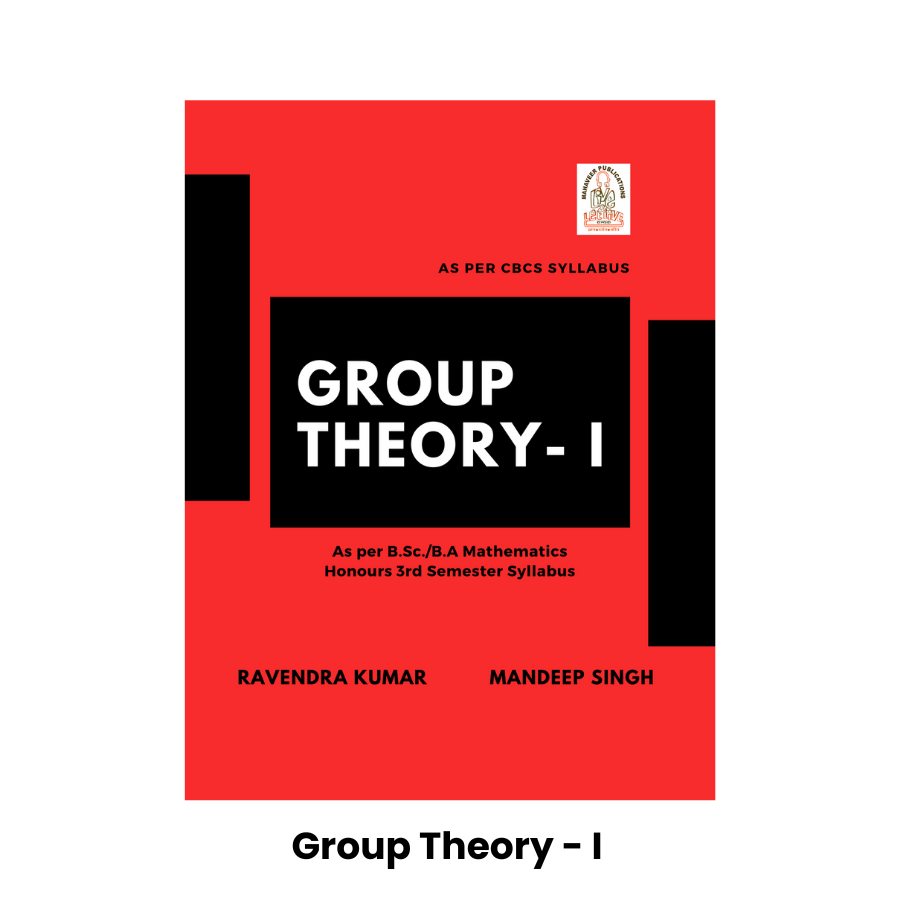
Group Theory - I
Inhouse product
-
 Rs212.50
Rs250.00 -
Rs290.00
Rs310.00 -
Rs430.00
Rs450.00 -
Rs288.00
Rs300.00 -
Rs235.00
Rs250.00 -
Rs300.00
Rs320.00



Reviews & Ratings
Group Theory–I by Ravendra Kumar and Mandeep Singh is a well-structured textbook designed according to the CBCS syllabus of B.Sc./B.A. Mathematics Honours 3rd Semester. It provides a clear and rigorous introduction to the fundamental concepts of abstract algebra, with a special focus on groups and their applications.
The book covers essential topics such as binary operations, group axioms, subgroups, cyclic groups, permutation and symmetric groups, cosets, Lagrange’s theorem, homomorphisms, isomorphisms, and normal subgroups. Each chapter includes theory explained in simple language, well-chosen examples, solved problems, and exercises that help learners strengthen conceptual understanding.
The text is ideal for undergraduate students pursuing mathematics honours and provides a solid foundation for advanced studies in algebra and mathematical structures. Published by Mahaveer Publications, this book serves as a dependable guide for both classroom learning and competitive examinations.
CHAPTER 1: SETS (Pages 7–58)
1.1 Definition
1.2 Kinds and Notation of Set
1.3 Venn Diagram
1.4 Application of Sets
1.5 Ordered Pair
1.6 Cartesian Product of Sets
1.7 Symmetric Difference
1.8 Relation
1.9 Domain and Range
1.10 Symmetric Relation
1.11 Anti-symmetric Relation
1.12 Equivalence Relation
1.13 Equivalence Classes or Equivalence Sets
1.14 Properties of Equivalence Classes
1.15 Partition of Set
1.16 Quotient Set
1.17 Mapping or Function
1.18 Range and Domain of a Function
1.19 Types of Mapping (Function)
CHAPTER 2: GROUPS (Pages 59–123)
2.1 Algebraic Structure
2.2 Group (Definition)
2.3 Abelian Group
2.4 Finite and Infinite Groups
2.5 Some Properties of Groups
2.6 Residue Classes for Set I of Integers
2.7 Some Special Examples of Groups
2.8 Integral Power of an Element of a Group
2.9 Order of an Element of a Group
2.10 Some Properties of Order
Permutations & Symmetric Groups
-
2.11 Permutation
-
2.12 Representation of Permutations
-
2.13 Symmetric Set of Permutations (Sn)
-
2.14 Product of Permutations
-
2.15 Inverse of Permutation
-
2.16 Cyclic Permutation
-
2.17 Even and Odd Permutations
-
2.18 Alternating Set (An)
CHAPTER 3: HOMOMORPHISM AND ISOMORPHISM (Pages 124–144)
3.1 Definition
3.2 Kernel of Homomorphism
CHAPTER 4: SUBGROUPS (Pages 145–179)
4.1 Definition
4.2 Some Theorems of Subgroups
4.3 Some Examples on Subgroups
4.4 Cosets (Definition)
4.5 Lagrange’s Theorem
4.7 Cyclic Group (Definition)
CHAPTER 5: NORMAL SUBGROUPS (Pages 180–213)
5.1 Definition
5.2 Centralizer of a Subset of a Group
5.3 Class Equation
5.4 Quotient Group
5.5 Homomorphism and Isomorphism (Review)
5.6 External Direct Product
5.7 Cauchy’s Theorem for Abelian Groups
Frequently Bought Products

PDE & Systems Of ODE
Product Queries (0)
Login Or Registerto submit your questions to seller
Other Questions
No none asked to seller yet
-
Rs212.50
Rs250.00 -
Rs290.00
Rs310.00 -
Rs430.00
Rs450.00 -
Rs288.00
Rs300.00 -
Rs235.00
Rs250.00 -
Rs300.00
Rs320.00
Mahaveer Publications