








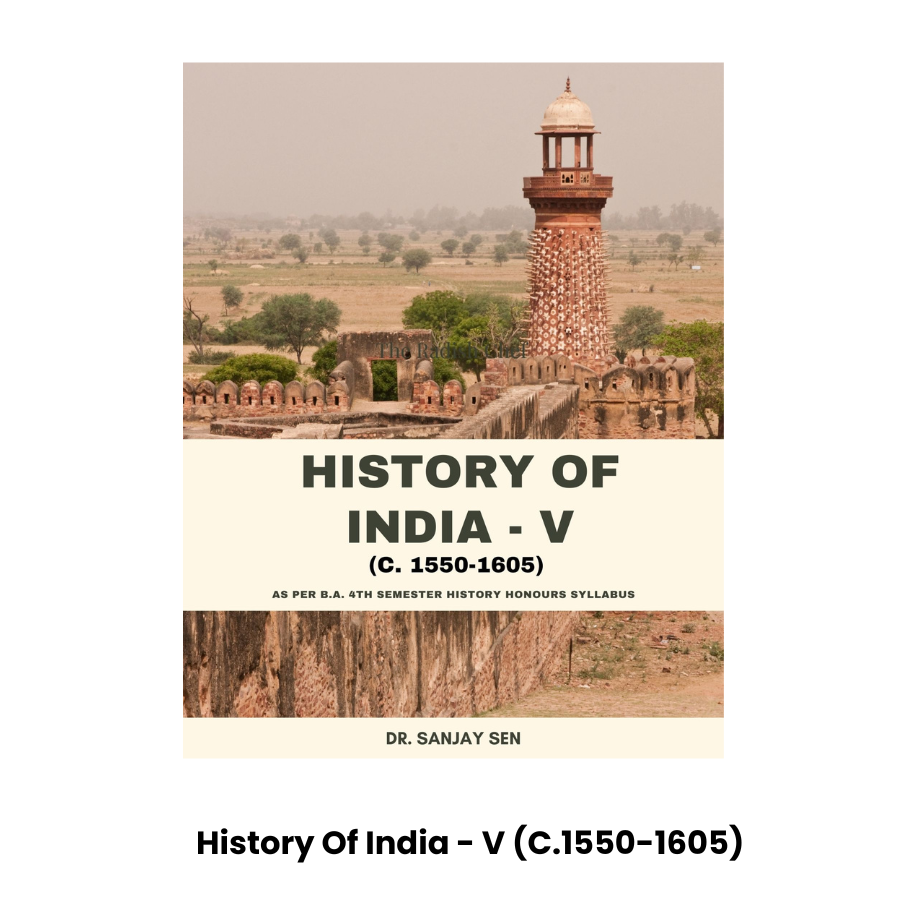
History Of India - V (C.1550-1605)
Inhouse product
-
 Rs212.50
Rs250.00 -
Rs290.00
Rs310.00 -
Rs430.00
Rs450.00 -
Rs288.00
Rs300.00 -
Rs235.00
Rs250.00 -
Rs300.00
Rs320.00




Reviews & Ratings
History of India – V (c.1550–1605) by Dr. Sanjay Sen provides a comprehensive and analytical study of one of the most formative periods in Indian history—the consolidation and expansion of the Mughal Empire, particularly under the reign of Emperor Akbar. Written strictly according to the FYUGP NEP/CBCS syllabus for BA 4th Semester History Honours, this textbook offers clear, evidence-based insights into the political, administrative, social, economic, and cultural developments of mid-16th to early-17th century India.
The book begins with the political scenario of India around 1550 and traces the early struggles of the Mughal state, leading to its transformation into a powerful and centralized imperial structure. Special emphasis is laid on Akbar’s role as an empire-builder, highlighting his military conquests, diplomacy with the Rajputs, and experiments in governance that shaped the Mughal ideology of kingship.
Students are introduced to Akbar’s administrative innovations, including the Mansabdari system, revenue policies of Todar Mal, and mechanisms of provincial governance, which collectively strengthened the empire. The volume also examines Akbar’s religious policies, his engagement with diverse communities, and intellectual initiatives such as Sulh-i Kul, the Ibadat Khana debates, and the synthesis attempted through Din-i Ilahi.
The book further explores the social and economic structure of Mughal India, the growth of trade and urban centers, agrarian relations, as well as the flourishing of art, architecture, literature, and culture during Akbar’s reign—a period often considered the “golden age” of Mughal history.
UNIT – I: Sources and Historiography (Pages 9–46)
This unit introduces students to the major literary, archival, and historiographical sources of the Mughal period. It covers:
-
Persian chronicles and court literature as primary sources.
-
Vernacular traditions such as Bakhar and Buranji, with emphasis on their value, origin, and historical methodology.
-
Comparative study of different kinds of history writing, including regional, administrative, and socio-cultural histories.
-
Modern historiographical interpretations, enabling learners to critically evaluate how knowledge of the Mughal era has evolved over time.
This unit strengthens the students’ foundation in historical research and interpretation.
UNIT – II: Establishment of Mughal Rule (Pages 47–82)
This unit traces the rise of the Mughal Empire beginning with Babur’s campaigns and the political landscape of India on the eve of his invasion. Major themes include:
-
Military technology, use of firearms, and the superior organization that facilitated Mughal victories.
-
Humayun’s struggle for empire, including his setbacks, exile, and restoration.
-
Sher Shah Suri’s administrative and revenue reforms, which deeply influenced Mughal governance.
-
The process of conquest and extension of empire that laid the foundation for Mughal consolidation.
Students develop an understanding of early Mughal state-building and the challenges faced by the empire before Akbar.
UNIT – III: Consolidation of Mughal Rule under Akbar (Pages 83–145)
This unit offers an in-depth exploration of Akbar’s policies and the administrative machinery that transformed the Mughal Empire into a powerful and centralized state.
Key areas include:
-
Expansion of Mughal power and Akbar’s strategies of political integration.
-
Mughal–Rajput diplomacy, alliances, and their long-term implications.
-
Akbar’s emergence as a national monarch known for his inclusiveness and administrative innovation.
-
Development of administrative institutions involving:
-
Zabt system
-
Mansabdari system
-
Jagirdari system
-
Madad-i-Maash grants
-
-
Study of revolts and resistance, explaining how Akbar managed internal challenges.
This unit highlights Akbar’s legacy as an empire-builder and reformer.
UNIT – IV: Society and Economy (Pages 146–225)
This unit examines the socio-economic fabric of Mughal India during the period 1550–1605.
Topics include:
-
Social structure, caste and community relations, and rural-urban distinctions.
-
Economy, including land rights, agrarian relations, zamindars, peasants, and rural tensions.
-
Agricultural expansion, methods of cultivation and irrigation, crop patterns, and productivity.
-
Internal trade routes and overseas commerce, showing the growing integration of Indian markets.
Students gain a clear picture of everyday life, agrarian structure, and economic activities of the Mughal age.
UNIT – V: Political and Religious Ideals (Pages 226–305)
This unit focuses on the ideological and religious foundations of Mughal kingship, particularly under Akbar.
Major themes include:
-
Divine theory of kingship and political thought.
-
Akbar’s policies of religious tolerance, the philosophy of Sulh-i Kul, and debates in the Ibadat Khana.
-
The creation and significance of Din-i Ilahi (Tauhid-i-Ilahi).
-
Sufi mystical contributions, intellectual debates, and pressures from orthodox Ulema.
Frequently Bought Products

Historiography
Product Queries (0)
Login Or Registerto submit your questions to seller
Other Questions
No none asked to seller yet
-
Rs212.50
Rs250.00 -
Rs290.00
Rs310.00 -
Rs430.00
Rs450.00 -
Rs288.00
Rs300.00 -
Rs235.00
Rs250.00 -
Rs300.00
Rs320.00
Mahaveer Publications