







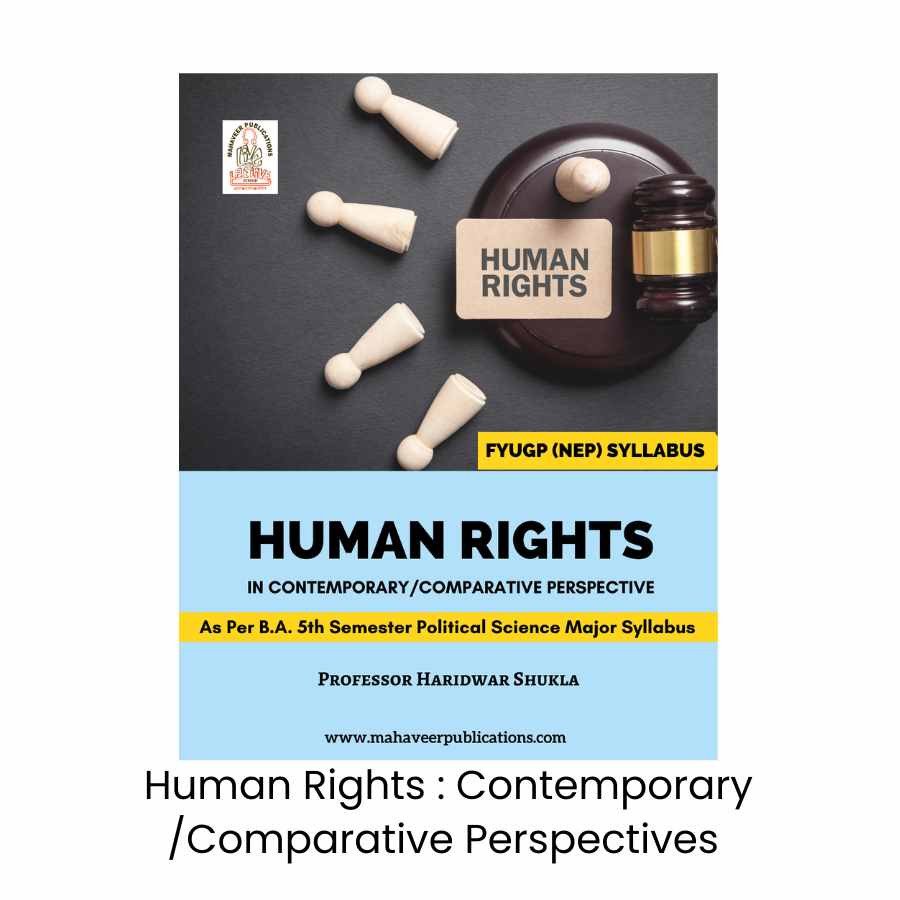
Human Rights In Contemporary / Comparative Perspective
Inhouse product
-
 Rs212.50
Rs250.00 -
Rs290.00
Rs310.00 -
Rs430.00
Rs450.00 -
Rs288.00
Rs300.00 -
Rs235.00
Rs250.00 -
Rs300.00
Rs320.00



Reviews & Ratings
Human Rights in Comparative / Contemporary Perspectives is a comprehensive and analytical textbook designed for Political Science Major students as per the semester-based syllabi of Dibrugarh University, Nagaland University, Manipur University, Gauhati University, Rabindranath Tagore University, Bodoland University, and other Indian universities. The book adopts a comparative and contemporary approach to the study of human rights, enabling learners to understand both the theoretical foundations and real-world applications of human rights in diverse national and international contexts.
The text begins with a systematic exploration of human rights theory and institutionalism, introducing students to the meaning, nature, characteristics, and importance of human rights. It critically examines major philosophical foundations such as utilitarianism, natural rights, positivism, and Asian values, while also tracing the historical growth and evolution of human rights.
Subsequent chapters focus on international institutional arrangements, with detailed discussions on the United Nations, the Universal Declaration of Human Rights (UDHR), International Covenants (ICCPR and ICESCR), optional protocols, and the different generations of human rights. The book further offers a comparative analysis of constitutional rights, particularly examining the human rights frameworks of India and South Africa.
Special emphasis is placed on contemporary human rights issues, including torture, surveillance and censorship, terrorism, minority insecurity, and structural violence related to caste, race, and gender. The concluding chapters address critical themes such as gender-based violence, Adivasi and Aboriginal land rights, and comparative perspectives between India and Australia, making the content socially relevant and academically rigorous.
Written in a clear, descriptive, and examination-oriented style, the book includes chapter-end questions to aid understanding and assessment preparation. This work serves as an essential resource for undergraduate students seeking a balanced understanding of human rights from theoretical, institutional, constitutional, and issue-based perspectives within the contemporary global and Indian framework.
Frequently Bought Products
Introduction to Comparative Government and Politics

Prespectives On International Relations & world History
Product Queries (0)
Login Or Registerto submit your questions to seller
Other Questions
No none asked to seller yet
-
Rs212.50
Rs250.00 -
Rs290.00
Rs310.00 -
Rs430.00
Rs450.00 -
Rs288.00
Rs300.00 -
Rs235.00
Rs250.00 -
Rs300.00
Rs320.00
Mahaveer Publications