








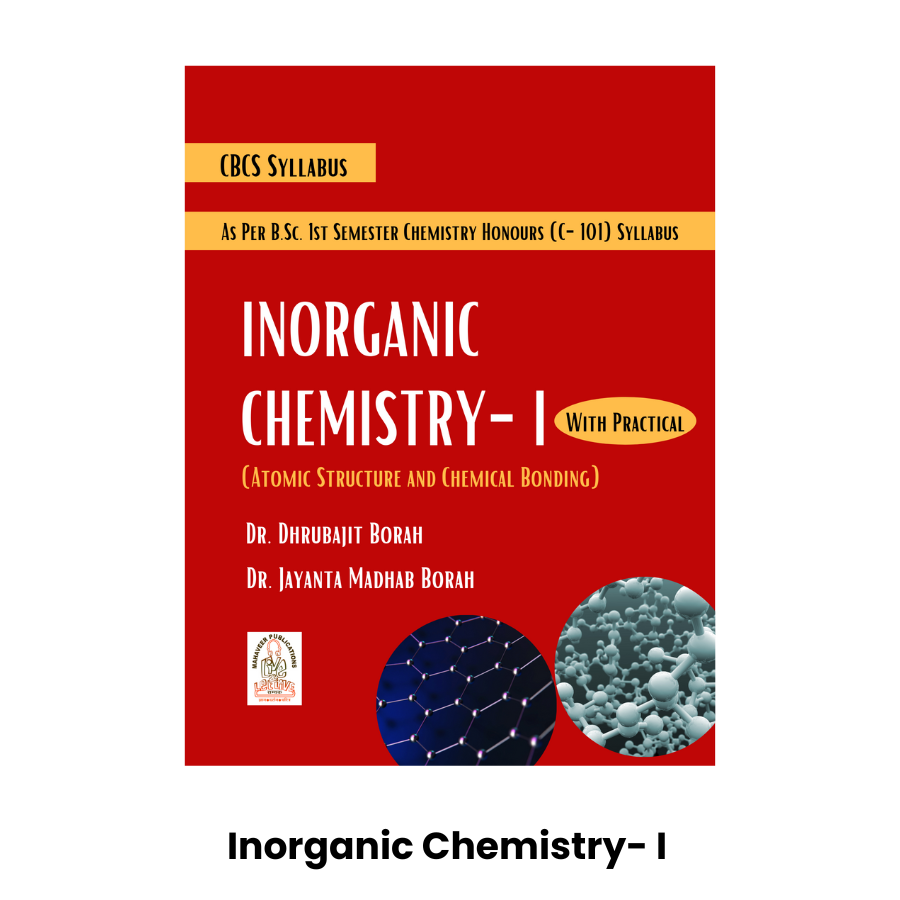
Inorganic Chemistry - I With Practical
Inhouse product
-
 Rs212.50
Rs250.00 -
Rs290.00
Rs310.00 -
Rs430.00
Rs450.00 -
Rs288.00
Rs300.00 -
Rs235.00
Rs250.00 -
Rs300.00
Rs320.00


Reviews & Ratings
This textbook is tailored specifically for the B.Sc. Honours Chemistry – 1st Semester under the CBCS (Choice-Based Credit System) and provides a strong foundation in inorganic chemistry with two major thematic blocks: atomic structure and chemical bonding, plus practical work. According to the publisher, the text is “a comprehensive textbook designed as per the CBCS syllabus for B.Sc. Chemistry Honours.”
Syllabus-aligned: The content aligns with the CBCS honour’s curriculum for 1st semester undergraduate chemistry, thereby making it suitable for colleges and universities following that pattern. mahaveerpublications.com+1
Theory + Practical Integration: While the focus is on atomic structure and chemical bonding, the inclusion of “With Practical” indicates the book includes practical exercises, laboratory work, or experimental components, making it useful for bridging theory and laboratory understanding.
Clear conceptual development: The atomic structure section introduces fundamental aspects of atoms—electronic configuration, quantum numbers, atomic models—and then the chemical bonding section develops topics such as ionic, covalent, metallic bonding, bond theories (valence-bond, molecular orbital), resonance, hybridisation, etc. (while the exact chapter breakdown isn’t shown here, this is the typical structure.)
Undergraduate-friendly: The explanatory style is suitable for first-year undergraduate students, aiming to provide clarity on important inorganic chemistry topics so they can follow lectures, solve problems, and perform lab work effectively.
Publisher’s academic quality: Mahaveer Publications has a track record of publishing undergraduate textbooks across science disciplines, which suggests good production quality, formatting, and alignment with academic needs.
Unit 1 — Atomic Structure (Weeks 1–4)
Week 1
-
Lecture 1: Historical models of the atom — Dalton, Thomson, Rutherford.
-
Lecture 2: Bohr model — hydrogen spectrum, limitations, scope.
Week 2
-
Lecture 3: Introduction to quantum mechanics — de Broglie, Heisenberg uncertainty.
-
Lecture 4: Schrödinger equation (qualitative), wave functions, orbitals.
Week 3
-
Lecture 5: Quantum numbers (n, l, m, s), orbital shapes and node structure.
-
Lecture 6: Pauli exclusion principle, Hund’s rule, electronic configurations (atoms and ions).
Week 4
-
Lecture 7: Atomic spectra and term symbols (introductory).
-
Lecture 8: Numerical problem session — electronic configuration, orbital energies.
Unit 2 — Periodicity of Elements (Weeks 5–6)
Week 5
-
Lecture 9: Modern periodic law and periodic table layout; s-, p-, d- block overview.
-
Lecture 10: Atomic and ionic radii — trends across periods and down groups.
Week 6
-
Lecture 11: Ionisation energy and electron affinity — factors influencing trends.
-
Lecture 12: Electronegativity, oxidation states, periodicity and chemical behaviour.
Unit 3 — Chemical Bonding (Weeks 7–11)
Week 7
-
Lecture 13: Ionic bonding — lattice energy, Born-Haber cycle (basic treatment).
-
Lecture 14: Covalent bonding — Lewis structures, formal charge, resonance.
Week 8
-
Lecture 15: VSEPR theory — molecular geometry and polarity.
-
Lecture 16: Hybridisation — sp, sp2, sp3, examples and geometry.
Week 9
-
Lecture 17: Valence bond theory (VBT) — concepts and simple examples.
-
Lecture 18: Molecular orbital theory (MOT) — diatomic molecules: H2, He2, O2, N2.
Week 10
-
Lecture 19: Bond order, bond length, bond energy from MO diagrams.
-
Lecture 20: MO theory for heteronuclear diatomics (qualitative), interplay with electronegativity.
Week 11
-
Lecture 21: Metallic bonding and band concept (introductory).
-
Lecture 22: Intermolecular forces & their relation to bonding (dipole, dispersion, H-bonding).
Unit 4 — Oxidation and Reduction (Weeks 12–13)
Week 12
-
Lecture 23: Oxidation states — rules, assigning oxidation numbers.
-
Lecture 24: Redox reactions — basic balancing by inspection.
Week 13
-
Lecture 25: Balancing redox equations using half-reaction method (acidic/basic media).
-
Lecture 26: Electrochemical series (intro), simple electrochemical cells (qualitative).
Revision, Tests & Advanced Topics (Weeks 14–16)
Week 14
-
Lecture 27: Problem solving session — selected numerical & conceptual problems.
-
Lecture 28: Short test (unit 1–3).
Week 15
-
Lecture 29: Advanced or optional topics (e.g., qualitative inorganic analysis intro, ligand field basics).
-
Lecture 30: Preparatory session for practical exam / viva.
Week 16
-
Lecture 31: Final theory revision.
-
Lecture 32: Final theory exam / evaluation.
Practical syllabus (16 sessions suggested)
Each practical session 2–3 hours. Emphasise safety, notebook practice, observation, and analysis.
Practical 1: Laboratory safety, making up solutions, calibration of volumetric glassware (pipette, burette).
Practical 2: Determination of concentration by simple titration (acid–base titration).
Practical 3: Qualitative test: identification of common cations (e.g., Na⁺, K⁺, Ca²⁺, Cu²⁺) — basic demonstrations.
Practical 4: Qualitative test: identification of common anions (Cl⁻, SO₄²⁻, NO₃⁻) — observation & confirmation tests.
Practical 5: Preparation of an inorganic salt (e.g., copper sulfate) and crystallisation.
Practical 6: Estimation of iron (colorimetric/titrimetric; basic).
Practical 7: Determination of percentage composition (simple gravimetric experiment).
Practical 8: Redox titration (e.g., KMnO₄ titration of oxalic acid or Fe²⁺).
Practical 9: Study of pH effect and ionic strength on reaction rates (demonstration).
Practical 10: Conductivity measurements and relation to electrolytic nature.
Practical 11: Flame tests and use of spot tests for metal ions.
Practical 12: Simple qualitative inorganic analysis of a mixture (guided).
Practical 13: Preparation of molar solutions and serial dilutions for spectroscopy (demo).
Practical 14: Recording and interpreting simple MO sketches for diatomic molecules (class exercise).
Practical 15: Practical revision and mock viva.
Practical 16: Practical exam (perform and viva).
(Adjust experiments to facility and safety rules — swap or omit hazardous experiments as needed.)
Assessment blueprint
-
Theory:
-
Midterm test / Unit tests: 20%
-
Assignments / Tutorials: 10%
-
Final theory exam: 50%
-
-
Practical:
-
Lab performance + notebook: 10%
-
Practical exam + viva: 10%
-
Frequently Bought Products

Organic Chemistry II Nep
Fuel Chemistry
Product Queries (0)
Login Or Registerto submit your questions to seller
Other Questions
No none asked to seller yet
-
Rs212.50
Rs250.00 -
Rs290.00
Rs310.00 -
Rs430.00
Rs450.00 -
Rs288.00
Rs300.00 -
Rs235.00
Rs250.00 -
Rs300.00
Rs320.00
Mahaveer Publications