








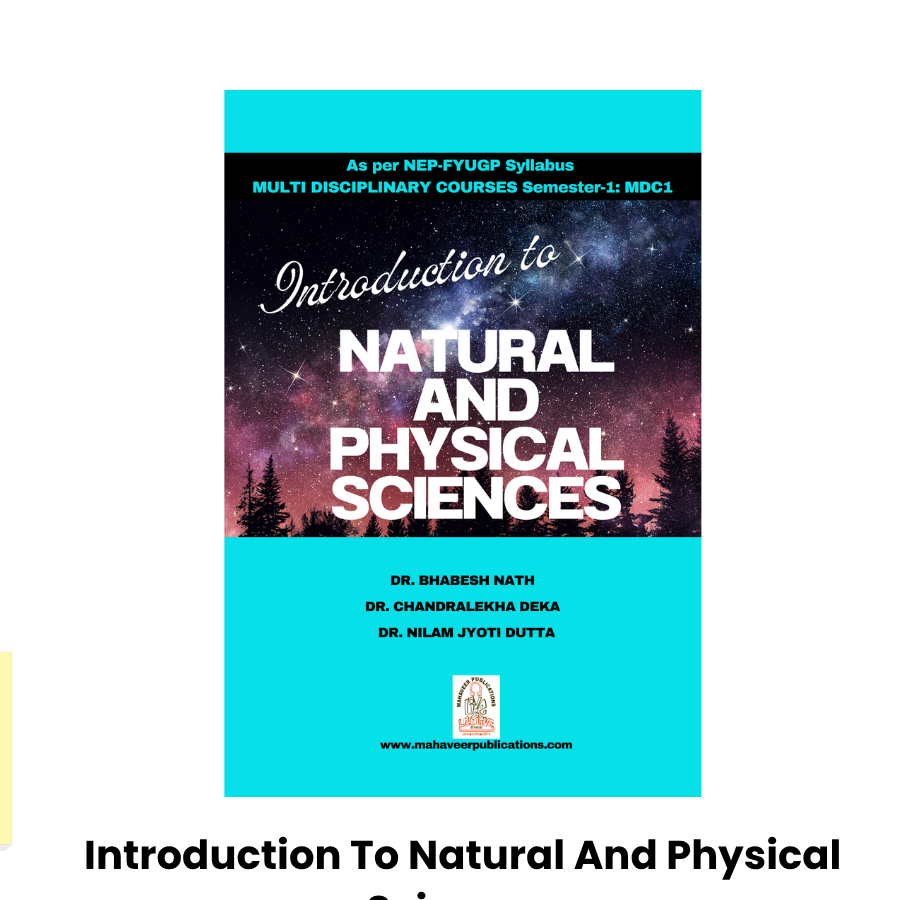
Introduction To Natural And Physical Sciences
Inhouse product
-
 Rs212.50
Rs250.00 -
Rs290.00
Rs310.00 -
Rs430.00
Rs450.00 -
Rs288.00
Rs300.00 -
Rs235.00
Rs250.00 -
Rs300.00
Rs320.00





Reviews & Ratings
Introduction to Natural and Physical Sciences is a foundational multidisciplinary textbook designed in accordance with the National Education Policy (NEP)–FYUGP syllabus for Semester 1 undergraduate students across all disciplines.
Authored by Dr. Bhabesh Nath, Dr. Chandralekha Deka, and Dr. Nilam Jyoti Dutta, this book introduces learners to the basic principles of natural and physical sciences, providing an integrated understanding of the physical world, biological systems, and environmental processes.
The content explores key themes such as the origin and structure of the universe, atomic and molecular organization, energy and matter interactions, life processes, evolution, and ecological balance, linking concepts from Physics, Chemistry, Biology, and Environmental Science in a unified framework.
Written in a clear, engaging, and interdisciplinary manner, the book helps students develop scientific literacy, analytical thinking, and appreciation of natural phenomena, aligning perfectly with the NEP’s goal of holistic and multidisciplinary education.
Key Features:
-
Based on FYUGP–NEP syllabus for multidisciplinary foundation courses.
-
Integrates concepts from Physics, Chemistry, and Biology in a simple and cohesive way.
-
Includes illustrations, real-life examples, and review questions for better understanding.
-
Encourages critical and environmental awareness through applied science perspectives.
-
Ideal for students of all disciplines in their first semester of undergraduate studies.
-
Authored by reputed academicians from leading universities of Assam.
-
Published by Mahaveer Publications, known for quality academic resources.
Unit 1: Structure and Constituents of the Material World
-
Atoms: The Building Blocks of Matter
-
Discovery of Atoms
-
John Dalton’s Atomic Theory (1803)
-
Discovery of Subatomic Particles and Atomic Models
-
-
Atomic Structure
-
Isotopes, Isobars, and Isotones
-
-
The Periodic Table and Its Modern Form
-
Alkali Metals (Group 1)
-
Alkaline Earth Metals (Group 2)
-
Transition Metals (Groups 3–12)
-
Halogens (Group 17)
-
Noble Gases (Group 18)
-
-
Significance and Applications of the Periodic Table
-
Molecules and Ions
-
Molecular Shape and Polarity
-
Non-polar Molecules
-
-
Ionic Compounds
-
Crystal Structure and Electric Conductivity
-
Unit 2: Laws of Nature
-
Gas Laws
-
Boyle’s Law, Charles’s Law, Gay Lussac’s Law, Avogadro’s Law
-
-
Kinds of Forces
-
Contact and Non-Contact Forces
-
-
Equilibrium and Balance in Nature
-
Heat and Thermodynamics
-
Nature of Heat, Temperature and Scales, Osmosis
-
Kinetics and Thermodynamic Laws
-
The Laws of Thermodynamics
-
-
Magnetism and Electricity
-
Conductors, Insulators, and Semiconductors
-
Static Electricity
-
Magnetism: North and South Poles, Electromagnets
-
Maxwell’s Equations and Unification of Forces
-
-
Friction, Waves, and Oscillations
-
Types and Applications of Friction
-
Types and Properties of Waves
-
Simple Harmonic Motion (SHM) and its Applications
-
Unit 3: Properties of Matter, States and Strength
-
States of Matter
-
Solids, Liquids, and Gases
-
Characteristics of Each State
-
Phase Transitions and Interconversions (Melting, Freezing, Boiling, Condensation, Evaporation)
-
-
Strength of Materials
-
Elasticity, Compression, and Tensile Strength
-
-
Optical Properties
-
Emission and Absorption of Light
-
Interference and Diffraction
-
Constructive and Destructive Interference
-
-
Polarization and Its Applications
-
Optical Devices, Material Characterization, Remote Sensing, Biomedical and Communication Uses
-
-
Unit 4: Nanomaterials and Smart Materials
-
Nanomaterials
-
Significance and Unique Properties: Surface Area, Quantum Size, Mechanical and Thermal Properties
-
Classification: Nanoparticles, Nanocomposites, Nanoporous Materials, Nanotextured Surfaces
-
Synthesis Methods: Bottom-up and Top-down Approaches, Self-Assembly, Biological Synthesis
-
Applications: Medicine, Industry, Environment, and Technology
-
-
Smart Materials
-
Types of Smart Materials
-
Shape Memory Alloys (SMA)
-
Piezoelectric Materials
-
Thermochromic Materials
-
Photochromic Materials
-
Electrorheological Fluids (ERFs)
-
-
Applications and Future Prospects
-
Unit 5: Sounds and Musical Instruments
-
Nature of Sound Waves and Their Parameters
-
Pitch, Loudness, and Frequency
-
Musical Instruments and Sound Production
-
Significance of Musical Instruments in Human Culture
-
Music as a Universal Language
-
Applications of Sound and Music in Technology and Art
-
Sound Recording and Reproduction
Supplementary Section
-
Some Important Multiple-Choice Questions (MCQs)
-
Possible Questions for Revision and Self-Assessment
Frequently Bought Products

Microbes & Plant Diversity

MECHANICS & PROPERTIES OF MATTER
Product Queries (0)
Login Or Registerto submit your questions to seller
Other Questions
No none asked to seller yet
-
Rs212.50
Rs250.00 -
Rs290.00
Rs310.00 -
Rs430.00
Rs450.00 -
Rs288.00
Rs300.00 -
Rs235.00
Rs250.00 -
Rs300.00
Rs320.00
Mahaveer Publications