








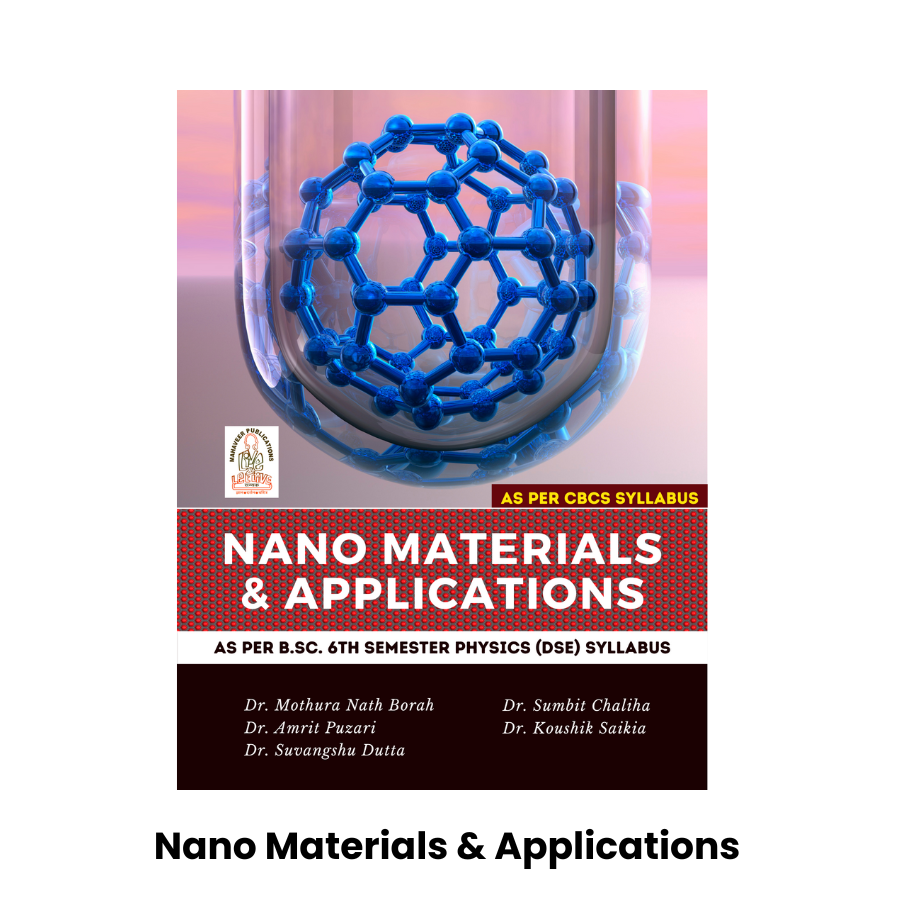
Nano Materials & Applications
Inhouse product
-
 Rs212.50
Rs250.00 -
Rs290.00
Rs310.00 -
Rs430.00
Rs450.00 -
Rs288.00
Rs300.00 -
Rs235.00
Rs250.00 -
Rs300.00
Rs320.00






Reviews & Ratings
Nano Materials & Applications, authored by M.N. Borah, S. Chaliha, A. Puzari, S. Dutta and K. Saikia, is a comprehensive and student-friendly textbook designed in strict accordance with the CBCS curriculum for B.Sc. Physics Honours (DSE), 5th & 6th Semester of Indian universities. Published by Mahaveer Publications, this book provides a clear, conceptual, and application-oriented understanding of nanoscience and nanotechnology.
This textbook introduces students to the fundamental principles, synthesis methods, properties, characterization techniques, and diverse applications of nanomaterials. The content has been developed with a balanced blend of theoretical depth and practical relevance, making it ideal for undergraduate physics learners.
Chapter 1: Nanoscale Systems (Pages 1–12)
This chapter introduces the fundamental ideas of nanoscience and the physics governing materials at the nanoscale. Students learn how matter behaves differently when dimensions shrink to billionths of a meter.
1.1 Length Scales in Physics
Understanding microscopic, mesoscopic, and nanoscopic length scales; comparison between bulk and nanoscale dimensions.
1.2 Nano Structures
Basic forms of nanostructures: nanoparticles, quantum dots, nanowires, thin films, nanotubes, nanoclusters etc.
1.3 Band Structure and their Classification
Energy bands, bandgap changes with size, quantum confinement impact on semiconductors.
1.4 Density of States of Materials at Nanoscale
How DOS changes in 0D, 1D, 2D and 3D systems; discrete states vs continuum.
1.5 Size Effects in Nano Systems
Optical, electrical, thermal and magnetic property variations due to size reduction.
1.6 Quantum Confinement
Origin of confinement, potential wells, particle-in-a-box model, quantum dots.
1.7 Application of Schrödinger Equation
Solving basic nanoscale problems; understanding wavefunctions and energy quantization.
1.8 Quantum Confinement of Carriers in Nanostructures
Carrier mobility, exciton formation, charge transport under confinement.
Chapter 2: Synthesis of Nanostructure Materials (Pages 47–88)
This chapter explains both Top-down and Bottom-up approaches used to fabricate nanoscale materials.
2.1 Top-Down and Bottom-Up Approach
Mechanical reduction vs chemical assembly; relative advantages and limitations.
2.2 Mechanical & Physical Methods
-
2.2.1 Ball Milling – Mechanical alloying and grain size reduction.
-
2.2.2 Photolithography – Pattern formation in micro- and nanoscale devices.
-
2.2.3 Gas Phase Condensation – Generation of nanoparticles via supersaturation.
-
2.2.4–2.2.14 PVD & CVD techniques – Vacuum deposition, thermal evaporation, e-beam evaporation, sputtering, pulsed laser deposition, spray pyrolysis, electro-deposition, sol-gel, chemical vapour deposition, hydrothermal method, colloidal method.
-
2.3.14 MBE Growth of Quantum Dots – Monolayer-controlled epitaxial growth.
This segment provides the theoretical principles and practical relevance of each technique.
Chapter 3: Characterization Techniques (Pages 89–112)
Understanding the structure and properties of nanomaterials requires advanced characterization tools.
3.1 X-ray Diffraction (XRD)
Crystal structures, Bragg’s law, grain size estimation (Scherrer formula).
3.2 Optical Microscopy
Basic imaging and surface studies.
3.3 Scanning Electron Microscopy (SEM)
Surface morphology at nanoscale; electron-matter interactions.
3.4 Transmission Electron Microscopy (TEM)
High-resolution imaging of lattice structures and defects.
3.5 Atomic Force Microscopy (AFM)
Surface topology, force interaction imaging.
3.6 Scanning Tunnelling Microscopy (STM)
Atomic-level imaging based on quantum tunneling.
Chapter 4: Optical Properties of Nanomaterials (Pages 113–126)
This chapter focuses on optical behaviour unique to nanosystems.
4.1 Coulomb Interaction in Nanostructures
Electron–hole interactions; role of Coulomb forces.
4.2 Dielectric Constant in Nanostructures
Size-dependent dielectric changes.
4.3 Charging of Nanostructures
Coulomb blockade and charging energies.
4.4 Quasi-Particles and Excitons
Formation and significance in semiconductors.
4.5 Excitons in Direct and Indirect Bandgap Nanocrystals
Difference in recombination and optical activity.
4.6 Radiative Processes
Absorption, emission, luminescence; photoluminescent behaviour of nanoparticles.
4.7 Optical Properties of Nanostructures & Heterostructures
Band alignment, heterojunction effects, quantum well transitions.
Chapter 5: Electron Transport (Pages 127–134)
5.1 Carrier Transport in Nanostructures
Electron mobility changes due to quantum confinement.
5.2 Coulomb Blockade Effect
Single-electron charging; tunneling junctions.
5.3 Tunneling Conductivity
Quantum tunneling and its applications in nanoscale devices.
5.4 Hopping Conductivity
Transport in disordered or doped nanomaterials.
5.5 Thermionic Emission
Electron emission over barriers in nanostructures.
5.6 Surface Defects and Deep-Level Defects
Impact on electrical performance and stability.
Chapter 6: Applications of Nanomaterials (Pages 135–162)
6.1 Applications of Nanoparticles
Catalysis, drug delivery, coatings, energy storage.
6.2 Applications of Quantum Dots
Optoelectronics, displays, sensors, biological tagging.
6.3 Nanowires & Thin Films for Photovoltaics
Solar cell efficiency enhancement using nanostructures.
6.4 Single Electron Devices
Operation principles and future significance.
6.5 CNT-Based Nanomaterial Devices
Electronics, composites, sensors.
6.6 Quantum Dot Heterostructure Devices
High-efficiency LEDs, lasers, photodetectors.
6.7 Nanoparticles for Optical Switching
All-optical communication devices.
6.8 MEMS and NEMS
Micro and nano electromechanical systems – sensors, actuators, biomedical devices.
6.9 Magnetic Quantum Wells, Dots & Data Storage
Spintronics, high-density storage, magnetic memory.
Frequently Bought Products

Renewable Energy And Energy Harvesting
Product Queries (0)
Login Or Registerto submit your questions to seller
Other Questions
No none asked to seller yet
-
Rs212.50
Rs250.00 -
Rs290.00
Rs310.00 -
Rs430.00
Rs450.00 -
Rs288.00
Rs300.00 -
Rs235.00
Rs250.00 -
Rs300.00
Rs320.00
Mahaveer Publications