








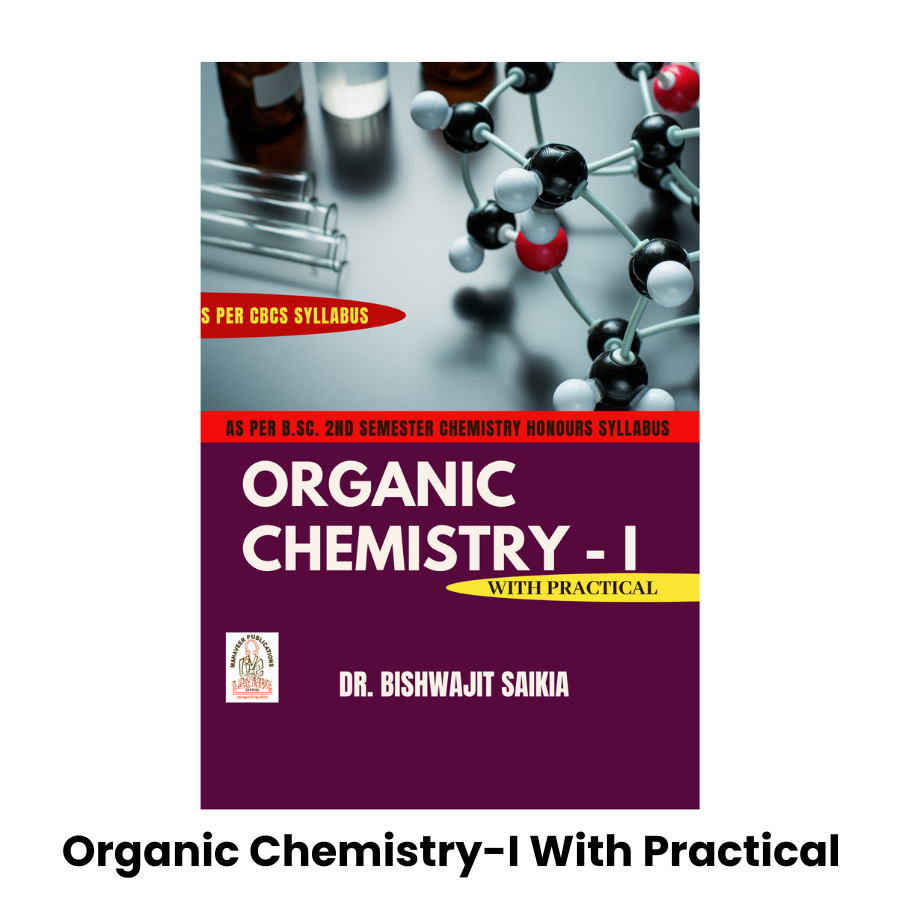
Organic Chemistry -I With Practical
Inhouse product
-
 Rs212.50
Rs250.00 -
Rs290.00
Rs310.00 -
Rs430.00
Rs450.00 -
Rs288.00
Rs300.00 -
Rs235.00
Rs250.00 -
Rs300.00
Rs320.00




Reviews & Ratings
Organic Chemistry – I (With Practical) by Dr. Biswajit Saikia is a well-structured textbook prepared according to the CBCS syllabus for B.Sc. 2nd Semester Chemistry (Honours) courses of Indian universities.
The book provides a thorough introduction to the fundamental principles, structures, and reactions of organic compounds, emphasizing the relationship between molecular structure and chemical reactivity. It integrates both theoretical and practical aspects, ensuring students gain conceptual understanding as well as experimental skills.
Key Features:
-
Covers the complete CBCS syllabus for B.Sc. 2nd Semester Chemistry Honours.
-
Detailed discussion on structure and bonding in organic molecules, nomenclature, and isomerism.
-
Step-by-step explanation of reaction mechanisms, electronic effects, and stereochemistry.
-
Chapters on hydrocarbons, alkyl halides, alcohols, aldehydes, and ketones with mechanisms and examples.
-
Includes laboratory experiments with clear procedures, chemical equations, and safety precautions.
-
Simplified illustrations, reaction flowcharts, and solved problems for easy comprehension.
-
Useful for students of Dibrugarh University, Gauhati University, Bodoland University, and other institutions following the CBCS pattern.
Chapter 1: Basic Organic Chemistry
-
Classification of Organic Compounds
-
Homologous Series and Functional Groups
-
IUPAC Nomenclature of Organic Compounds
-
Hybridization and Types of Hybridization (sp, sp², sp³)
-
Influence of Hybridization on Bond Properties
-
Electronic Displacements:
-
Inductive Effect
-
Electromeric Effect
-
Resonance or Mesomeric Effect
-
Hyperconjugation
-
-
Dipole Moment and Molecular Polarity
-
Organic Acids and Bases
-
Hard and Soft Acids and Bases (HSAB Principle)
-
Bond Fission: Homolytic and Heterolytic Cleavage
-
Curly Arrow Rules and Formal Charges
-
Classification of Attacking Reagents: Electrophiles & Nucleophiles
-
Nucleophilicity and Basicity
-
Reaction Intermediates:
-
Carbocations
-
Carbanions
-
Free Radicals
-
Carbenes
-
-
Energy Profile Diagrams (One-step, Two-step, Three-step Reactions)
-
Activation Energy and Reaction Mechanisms
Chapter 2: Stereochemistry
-
Isomerism and Classification of Isomers
-
Representation of Organic Molecules (Flying-Wedge, Fischer, Newman & Sawhorse Projections)
-
Geometrical Isomerism and Cis–Trans Forms
-
E/Z Notations and Physical Properties of Geometrical Isomers
-
Optical Isomerism and Chirality
-
Elements of Symmetry (σ, i, Cₙ, Sₙ)
-
Enantiomers and Diastereoisomers
-
Molecules with Multiple Chiral Centres
-
Meso-structures and Racemic Mixtures
-
Resolution of Enantiomers (Mechanical, Biochemical, Chemical, Kinetic)
-
Walden Inversion, Erythro & Threo Nomenclature
-
Relative and Absolute Configuration (R/S, D/L, CIP Rules)
Chapter 3: Chemistry of Aliphatic Hydrocarbons
-
Formation and Reactions of Alkanes
-
Wurtz and Wurtz–Fittig Reactions
-
Corey–House Synthesis
-
Free Radical Halogenation (Chlorination, Bromination)
-
E1, E2, and E1cB Eliminations
-
Saytzeff and Hofmann Rules
-
-
Preparation of Alkenes (Syn Elimination, Pyrolysis, Chugaev Reaction)
-
Reactions of Alkenes:
-
Halogenation, Hydroboration, Hydrogenation, Ozonolysis
-
Markovnikov and Anti-Markovnikov Additions
-
Diels–Alder Reaction
-
-
Reactions of Alkynes:
-
Electrophilic and Nucleophilic Additions
-
Hydrogenation and Hydration
-
Acidity and Alkylation of Terminal Alkynes
-
-
Stereoselectivity and Stereospecificity in Alkene and Alkyne Reactions
Chapter 4: Cycloalkanes and Conformational Analysis
-
Structure and Nomenclature of Cycloalkanes
-
Preparation Methods:
-
From Dihalogen Compounds, Malonic Ester Condensation, Simmons–Smith Reaction, etc.
-
-
Stability of Cycloalkanes (Baeyer’s Strain Theory)
-
Conformational Analysis of Ethane and Butane
-
Conformations of Cyclohexane and Substituted Cyclohexanes
-
Axial and Equatorial Bonds; Chair and Boat Conformations
-
Energy Profile Diagrams of Cyclohexane Conformers
Chapter 5: Aromatic Hydrocarbons
-
Concept of Aromaticity
-
Huckel’s Rule and Systems of π Electrons
-
Aromaticity in Fused Rings and Heterocyclic Compounds
-
Electrophilic Aromatic Substitution (EAS) Reactions:
-
Nitration, Sulphonation, Halogenation
-
Friedel–Crafts Alkylation and Acylation
-
-
Mechanism of EAS and Directive Influence of Substituents
-
Ortho–Para and Meta Orientation Effects
-
Deactivating and Activating Groups in Benzene Ring
Practical Section
-
Qualitative Organic Analysis:
-
Identification of Organic Compounds
-
Detection of Elements (N, S, Halogens)
-
Functional Group Analysis
-
-
Quantitative Organic Experiments:
-
Determination of Melting and Boiling Points
-
Crystallization and Purification Techniques
-
-
Preparation of Organic Compounds:
-
Acetanilide, Benzoic Acid, Aspirin, etc.
-
-
Frequently Bought Products
Fuel Chemistry
Product Queries (0)
Login Or Registerto submit your questions to seller
Other Questions
No none asked to seller yet
-
Rs212.50
Rs250.00 -
Rs290.00
Rs310.00 -
Rs430.00
Rs450.00 -
Rs288.00
Rs300.00 -
Rs235.00
Rs250.00 -
Rs300.00
Rs320.00
Mahaveer Publications