








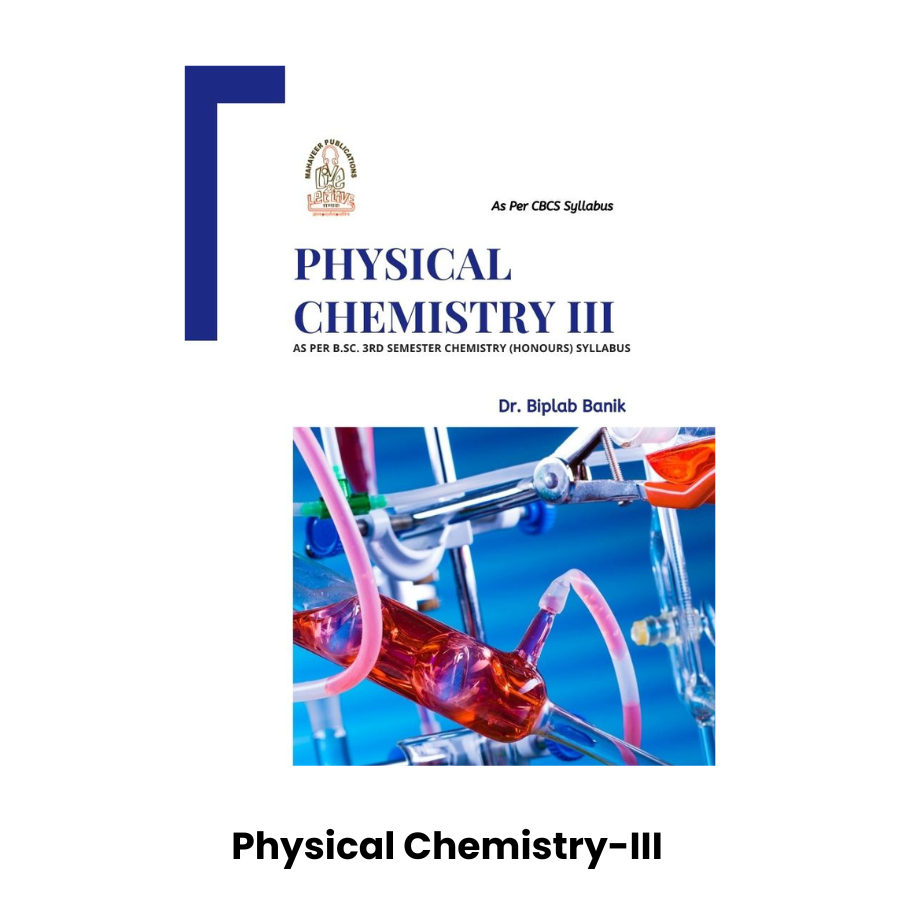
Physical Chemistry - III
Inhouse product
-
 Rs212.50
Rs250.00 -
Rs290.00
Rs310.00 -
Rs430.00
Rs450.00 -
Rs288.00
Rs300.00 -
Rs235.00
Rs250.00 -
Rs300.00
Rs320.00






Reviews & Ratings
Physical Chemistry – III by Dr. Biplab Banik is a comprehensive and concept-oriented textbook designed for B.Sc. 3rd Semester Chemistry Honours students following the CBCS curriculum. Published by Mahaveer Publications, the book covers advanced physical chemistry topics that form the backbone of higher studies in Chemistry, providing clear explanations, mathematical treatment, and rigorous conceptual detail.
This text continues the progression from Physical Chemistry I and II, introducing students to deeper areas such as Chemical Thermodynamics (applications), Chemical Kinetics (advanced), Electrochemistry, Surface Chemistry, Phase Rule, Quantum Chemistry basics, and Photochemistry, depending on the specific CBCS structure. Each chapter is student-friendly yet academically rich, supported by derivations, solved numericals, theory questions, graphs, and illustrations to strengthen understanding and improve exam performance.
Unit – 01: Phase Equilibria
-
Introduction to Phase Equilibria
-
Degree of Freedom or Variance
-
Gibbs Phase Rule – Statement & Significance
-
Criterion of Phase Equilibrium
-
Thermodynamic Derivation of Phase Rule
-
Clausius–Clapeyron Equation
One-Component Systems
-
Water system
-
Sulphur system
-
Carbon dioxide system
Two-Component Systems
Simple Eutectic Systems:
-
Pb–Ag system
-
Au–Tl system
-
KI–H₂O system
-
Formation of congruent melting compounds:
-
Mg–Zn system
-
Sn–Mg system
-
K–Sb system
-
Fe₂Cl₆–H₂O system
-
Na₂SO₄–H₂O system
-
NaCl–H₂O system
-
Na–K system
-
Three-Component System
-
Triangular Plot – CHCl₃–H₂O–CH₃COOH system
Advanced Topics
-
Gibbs–Duhem–Margules equation
-
Application of Gibbs–Duhem–Margules equation
-
Derivation of Konovalov’s laws
-
Vapour Pressure–Composition Diagrams (Ideal & Non-ideal Solutions)
-
The Lever Rule
-
Boiling Point–Composition Diagrams
-
Fractional Distillation & Steam Distillation
-
Completely Immiscible Liquids
-
Liquid–Liquid Systems: Partial Miscibility
-
Effect of Impurities on CST
Unit – 02: Chemical Kinetics
-
Zero Order Reaction
-
First Order Reaction
-
Second Order Reaction
-
Fractional Order Reactions
-
Pseudo-first Order Reactions
-
Complex Reaction Mechanisms
-
Reversible & Consecutive Reactions
-
Opposing Reactions
-
Chain Reactions
Theories of Reaction Rates
-
Collision Theory
-
Transition State Theory
-
Mathematical treatment of TST
-
Comparison of Transition State Theory and Collision Theory
Arrhenius Equation
-
Graphical representation
-
Factors affecting rate of reaction
Unit – 03: Catalysis
-
Introduction – Definition & Types of Catalysts
-
Characteristics of Catalysis
-
Homogeneous & Heterogeneous Catalysis
-
Enzyme Catalysis
-
Michaelis–Menten Equation
-
Mechanism & Kinetics of Acid–Base Catalysis
-
Mechanism of Heterogeneous Catalysis
-
Autocatalysis & Surface Reaction Kinetics
-
Effect of Temperature on Catalysis
-
Kinetics of Ester Hydrolysis
-
Catalytic Promoters & Catalytic Poisons
-
Advantages & Limitations of Homogeneous & Heterogeneous Catalysis
-
Activity & Selectivity of Catalysts
-
Catalyst Cycle & Nanoparticle Efficiency
Unit – 04: Surface Chemistry
-
Introduction to Adsorption
-
Types of Adsorption – Physical & Chemical
-
Factors Affecting Adsorption
-
Characteristics of Adsorption
Adsorption Isotherms
-
Freundlich Isotherm
-
Langmuir Isotherm
-
Gibbs Adsorption Isotherm
Applications of Adsorption
-
Measurement of surface area of adsorbent
-
Adsorption of N₂ on iron surface
-
Industrial & catalytic relevance
Frequently Bought Products
Product Queries (0)
Login Or Registerto submit your questions to seller
Other Questions
No none asked to seller yet
-
Rs212.50
Rs250.00 -
Rs290.00
Rs310.00 -
Rs430.00
Rs450.00 -
Rs288.00
Rs300.00 -
Rs235.00
Rs250.00 -
Rs300.00
Rs320.00
Mahaveer Publications