








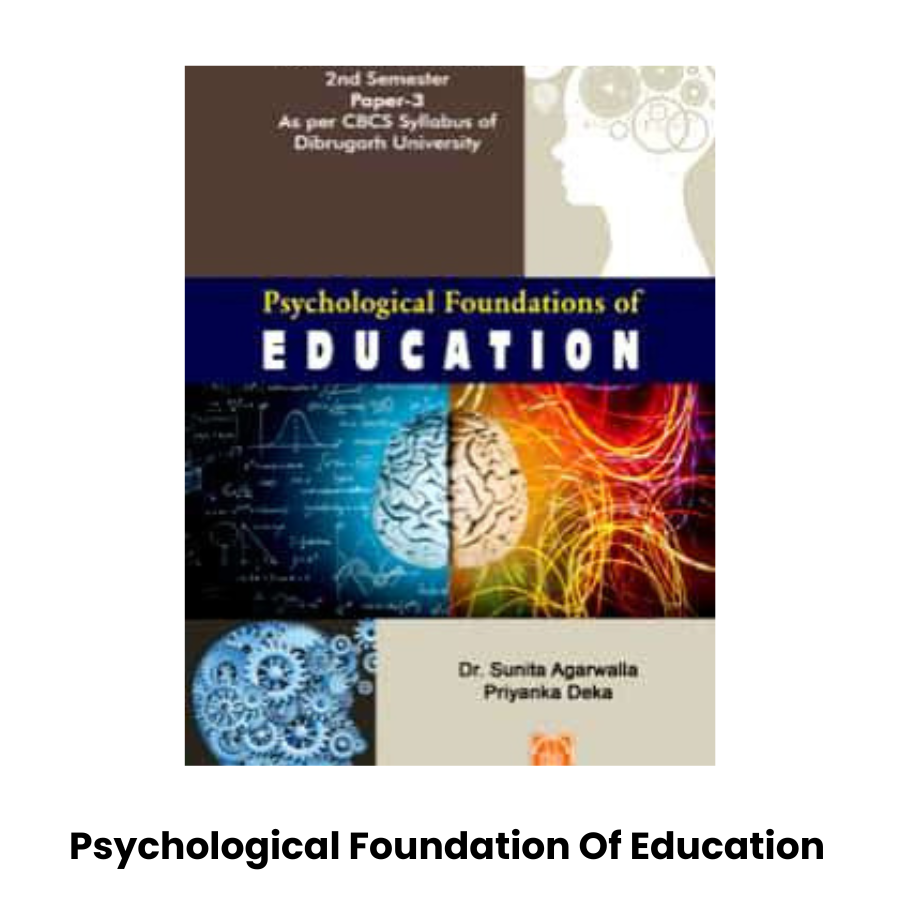
Psychological Foundations Of Education
Inhouse product
-
 Rs212.50
Rs250.00 -
Rs290.00
Rs310.00 -
Rs430.00
Rs450.00 -
Rs288.00
Rs300.00 -
Rs235.00
Rs250.00 -
Rs300.00
Rs320.00


Reviews & Ratings
Psychological Foundations of Education by Dr. Sunita Agarwalla and Priyana Deka is a comprehensive textbook designed according to the BA 2nd Semester Education (Honours & Non-Honours) syllabus of Dibrugarh University. This book provides an in-depth understanding of the psychological principles that shape educational processes, learner behaviour, teaching strategies, and classroom practices.
The text presents a clear linkage between psychological theories and their application in teaching-learning situations, making it an essential guide for Education students. It introduces the scientific study of human behaviour, mental processes, and individual differences, explaining how these factors influence learning outcomes. The authors present major concepts in a simple, systematic, and student-friendly language, making the book ideal for undergraduate learners.
UNIT I: Psychology and Education
-
Meaning, nature, and scope of psychology
-
Schools of psychology: Behaviourism, Structuralism, Functionalism, Gestalt, Psychoanalysis, Constructivism
-
Nature, meaning, and scope of Educational Psychology
-
Importance of Educational Psychology in classroom teaching
This unit introduces students to the foundations of psychology and its direct relevance to educational processes.
UNIT II: Learning and Motivation
-
Meaning, nature, and determinants of learning
-
Learning variables: home, school, mass media, personal and social factors
-
Types of learning: cognitive, affective, psychomotor
-
Theories of learning: Classical Conditioning, Operant Conditioning, Gestalt theory
-
Thorndike’s Laws of Learning
-
Motivation and role in learning
-
Maturation & learning
-
Transfer of learning (positive, negative, vertical, horizontal, bilaterally)
-
Attention and interest
-
Memory and techniques of learning
This unit builds the foundation for understanding how individuals acquire knowledge and skills, how motivation affects learning, and how behaviour is shaped.
UNIT III: Intelligence and Creativity
-
Meaning, nature, and measurement of intelligence
-
Factors of intelligence; hereditary vs. environment
-
Theories of intelligence: Monarchic, Spearman, Thurstone, Guilford’s SOI, Multifactor theories
-
Emotional Intelligence
-
Creativity: meaning, nature, product & process
-
Stages of creativity
-
Nurturing creativity in classrooms
-
Giftedness and exceptional children
-
Education of gifted, slow learners, educable & trainable children
This unit helps students understand intellectual processes, creativity development, and individual differences important for classroom planning.
UNIT IV: Personality and Mental Health
-
Meaning and characteristics of personality
-
Factors of personality: physical, mental, social, emotional
-
Type theories (Hippocrates, Sheldon, Kretchmer, Spranger, Jung)
-
Trait theories (Cattell, Eysenck)
-
Balanced mature personality
-
Mental health and mental hygiene
-
Adjustment mechanisms: Fantasy, Compensation, Identification, Rationalization, Sublimation
-
Instinct and Emotion
-
Instinct–Emotion relationship
-
Educational significance of instincts
-
Emotional training in the classroom
Frequently Bought Products
Product Queries (0)
Login Or Registerto submit your questions to seller
Other Questions
No none asked to seller yet
-
Rs212.50
Rs250.00 -
Rs290.00
Rs310.00 -
Rs430.00
Rs450.00 -
Rs288.00
Rs300.00 -
Rs235.00
Rs250.00 -
Rs300.00
Rs320.00
Mahaveer Publications