








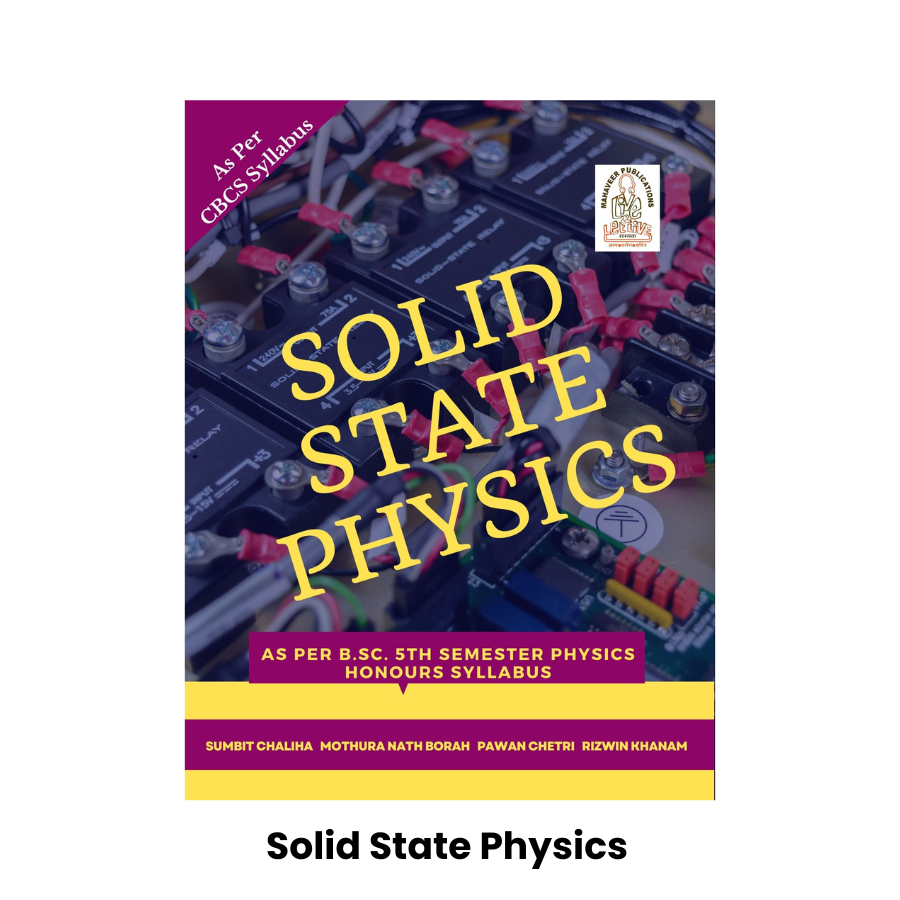
Solid State Physics
Inhouse product
-
 Rs212.50
Rs250.00 -
Rs290.00
Rs310.00 -
Rs430.00
Rs450.00 -
Rs288.00
Rs300.00 -
Rs235.00
Rs250.00 -
Rs300.00
Rs320.00





Reviews & Ratings
Solid State Physics by S. Chaliha, M. N. Borah, P. Chetri, and R. Khanam is a comprehensive textbook designed according to the CBCS syllabus for B.Sc. 5th Semester Physics Honours students. The book provides a clear and systematic presentation of the fundamental principles of solid-state physics, making it suitable for undergraduate learners across universities.
The content covers essential topics including crystal structures, Miller indices, X-ray diffraction, bonding in solids, lattice vibrations, thermal properties, free electron theory, band theory of solids, semiconductors, dielectric and magnetic properties, superconductivity, and crystal defects. Each chapter includes clear explanations, mathematical formulations, illustrative diagrams, solved examples, and well-structured exercises to help students strengthen conceptual understanding.
The book bridges theoretical foundations with modern applications in materials science and condensed matter physics, making it an ideal text for both classroom learning and examination preparation. Published by Mahaveer Publications, it serves as a dependable reference for students, teachers, and academic institutions following the CBCS curriculum.
Chapter 1: Crystal Structure (Pages 1–56)
1.1 Introduction
1.2 Solids: Amorphous and Crystalline Materials
1.3 Lattice Translation Vectors
1.4 Unit Cell
1.5 Lattice with a Basis – Central and Non-Central Elements
1.6 Miller Indices
1.7 Types of Lattices
1.8 Reciprocal Lattice
1.9 Brillouin Zones
1.10 Diffraction of X-rays by Crystals: Bragg’s Law
1.11 Atomic Scattering Factor
1.12 Geometrical Structure Factor
Chapter 2: Elementary Lattice Dynamics (Pages 57–84)
2.1 Lattice Vibrations
2.1.1 One Dimensional Lattice (Monoatomic Atoms)
2.1.2 Diatomic 1D Lattice
2.2 Specific Heat
2.2.1 Classical Theory (Dulong–Petit’s Law)
2.2.2 Einstein Theory of Specific Heat
2.2.3 Introduction to Phonon
2.2.4 Debye Theory of Specific Heat (T³ Law)
Chapter 3: Magnetic Properties of Matter (Pages 85–116)
3.1 Introduction
3.2 Diamagnetic Materials
3.3 Paramagnetic Materials
3.4 Ferromagnetic Materials
3.5 Domain Theory (Weiss’s Theory) of Ferromagnetism
3.6 B–H (Hysteresis) Curve
3.7 Energy Involved in Domain Growth
3.8 Hysteresis Loss
3.9 Antiferromagnetism
3.10 Ferrimagnetic Materials
Chapter 4: Dielectric Properties of Materials (Pages 117–156)
4.1 Dielectrics
4.2 Polarization
4.3 Electrical Susceptibility
4.4 Local Electric Field at an Atom
4.5 Polarizability
4.6 Types of Polarization Mechanisms
4.7 Internal Field Calculation
4.8 Frequency Dependence of Polarizability
4.9 Dielectric Losses
4.10 Ferroelectric Crystals
4.11 Characteristics of Ferroelectrics
4.12 Structural Phase Transition
4.13 Piezoelectric Effect
4.14 Pyroelectric Effect
4.15 Distinction between Piezoelectric, Pyroelectric & Ferroelectric Materials
Chapter 5: Elementary Band Theory (Pages 157–213 approx.)
5.1 Qualitative Interpretation of Energy Bands in Solids
5.2 Periodic Potential in Crystalline Solids
5.3 Kronig–Penney Model
5.4 Electron and Hole Concept
5.5 Valence Band, Conduction Band & Fermi Level
5.6 Classification of Solids: Metals, Insulators & Semiconductors
Chapter 6: Semiconductors
6.1 Band Theory of Semiconductors
6.2 Intrinsic Semiconductors
6.3 Extrinsic Semiconductors
6.4 Carrier Concentration
6.5 Mobility
6.6 Electrical Conductivity of Semiconductors
6.7 Hall Effect
6.8 Measurement of Conductivity
6.9 Measurement of Hall Coefficient
Chapter 7: Superconductivity (Pages ~234–250)
7.1 Introduction
7.2 Experimental Results
7.3 Critical Temperature
7.4 Effect of Magnetic Field and Critical Magnetic Field
7.5 Meissner Effect
7.6 Type I and Type II Superconductors
7.7 London’s Equation and Penetration Depth
7.8 Isotope Effect
7.9 Elementary Idea of BCS Theory
7.10 High Temperature Superconductors
7.11 Applications of Superconductors
APPENDICES
-
Appendix 1
-
Appendix 2
-
Appendix 3
Frequently Bought Products

Analog Systems & Applications
Product Queries (0)
Login Or Registerto submit your questions to seller
Other Questions
No none asked to seller yet
-
Rs212.50
Rs250.00 -
Rs290.00
Rs310.00 -
Rs430.00
Rs450.00 -
Rs288.00
Rs300.00 -
Rs235.00
Rs250.00 -
Rs300.00
Rs320.00
Mahaveer Publications