








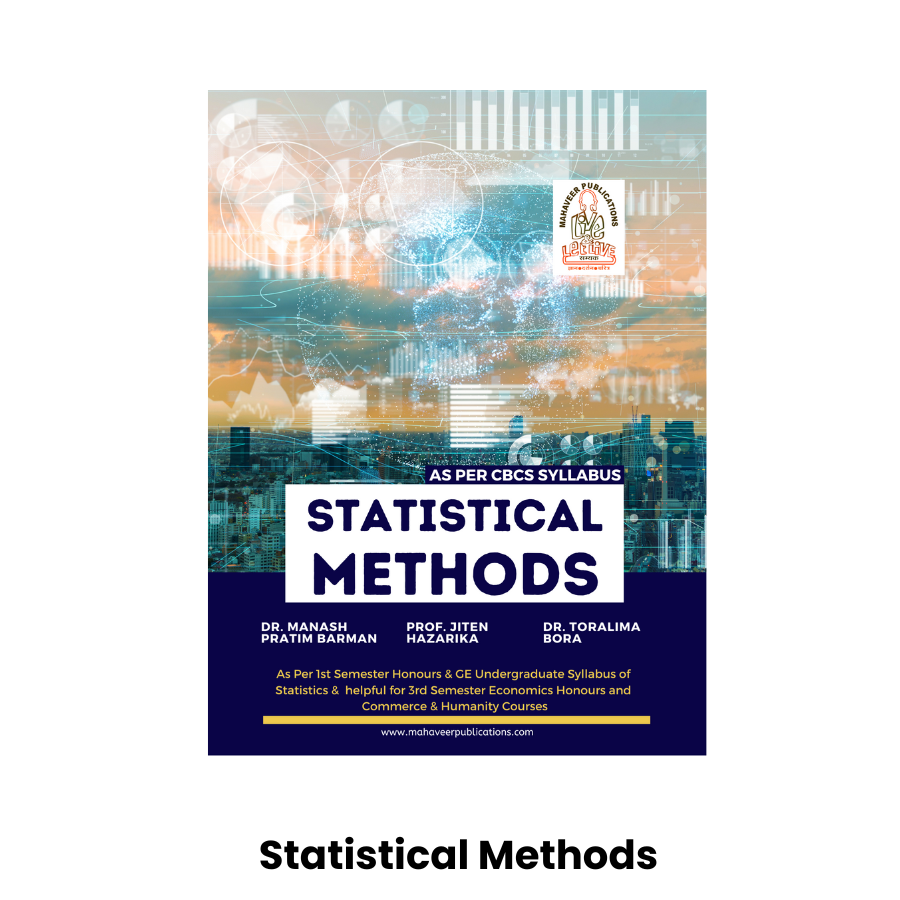
Statistical Methods
Inhouse product
-
 Rs212.50
Rs250.00 -
Rs290.00
Rs310.00 -
Rs430.00
Rs450.00 -
Rs288.00
Rs300.00 -
Rs235.00
Rs250.00 -
Rs300.00
Rs320.00




Reviews & Ratings
Statistical Methods by Dr. Manash Pratim Barman, published by Mahaveer Publications, is a comprehensive and concept-oriented textbook designed to meet the requirements of the B.Sc. 1st Semester (Honours/Core) and Generic Elective (GE) undergraduate syllabus in Statistics under the FYUGP / NEP / CBCS system. The book also serves as an excellent reference for Commerce and Social Science students in the 3rd Semester, where applied statistics is introduced as a foundational analytical tool.
It combines theoretical clarity with practical applications, helping students understand how statistical reasoning supports decision-making in business, economics, and social research.
Key Features
-
Curriculum-Aligned: Prepared according to the latest FYUGP / NEP / CBCS syllabus prescribed for Indian universities.
-
Comprehensive Coverage: Includes descriptive and inferential statistics — data classification, measures of central tendency and dispersion, moments, skewness, kurtosis, correlation, regression, probability distributions, and hypothesis testing.
-
Step-by-Step Approach: Concepts are explained through solved examples and diagrams for better comprehension.
-
Balanced Theory & Application: Demonstrates how statistical tools apply to real-life problems in commerce, economics, psychology, sociology, and management.
-
Exam-Oriented Presentation: Each chapter includes key formulas, definitions, review questions, and numerical exercises to aid revision.
-
Interdisciplinary Utility: Particularly helpful for B.Com, BBA, BA Economics, and Social Science courses involving quantitative techniques or research methodology.
Contents
Chapter 1: Introduction
1.1. History of the Word Statistics
1.2. Meaning and Definition of Statistics
1.3. Scope of Statistics
1.4. Limitations of Statistics
1.5. Population and Sample
1.6. Data
1.7. Scales of Measurement
1.8. Tabulation
1.9. Frequency Distribution Table
1.9.1. Cumulative Frequency Distribution Table
1.10. Diagrams and Graphs
Chapter 2: Measures of Central Tendency
2.1. Introduction
2.1.1. Definition
2.1.2. Characteristics of a Good Measure of Central Tendency
2.2. Mathematical Averages
2.2.1. Arithmetic Mean (A.M.) or Simple Mean
2.2.2. Geometric Mean (G.M.)
2.2.3. Harmonic Mean (H.M.)
2.3. Positional Averages
2.3.1. Median
2.3.2. Quartiles, Deciles, and Percentiles
2.3.3. Mode
2.4. Relationship Between Measures of Central Tendency
2.4.1. Relationship Between Arithmetic, Geometric, and Harmonic Mean
2.4.2. Relationship Between Mean, Median, and Mode
Chapter 3: Measures of Dispersion
3.1. Introduction
3.1.1. Definition of Dispersion
3.1.2. Characteristics of an Ideal Measure of Dispersion
3.2. Absolute and Relative Measures of Dispersion
3.3. Measures of Dispersion
3.3.1. Range
3.3.2. Inter-Quartile Range
3.3.3. Quartile Deviation or Semi Inter-Quartile Range
3.3.4. Mean Deviation
3.3.5. Standard Deviation
3.3.6. Variance
3.3.7. Properties of Standard Deviation
3.3.8. Relationship Between Measures of Dispersion
3.4. Coefficient of Variation
3.5. Moments
3.5.1. Types of Moments
3.5.2. Effect of Change of Origin and Scale on Moments
3.5.3. Sheppard’s Correction for Moments
3.6. Factorial Moments
3.7. Skewness and Kurtosis
3.7.1. Skewness (Sk)
3.7.2. Kurtosis
Chapter 4: Measures of Correlation
4.1. Bivariate Data
4.2. Correlation
4.2.1. Definition of Correlation
4.2.2. Uses of Correlation
4.2.3. Different Types of Correlation
4.3. Methods of Studying Simple Correlation
4.4. Scatter Diagram
4.5. Karl Pearson’s Coefficient of Correlation (Covariance Method)
4.6. Two-Way Frequency Table (Bivariate Correlation Method)
4.7. Rank Method
Chapter 5: Regression Analysis
5.1. Introduction
5.2. Definition
5.3. Types of Regression
5.4. Lines of Regression
5.5. Line of Regression Equations
5.6. Methods of Regression Analysis
5.7. Properties of Regression Coefficients
5.8. Angle Between Two Regression Lines
5.9. Fitting of Second Degree Parabola
5.10. Multiple Correlation
Chapter 6: Index Number
6.1. Introduction
6.2. Definition
6.3. Uses of Index Number
6.4. Problems in Constructing an Index Number
6.5. Construction of Index Number
6.6. Notations and Terminology
6.7. Chain Index Number
6.8. Test of Adequacy of Index Number
6.9. Consumer Price Index Number
6.10. Limitations of Index Number
Chapter 7: Theory of Attributes
7.1. Theory of Attributes
7.2. Notations
7.3. Classes and Class Frequencies
7.4. Order of Classes
7.5. Consistency of Data
7.6. Independence of Attributes
7.7. Association of Attributes
7.8. Yule’s Coefficient of Association
Bibliography
Frequently Bought Products
Product Queries (0)
Login Or Registerto submit your questions to seller
Other Questions
No none asked to seller yet
-
Rs212.50
Rs250.00 -
Rs290.00
Rs310.00 -
Rs430.00
Rs450.00 -
Rs288.00
Rs300.00 -
Rs235.00
Rs250.00 -
Rs300.00
Rs320.00
Mahaveer Publications