







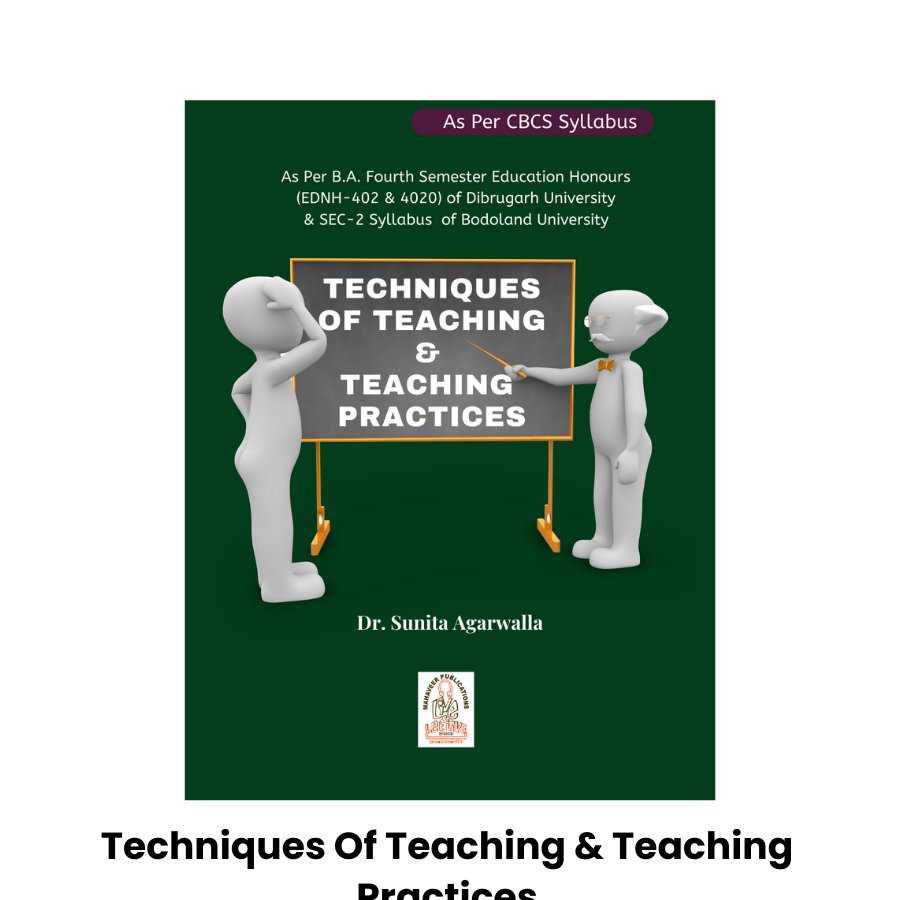
Techniques Of Teaching & Teaching Practices
Inhouse product
-
 Rs212.50
Rs250.00 -
Rs290.00
Rs310.00 -
Rs430.00
Rs450.00 -
Rs288.00
Rs300.00 -
Rs235.00
Rs250.00 -
Rs300.00
Rs320.00

Reviews & Ratings
Techniques of Teaching & Teaching Practices by Dr. Sunita Agarwalla is a comprehensive and student-friendly textbook designed according to the CBCS syllabus for BA 4th Semester Education Honours of Dibrugarh University and Bodoland University. The book presents a clear and systematic understanding of the principles, methods, and real-world practices of teaching required for future educators.
The content blends theoretical foundations with practical insights, enabling students to understand the evolving role of a teacher in modern classrooms. It explains various teaching techniques, learner-centered approaches, instructional strategies, micro-teaching skills, lesson planning, classroom management, and evaluation procedures. The book also emphasizes reflective teaching, professional ethics, and innovative methods suitable for contemporary educational environments.
Written in simple and descriptive language, the book serves as an essential resource for Education Honours students, teacher trainees, and anyone preparing for teaching professions. With updated examples, illustrations, and CBCS-aligned content, it ensures clarity, academic depth, and applicability in actual teaching-learning situations.
Published by Mahaveer Publications, this textbook is a reliable companion for understanding both the art and science of teaching, supporting learners in developing strong pedagogical skills and teaching competencies.
UNIT – 01 : The Teaching–Learning Process
This unit provides a foundational understanding of the teaching–learning system. It explores how teaching has evolved and explains the key principles that govern effective teaching.
1.1 Meaning and Nature of Teaching
– Explains teaching as a planned, purposeful and interactive process.
– Highlights its characteristics and scope.
1.2 Evolving Concept of Teaching
– Discusses traditional, modern and progressive views of teaching.
– Shows how teaching has moved from teacher-centered to learner-centered approaches.
1.3 Principles of Teaching
– Fundamental rules that guide effective classroom instruction.
1.4 Principles of Learning
– Covers psychological principles and how learners acquire knowledge.
1.5 General Maxims of Teaching
– Important guidelines such as simple to complex, known to unknown, concrete to abstract, etc.
1.6 Phases of Teaching
– Pre-active, inter-active, and post-active phases explained in detail.
1.7 Teaching Behaviour
– Types, patterns, and components of a teacher’s behavior in the classroom.
1.8 Classroom Problems of Beginners
– Common issues faced by novice teachers and ways to overcome them.
Exercise
– Unit-based practice questions.
UNIT – 02 : Planning Teaching
This unit emphasizes effective teaching preparation through planning, lesson structuring, and skill development.
2.1 Lesson Plan – Its Meaning and Importance
– Definition, components, and necessity of lesson plans for systematic teaching.
2.2 Herbartian Steps of Lesson Planning
– Explanation of the five formal steps: Preparation, Presentation, Comparison, Generalization, and Application.
2.3 Teaching Skills
– Micro-teaching skills such as questioning, reinforcement, explanation, stimulus variation, etc.
2.4 Micro Teaching
– Concept, cycle, and uses in teacher training.
2.5 Objectives of Teaching Language at Elementary and Secondary Level
– Linguistic, psychological, and pedagogical objectives of language teaching.
Exercise
– Unit-based questions for practice.
UNIT – 03 : Methods and Approaches of Teaching
This unit introduces major teaching methods and approaches essential for classroom implementation.
3.1 Methods of Teaching
– Overview of teacher-centered, learner-centered, and interactive methods.
3.2 Playway Method
– Learning through activities, games, and joyful experiences.
3.3 Activity Method
– Hands-on learning, project activities, experiential learning.
3.4 Discussion Method
– Classroom discussion techniques, advantages, limitations.
3.5 Inductive–Deductive Method
– Learning from specific to general and general to specific.
3.6 Heuristic Method
– “Find out yourself” approach leading to independent thinking.
3.7 Problem Solving Method
– Steps of problem-solving and its use in teaching.
3.8 Project Method
– Principles of purposeful activity, planning, and teamwork.
3.9 Methods of Teaching Language
– Approaches, methodologies, and techniques for effective language instruction.
3.10 Teaching Approaches
– Modern approaches including constructivist, competency-based, and learner-centered approaches.
Exercise
– Unit-based questions for evaluation.
Bibliography
– Reference materials for extended study.
Frequently Bought Products

Educational Technology

Education In Pre-Independent India
Product Queries (0)
Login Or Registerto submit your questions to seller
Other Questions
No none asked to seller yet
-
Rs212.50
Rs250.00 -
Rs290.00
Rs310.00 -
Rs430.00
Rs450.00 -
Rs288.00
Rs300.00 -
Rs235.00
Rs250.00 -
Rs300.00
Rs320.00
Mahaveer Publications